





 English
  Francês
  Alemão
  Italiano
  Japonês
  Norueguês
  Portuguese
  Spanish
  5 min of reading
  0 comments


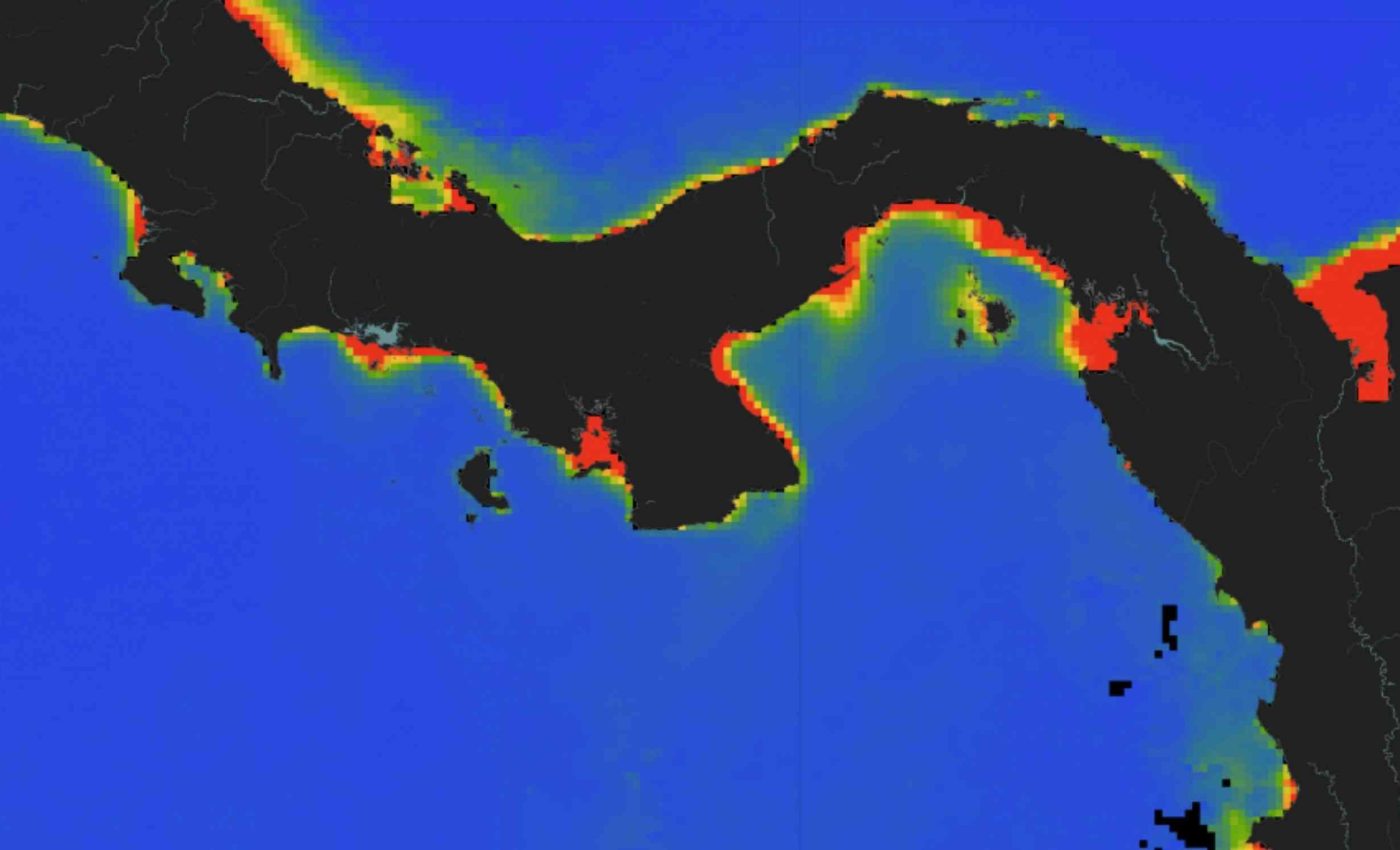
For the first time in at least 40 years, the Gulf of Panama did not register in the expected period the upwelling that cools coastal waters, brings nutrients to the surface, and sustains reefs, fish, and communities linked to marine productivity
The seasonal upwelling in the Gulf of Panama failed in 2025 for the first time in at least 40 years, interrupting an oceanic cycle that sustained the cooling of coastal waters and the arrival of nutrients during the dry season. The disruption in the Gulf eliminated a crucial pulse for reefs, fish, and marine food chains, as well as raising alarms about the impacts of a season that did not occur as expected.
Unprecedented failure disrupts historical pattern in the Gulf of Panama
Along the Pacific coast of Panama, the waters that normally cool during the dry season remained exceptionally warm in 2025.
The analysis of long-term observations led Aaron O’Dea to note that the expected drop in temperature and increase in productivity simply did not happen that year.
-
350-year mystery may have been solved: remains of a soldier who inspired the hero of The Three Musketeers found beneath a church in the Netherlands.

-
NASA photographed a nearly perfect square with 3 km sides on Mars, 13 times larger than the Great Pyramid of Giza, but the official explanation is natural erosion; still, no one has explained why the four sides have almost identical lengths.

-
Starlink breaks the barrier of 10,000 satellites in orbit and takes its expansion to an unprecedented level, with a direct impact on global internet, technological competition, and the race for space.

-
Japan finds an alternative to oil amid rising prices by transforming ocean balance into electricity with a new technology that maintains efficiency even when the sea changes.

For four decades, this seasonal change occurred predictably every year, making its complete absence in 2025 a clear break from the historical pattern.
The change indicated that something failed in the forces driving this cycle and heightened the need to understand what happened.
The anomaly was easily identified precisely because the historical data was consistent. In all previous years, the seasonal drop in temperature occurred by January 20, but in 2025 the ocean only cooled on March 4, more than six weeks later than usual.
Even when the cooling finally appeared, it was brief and incomplete. The coldest period lasted only 12 days, instead of about two months, and the water did not reach the minimum temperatures recorded in previous years.
How upwelling sustains marine life
During the dry season, strong winds from the north push surface water out to sea. This displacement creates space for cold water from the depths to rise to the surface, in a phenomenon that scientists call upwelling.
When this deep water emerges, it brings nutrients that feed phytoplankton, described as tiny floating plants that sustain the sea. This increase in nutrients spreads energy throughout the food chain and strengthens the functioning of the region’s marine ecosystems.
In addition to increasing productivity, the process cools the water near the coast. As a result, fish and corals often endure the dry months of Panama under more favorable conditions, benefiting from extra help precisely when this support was expected reliably.
In 2025, however, the water column profiles showed warming in layers, not the cold ascent that would normally mark the season. For researchers, this behavior left no doubt that there was a break in the oceanic system that used to repeat every year.
Less frequent winds disrupted the cycle
The main surprise was not in the intensity of the wind, as the recorded gusts remained close to normal. The problem arose in the frequency, which plummeted throughout the season and altered the accumulated force needed to push surface water.
Winds blowing from the north occurred 74% less frequently during the season as a whole. The periods of calm between wind episodes also became longer, which reduced the total thrust exerted on the ocean even when isolated gusts remained strong.
Without the repetition of this force, the cold water from the depths failed to reach the surface. This interruption helps explain why the Gulf of Panama lost the cooling and nutrient season it depended on in 2025.
The text also highlights that a weak La Niña phenomenon was present, but the gulf had already endured stronger oscillations without losing its annual cooling. This contrast reinforced the assessment that the situation in 2025 was not a simple repetition of a known climate cycle in the Pacific.
In addressing this difference, O’Dea wrote that the failure of upwelling in Panama in 2025 shows how regional dynamics are essential to understanding tropical upwelling systems. The observation supports the importance of local monitoring in light of general climate classifications that, alone, do not indicate what the next dry season will bring for coastal communities.
Reefs, fishing, and coastal communities on alert
The absence of cold water removed an annual cooling reserve from coral reefs. Previous studies on Panamanian reefs had indicated that this seasonal drop in temperature helped many corals escape the more intense heat during El Niño episodes.
Without this relief, thermal stress can grow faster and last longer. The text emphasizes that a single hot season will not destroy a reef, but repeated years like this can make bleaching harder to avoid.
The effects also extend to the base of the food chain. When cold water does not rise, the first impacts hit the plankton and small fish that sustain larger catches, with direct repercussions for those who rely on fishing or depend on it for consumption.
The relationship between these productive waters and human occupation of the Pacific coast of Panama goes back long before modern records. A 2025 review of the southern Pacific coast of Central America describes a deep human history built around marine resources.
Therefore, the damages can be felt by coastal families even before any long-term trend is formally measured. The disruption of an expected season affects not only the marine environment but also the planning capacity of communities linked to this seasonal calendar.
Long-term monitoring revealed the dimension of the disruption
Many tropical upwelling zones remain poorly monitored, meaning that a failure of this kind could go unnoticed in other regions. In Panama, the difference was detected because STRI scientists had satellite data since 1985 and direct temperature records since 1995.
Measurements taken by the S/Y Eugen Seibold, described as a research sailing vessel used to study oceanic conditions, showed warm water accumulated in layers where cold water would normally rise. These records reinforced the finding that upwelling did not establish itself as in previous years.
As such long historical series are rare in the tropics, scientists point out that the frequency with which vital oceanic rhythms fail may be underestimated. The case of 2025, therefore, also exposed the value of continuous and detailed monitoring networks.
Now, researchers are seeking to determine whether what occurred in 2025 was an isolated shock or the first sign of a pattern change.
A public monitoring page shows the STRI team tracking the 2026 season week by week, and the first updates reported new sharp cooling, although this does not eliminate the need for more accurate forecasts and intensified vigilance.
The study was published in the Proceedings of the National Academy of Sciences.







Seja o primeiro a reagir!