





 Portuguese
  English
  Spanish
  8 min of reading
  0 comments


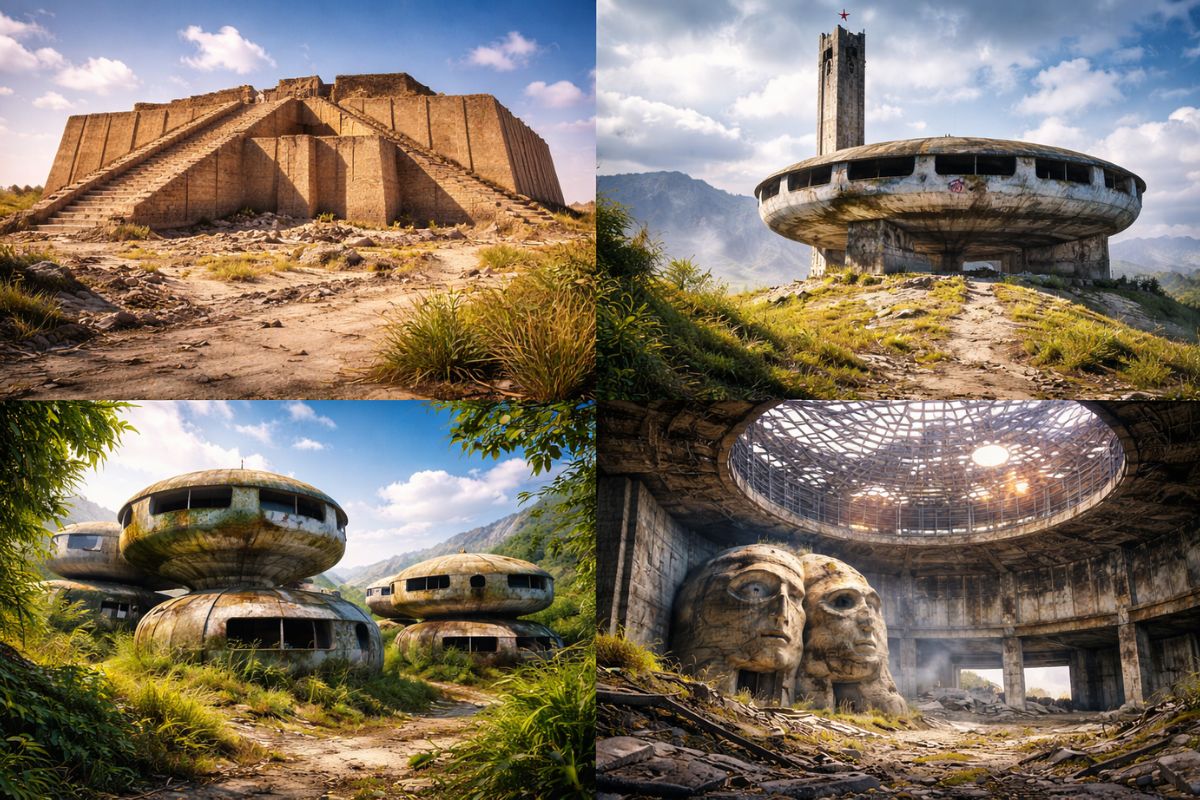
Ziggurat of Ur, Sanji’s UFO Houses, and Other Giant Ruins Show How Abandoned Monuments and Forgotten Giants Turn to Dust, Mold, and Silence Around the World.
In southern Iraq, in the mountains of Bulgaria, on the coast of Taiwan, in Turkey, in Russia, and in Mexico, forgotten giant ruins crumble in silence. They are temples, concrete discs, mausoleums, and ceremonial arches that once represented power, faith, ideology, and future, but today they accumulate dust, mold, and cracks.
These forgotten giants were born to withstand the centuries, mark boundaries, and tell stories of empires and revolutions. Instead, they have been swallowed by wars, economic crises, political changes, and simple disinterest. Before they disappear completely, it is still possible to see in them a brutal summary of how time treats human ambition.
Ziggurat of Ur: Sacred Mountain That Is Crumbling in Silence

In southern Iraq, near the Euphrates River, the great ziggurat of Ur still stands as a monumental block of mud bricks and bitumen.
-
He started running at 66 years old, broke records at 82, and is now a subject of study for having a metabolic age comparable to that of a 20-year-old, in a case that is intriguing scientists and inspiring the world.

-
Oldest tree on the planet reappears after 130 years of searches: Wattieza, 385 million years old, was 10 meters tall and had no leaves or seeds; Gilboa fossils in New York solved the mystery in 2007.

-
A 48-square-meter house assembled in hours with 4,000 bricks made of recycled plastic that does not absorb moisture, has natural thermal insulation, and costs less than 90,000 reais in a complete kit.

-
Luciano Hang revealed that Havan’s air fleet has already accumulated more than 20,000 landings, 10,000 flight hours, and 6 million kilometers traveled, and he says that without the planes, the company would never have grown so quickly.

More than 4,000 years ago, it was built to honor the moon god, Nanna, in the heart of one of the most powerful cities of Mesopotamia. It was literally an artificial mountain, a staircase between heaven and earth.
Today, what remains is the shell of an ancient wonder. The temple at the top has disappeared, the upper levels have collapsed, and the outer coating is peeling off in pieces.
Decades of rain, extreme desert heat, and salt from underground water are corroding the structure brick by brick. Recent wars have left additional marks around and on the foundations.
In the 80s, a partial reconstruction commissioned by Saddam Hussein attempted to “revive” the façade. The result was controversial: concrete and cement stuck to a millennia-old mud base, retaining moisture and accelerating destruction.
Today, local teams and international organizations are trying to stabilize what remains, but one of the greatest forgotten giants in history is racing against time. If nothing changes, the ziggurat of Ur may end up reduced to a heap of unrecognizable rubble.
Sanji’s UFO Houses: The Futuristic Resort That Became a Legend

On the northern coast of Taiwan, near the seaside town of Sanji, a set of colorful capsule-shaped discs seemed like an announcement of a future that never came.
These were the famous UFO houses of Sanji, circles stacked on columns, round windows, and a science fiction aesthetic. The original plan was ambitious: a luxury resort for American military personnel and rich Taiwanese.
The project began in the 70s, mixing “space age” architecture with tropical climate. However, from the very start, everything seemed cursed.
Rumors said that the land was an ancient burial ground for Dutch soldiers. Accidents with workers fed the reputation of a haunted place. At the same time, the numbers didn’t add up, investors backed out, and construction stalled.
In 1980, the capsules were officially abandoned. For decades, the complex became a paradise for photographers and urban explorers: ruined discs, wind blowing through broken doors, empty circular rooms, and that feeling of silent apocalypse by the sea. In 2010, most of it was demolished. Today, only parts of the foundation and rubble remain.
One of the most iconic scenes among the forgotten giant ruins of the 20th century has become merely a memory, an old photo, and an internet legend.
Communist Disc of Buzludzha: Concrete Ship That Lost the Country

On top of a mountain in Bulgaria, surrounded by fog, snow, and forests, the Buzludzha monument looks like anything but an ordinary building.
The shape of a flying saucer, the giant dome, and the raw concrete give the impression of a spaceship abandoned in the middle of nowhere. In fact, it was built to celebrate the Bulgarian Communist Party.
In the 70s, the regime chose that peak with strong historical symbolism, the site of battles against the Ottoman Empire and clandestine socialist meetings.
The result was a colossal circular hall, with a ceiling decorated by a huge red sickle and hammer, visible for miles. For a few years, the place hosted ceremonies, events, and propaganda.
With the fall of communism in 1989, the monument was abandoned overnight. No maintenance, no security, no function.
Rain, snow, and wind began to tear pieces from the roof, rust structures, and detach mosaics that once shone as ideological showcases. Today, the place is officially closed, but it still attracts adventurers.
Inside, communist mosaics covered in dust, broken concrete, and a dome that echoes only the sound of the wind.
Outside, a rusted stone ship lost on top of the mountain. Among all the forgotten giants of the communist era, Buzludzha is perhaps the most cinematic and at the same time the one that most starkly reveals the fragility of a system that thought it would last forever.
Mausoleum of Halicarnassus: The Ancient Wonder That Remains in Pieces

Of the seven wonders of the ancient world, only the Great Pyramid of Giza still stands. Among those that have vanished, the mausoleum of Halicarnassus occupies a special place. It was not just a monumental tomb. It was the construction that gave rise to the word “mausoleum” that we still use today.
Its story begins in the 4th century BC, when Mausolus, the ruler of Halicarnassus, dies in the city that is now Bodrum, Turkey.
His wife and sister, Artemisia II, commissioned a monumental tomb, calling some of the leading architects and sculptors of the time.
The result was a structure about 45 meters tall, a mix of Greek, Egyptian, and Lycian styles, crowned by a four-horse chariot on top.
For nearly 1,500 years, the mausoleum withstood empires, invasions, and changes of power. But a series of earthquakes in the 11th century brought down the roof, columns, and exposed the interior to rain and looting. Stone by stone, the monument was cannibalized.
Local residents reused blocks in constructions in the region. Later, Crusaders dismantled what remained to reinforce the walls of a castle.
In the 19th century, excavations revealed foundations and fragments that are now scattered in museums, especially in the British Museum.
At the original site, visitors find basically a large hole, remnants of foundation, and disconnected stones.
Among the forgotten giants of the ancient world, the mausoleum of Halicarnassus is the cruel reminder that even a “wonder” can turn into a pile of rubble.
Lenin of Sherbinka: The Bronze Giant That No One Looks at Anymore

In the outskirts of Sherbinka, south of Moscow, a statue of Lenin stands on a cracked pedestal, surrounded by weeds and crumbling concrete.
The coat seems to still flutter in the wind, and the hand remains extended in a gesture of promise. But now, no one responds anymore.
Erected in the 70s, during the Soviet era, the statue was part of the strategy to spread Lenin monuments across factories, squares, and villages. In Sherbinka, then a military hub, the bronze leader was the center of the main square, a symbol of local pride.
With the collapse of the Soviet Union in 1991, money ran out, ideological prestige disappeared, and Lenin’s figure began to annoy more than inspire.
The statue was too large to be easily removed, too controversial to be celebrated, and too durable to simply fall apart. It remained. And it was abandoned.
The pedestal sank, murals became shadows, and the surroundings deteriorated. Occasionally, proposals for restoration or removal arise, but they always stumble upon costs, political disputes, or lack of interest.
Today, this forgotten giant of Soviet propaganda is just a weary landmark on the way home, waiting for the day when time or a machine will decide its fate.
Anitkabir: The Symbolic Giant That Stubbornly Endures

On top of a hill in Ankara, Turkey, Atatürk’s mausoleum, Anitkabir, looks impeccable at first glance. Aligned marble, guards in perfect march, well-kept gardens.
It holds the body of Mustafa Kemal Atatürk, the founder of the Turkish Republic, and for decades has been the main center of the country’s secular identity.
Construction began in 1944, a few years after Atatürk’s death. A long ceremonial avenue, lion sculptures, a monumental honor hall, a symbolic sarcophagus weighing dozens of tons, and a subterranean burial chamber compose a scene designed to impose respect. On national holidays, crowds climb the hill.
But at the same time, the country has changed. Turkish politics has strayed far from the rigid secular vision of the early Republic.
Religion has returned strongly to public space, and Atatürk’s symbolic role has begun to be questioned and reinterpreted. The monument remains solid, but its meaning is no longer the same.
The result is a different kind of forgetting. Not physical, but symbolic. Anitkabir remains clean, aligned, and visited, yet part of the population no longer sees it in the same way. For some, it has become a mandatory stop for school trips or a photo backdrop.
For others, a symbol of a political project from the past. Among the forgotten giants, it is the most paradoxical: intact in stone, but slowly eroded in collective memory.
Saint Sebastian Arch of Palenque: The Sacred Gate That Became Background
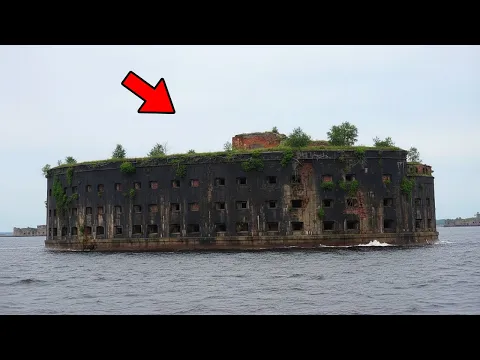

In the outskirts of Palenque, Mexico, a whitewashed arch resists as best as it can against the strong sun, rain, and the vines that have taken over its walls. Crumbling plaster, almost faded details, and a ruinous appearance to anyone passing by in a car.
For nearly 300 years, this arch was the ceremonial entrance gate of a settlement deeply marked by religious and colonial presence.
Built in the early 16th century in an adapted baroque style with local materials, it served as a backdrop for processions, festivals, and rituals.
To pass beneath it was symbolically to leave the “bush” and enter the world of the church and Spanish law.
Over time, attention shifted. Tourists arriving in the region rush to the Mayan ruins, the Temple of Inscriptions, Pakal’s tomb, the large stone reliefs.
The colonial arch was left off the itinerary. Without investment, no attention-grabbing plaques, and no strong narrative, it faded away.
Today, almost no one knows its name, history, or reason for existence. It is one of the most discreet forgotten giants on the list, a gate that once separated two worlds and now leads nowhere.
When the Forgotten Giants Collapse, What Collapses with Them?
From Sumerian temples to communist discs, from UFO houses to national mausoleums, all of these forgotten giants share something in common: they show that neither the heaviest concrete, nor the most expensive marble, nor the strongest political symbol is safe from time, regime change, and indifference.
In the end, what really survives is not just the stone, but how we choose to look at it.
And you, which of these forgotten giants impressed you the most, and which would you have the courage to visit personally today?








-

Uma pessoa reagiu a isso.