





 Portuguese
  English
  Spanish
  4 min of reading
  0 comments


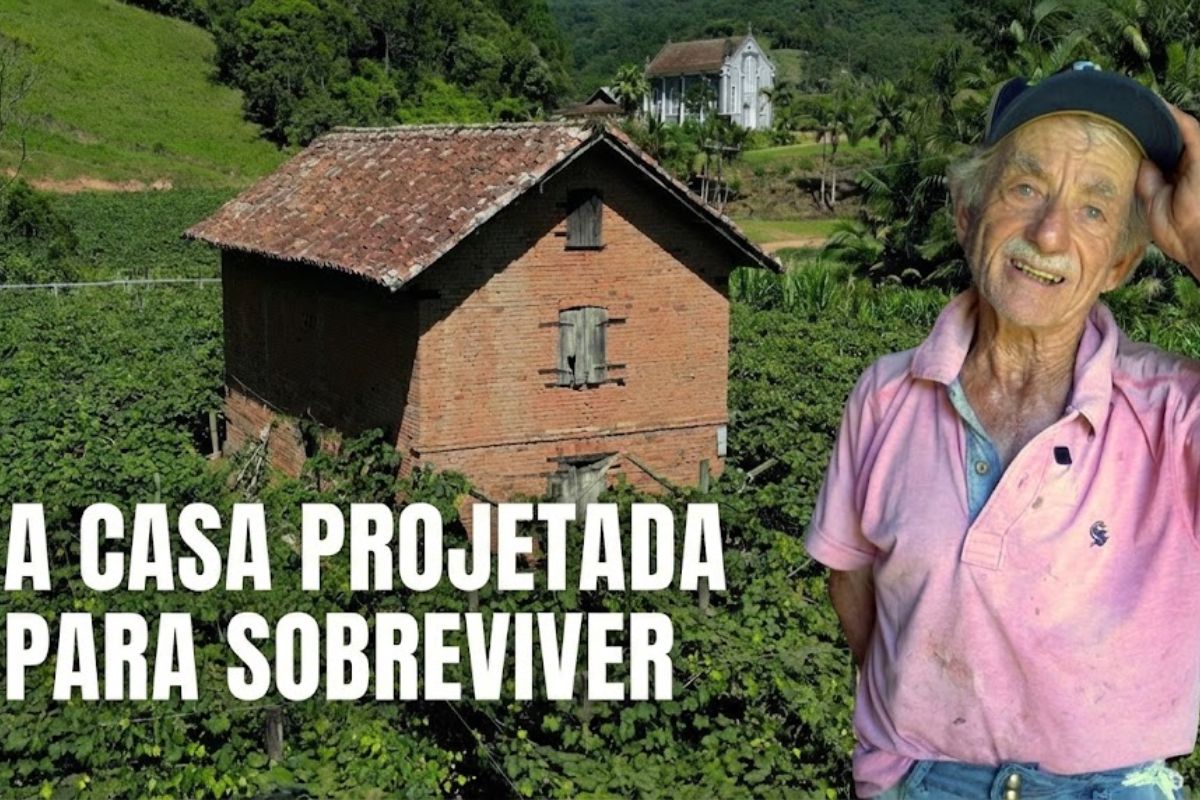
Erected by Italian immigrants in the Valley of Itajaí, the 1880 house impresses with its defensive architecture, closed walls, removable ladder, and internal gates. Built with clay, local wood, and hand-molded tiles, the dwelling withstood the test of time, holds family memories, and today integrates the rural historical landscape.
In the interior of Ascurra, in the Valley of Itajaí, a house built in 1880 draws attention not only for its age but for its original function: to protect a family of Italian immigrants in a region still marked by conflicts and isolation. On one side, imposing windows. On the other, no openings.
The house was designed to survive. Closed walls at the top, controlled access, and even a ladder that could be pulled up at night show that the dwelling was also a domestic fortress, where security and survival went hand in hand with the family’s daily routine.
The House in the Middle of the Vineyards

The house is located in the Guaricanas community, surrounded by grape vineyards that today compose one of the most beautiful landscapes in the region.
-
Trump wanted to spend $400 million on the White House, but the courts prohibited the million-dollar construction.

-
How the Egyptians erected giant structures like pyramids, temples, and obelisks without modern technology, cranes, or engines still amazes the world and reveals the power of engineering based on ramps, levers, ropes, and colossal organization.

-
The induction stove you know may be numbered: a new invisible technology hides the stove under the stone countertop, heats only the pot, and promises to cook up to 50% faster while using less energy.

-
Garlic with pure honey undergoes a natural fermentation that transforms the two ingredients into a versatile condiment for marinades, sauces, and roasted vegetables, and it can also be used as a natural treatment in your garden.


The contrast between the bucolic view and the defensive architecture reveals how life in the interior of Santa Catarina at the end of the 19th century required courage and strategy.
While one side of the house showcases wide windows, the other is completely closed.
The absence of openings is not an aesthetic oversight. It was direct protection against possible nighttime attacks, when vulnerability was greater.
Materials Extracted from the Land

As was common at the time, almost everything in the house came from the very land. A hole was dug to extract the clay used in the bricks, and the hardwood was manually worked to form beams, rafters, and sturdy floors.
The tiles also have a history. They were hand-molded, using artisanal techniques that involved simple molds and physical effort.
The roof follows a different pattern, with a structure adapted to this type of tile, showing how the construction technique shaped the form of the house.
Architecture Thought Out for Defense

The side without windows at the top of the house had a clear function. The concern about indigenous attacks was part of the reality of the time, and the construction reflected this constant fear.
The strategy was to reduce vulnerable points where arrows could hit those inside.
Inside the house, precautions continued. There was a ladder that, at night, was pulled up, making access to the upper floor difficult. Internal gates were also closed at dusk, creating additional barriers.
The division of spaces took into account the protection of the family, which was large and slept distributed among the floors.
Everyday Life Inside the Fortress House

Despite the climate of tension that shaped the construction, the house was also the stage for an intense family life. The two upper floors housed the bedrooms.
The wooden floor, made with resistant species, still bears the marks of time and the manual technique used in preparing the pieces.
On the first floor was the kitchen, with an open fire pit. The family table occupied the center of the space, where simple meals such as polenta and cheese were prepared.
The house brought together generations, with grandparents, parents, uncles, and children sharing the same environment, in a hard routine, but full of bonds.
Living Memory of Those Who Still Remember

Mr. José, a direct descendant of the builder, grew up listening to stories linked to the house and the family’s past.
He lived there before getting married and then moved to another dwelling on the same land, keeping the old construction preserved, even if closed.
Since the 1970s, the house ceased to be a residence and started to store ancient objects from the family and relatives.
Furniture, utensils, and memories transformed the space into a repository of memory, keeping alive the connection between the past and the present.
From Fortress to Rural Heritage
Almost 150 years later, the house still stands, surrounded by vineyards planted about 15 years ago as an alternative source of income for the property.
The family is also working on creating a tourism association to include historical buildings like this in visitation routes.
What was once a shelter against fear has become a silent testament to courage and adaptation.
The house represents an era when living meant resisting, producing one’s own sustenance, and protecting those around with available resources.
Would you visit a historic house like this, designed to be both a home and a fortress?








-

-

-

4 pessoas reagiram a isso.