





 Portuguese
  English
  Spanish
  5 min of reading
  3 comments


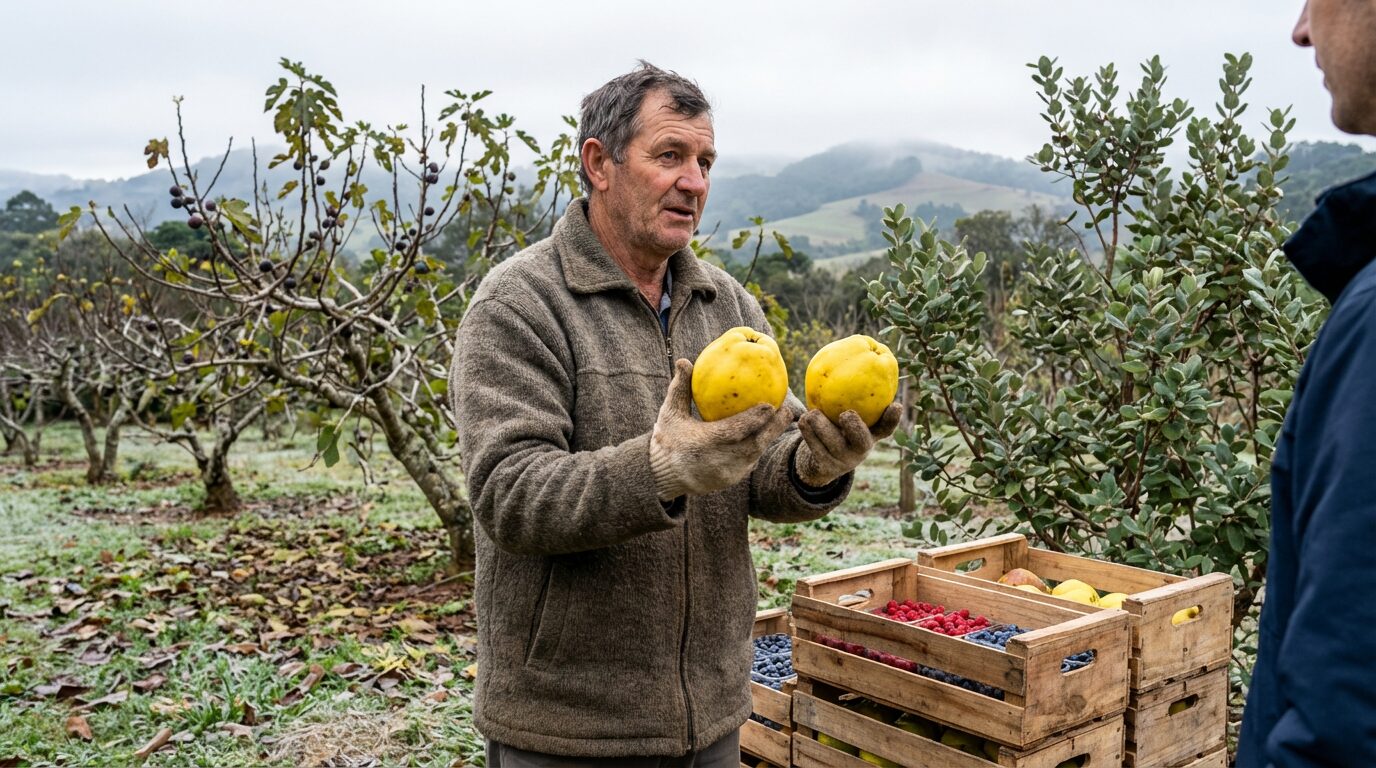


On a 12-Hectare Property in the Pessim Neighborhood in Erechim, a Fruit Grower Keeps the Cultivation of Native Fruits and Old Varieties Alive, Combining Family Knowledge, Patient Management, and Direct Sales.
In the interior of Erechim, in the north of Rio Grande do Sul, Luciano Corto transformed an orchard into a living laboratory of diversified fruit cultivation. On about 5 to 6 hectares dedicated to fruits, he grows a bit of everything, from natives like butia, serran guava, and araçá to old varieties like quince and fig. The rest of the area is used for management and preservation.
The system is visually simple but sophisticated in management. Mowing occurs at key periods, close to pruning and harvesting, reducing costs and forming a layer of organic matter in the soil. To someone looking from afar, it appears as tall grass; to someone who knows, it’s a productive mosaic with thousands of fruit-bearing plants of different ages and sizes.
With 5 to 6 thousand plants, Corte organizes the year to harvest almost all the time. The harvest begins in October with blackberry and raspberry, goes through peach and plum, and continues with blueberry, fig, and quince from summer to autumn. Diversification dilutes climate and price risks and avoids spikes in work that would require a lot of labor.
-
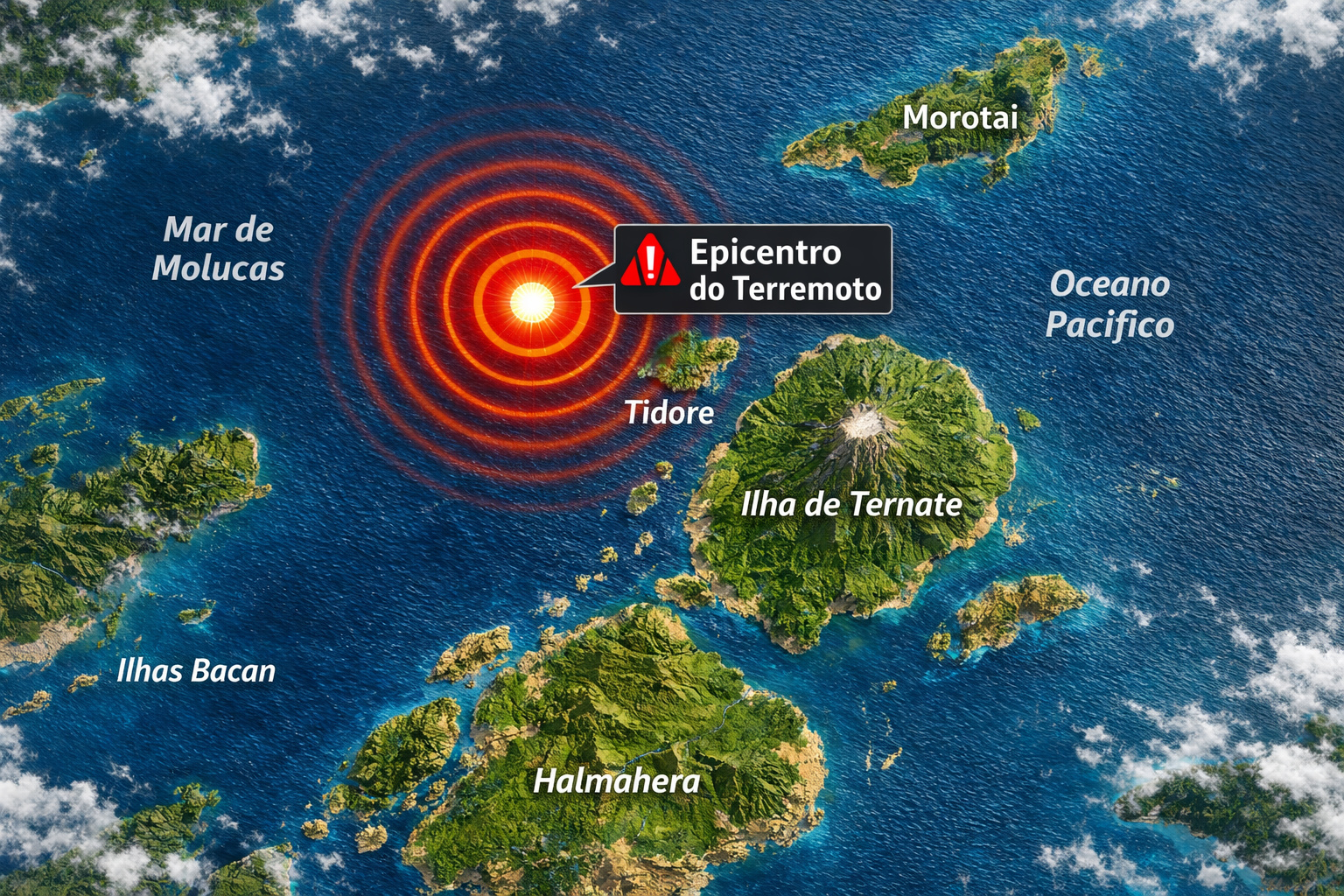
7.8 magnitude earthquake in Indonesia frightens the population, triggers tsunami alert, and hits an island with over 200,000 inhabitants this Thursday.
-
Google will finally let you change that embarrassing Gmail address you created in your teenage years without losing any accounts, logins, or old emails: the feature is already available in the United States.

-
Heading to Brazil in a Bonanza F33 single-engine aircraft: a couple departs from Florida on a visual flight, makes technical stops in the Caribbean to refuel and organize paperwork, and begins the staged crossing until they reach the country.

-
Unknown Brazilian rewrites one of the pillars of physics and gains global prominence: discovery made in Rio becomes central theme of the 2027 Nobel Prize.


Among the rows, he keeps bees for pollination and stores stakes of rare varieties for propagation. It is not agroforestry but a managed orchard focused on management, genetic preservation, and niche market, supplied by a roadside stand and customers from the region.
Old Varieties and Native Fruits Sustain Income, Ensure Continuous Supply, and Preserve Genetics
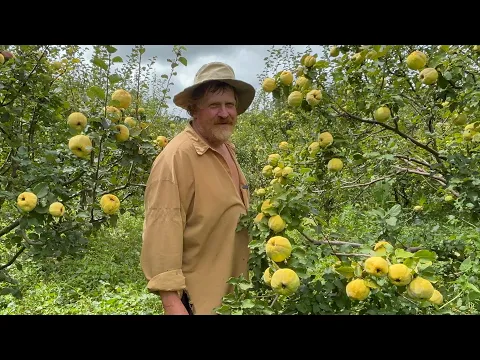

Instead of betting everything on a single crop, the producer distributes the risk among native fruits and old varieties of fig, quince, and other species. He retrieves stakes from neighboring properties, produces his own seedlings, and returns to the orchard cultivars that commerce has abandoned due to logistical and standardization issues.
In addition to preservation, the strategy helps in the local market. Those who buy directly seek flavor, history, and diversity, and pay better for raspberry, blueberry, and artisanal processed goods when the supply is short.
Quince Requires Cold and Management Year-Round, Rescue of Cultivars Expands Size and Flavor, and Prevents Losses
The quince is the pride and the challenge. Demanding in cold and water, it produces better at altitude in southern Brazil. According to Embrapa Temperate Climate, the quince tree requires hours of cold in winter to break dormancy and bloom regularly in regions above 600 m, which aligns with producers’ experiences in Serra Gaúcha.
For it to work, management is continuous. In winter, Corte applies sulphur-calcium spray to sanitize skins and control diseases like entomosporiosis, also known in apples, which can be devastating in quinces. Pruning reduces wind breakage and concentrates fruiting on sturdier branches.
Cross-pollination between different types of quince improves productivity and size. On the site, apple-quince and imperial-quince coexist, the latter yielding very large fruits, sometimes close to 1 kg, although more acidic. Genetic diversity compensates for failures and extends the harvest window.
As part of the fruit is attacked by fruit flies and oriental moths, the producer resorts to chemical inputs carefully during the growth phase, switching to repellents like neem oil as maturity approaches. According to Senar/RS, this transition reduces residues and preserves pollinators when well planned and the waiting period is respected.
On the price, the quince in natura sells for around R$ 10 per kilogram, and part goes to quince paste, jam, compote, and tea, traditional uses that help rotate stock and enhance the harvest’s value.
Fig, Raspberry, and Blueberry, Choosing the Right Varieties and Pollinators Ensures Production in the Cold
In fig, he maintains a living bank of cultivars such as São Pedro, Gota de Mel, and Purple Valinhos, each with different productivity and cold tolerance. In harsh winters, less hardy varieties suffer, so the focus is on diversifying to always have a harvest.
Raspberry has two harvests a year, in spring and autumn. It is labor-intensive, but pays well in retail, with 100 g containers selling for R$ 10 to R$ 15 at the height of the harvest. Meanwhile, blueberry is meticulous in harvesting and sensitive to fungi and soil pH, which explains prices around R$ 70 to R$ 80 per kilogram for local frozen products.
For blueberry, native bees and bumblebees are key. According to research released by Embrapa, pollination by larger bees improves blueberry set, as the European bee visits its flowers less. Preserving these pollinators is vital for family farming.
Direct Sales and Diversification Protect Against Price Pressure and Dependence on Wholesale
Instead of being tied to a wholesaler and facing price auctions, the producer prioritizes direct sales at the roadside stand and to city consumers. Thus, he adds value to small fruits and processed goods, and doesn’t need to scale volume beyond local demand.
When regional supply explodes, as in peach during full harvests, those dependent on intermediaries struggle to sell. With the variety of fruits, Corte avoids the “all or nothing” and keeps income distributed throughout the year.
Harvest Calendar, Soil Management, and Inputs in the Right Measure Balance the System
The annual agenda is tuned to the altitude climate of Alto Uruguai. October starts with blackberry and raspberry; in summer, peach, plum, blueberry and fig come in; the quince occupies the end of summer and autumn; citrus and natives help fill gaps.
The shallow and stony soil requires patience with rooting, and the spot mowing forms a “carpet” of mulch that conserves moisture and nourishes the land. In drier or frost-prone areas, he protects with trees and tests species like pitaya and palm, which tolerate adversities.
Not everything is 100% organic. Blackberries, raspberries, blueberries, and figs tend to do well with biological management; however, stone fruits require treatments during the fruit formation phase. According to Emater/RS-Ascar, the key is to adjust the integrated management to reduce impacts and preserve pollinators.
With scarce labor, the producer calibrates area and scale to avoid losing fruit on the tree. Diversification not only spreads risks but also distributes work into shorter and more manageable windows.
What do you think about the strategy of diversifying and selling directly in the gaucho countryside? In regions with strong wholesale markets, does it make sense to forgo scale to prioritize value-added? Comment and share your experience, especially if you have already cultivated quince, raspberry, or blueberry. The debate about fair pricing, pollination, and preservation of old varieties deserves to be heard.







Acho muito validou esse tipo de produção, já que quem se beneficia somos nós aqui do sul.
Como fazer para adquirir mudas destas plantas.(meu watzap 87-981783162)
Escreva para o Globo Rura, Embrapa, pesquise no Google.