






 Portuguese


An Unexpected Encounter Led a Young Engineering Student to Transform Simple Materials into Assistive Technology That Grew Beyond the University, Gained International Recognition, and Began Helping People with Limited Hand Mobility.
Straws, pipe cleaners, and a sponge hardly resemble components of medical equipment.
It was precisely with these simple materials that the then Canadian student Lianna Genovese began testing an idea that years later would reach hospitals, schools, and homes in dozens of countries.
The inspiration came when she met Elissa, introduced through the James Dyson Award and McMaster University as a woman with cerebral palsy who had lost the ability to use a brush and, consequently, her ability to paint as she once did.
-
Brazilian Researchers Create Solar-Powered Stove That Cooks Without Gas, Providing Solutions for Low-Income Households

-
At 14, Teenager Transforms Ordinary Sheet into Structure Capable of Supporting Nearly 10,000 Times Its Own Weight and Designs Foldable Shelters for Disaster Relief
-
A 190-Meter, 54,000-Ton Spaceship Traveling at 36,000 km/s: The Plan to Use 50,000 Tons of Fusion Fuel to Cross 56 Trillion Kilometers and Reach Barnard’s Star in Just 50 Years
-
Henrique Barbosa Receives Certificate After Training in 3D Printing and Robotics at São Paulo’s Fab Labs, While Municipal Program Supports 17,000 Individuals in Vulnerable Situations


Lianna was only 18 and studying biomedical and mechanical engineering at McMaster University in Canada.
What started as a university project ultimately evolved into the Guided Hands, a mechanical device designed to help people with limited hand mobility write, draw, paint, and access touch screens.
In 2021, the invention earned Lianna the James Dyson Award for Canada.
However, the story didn’t end with the award.
By January 2026, the company founded by the engineer reported that Guided Hands was being sold in over 25 countries, had surpassed a seven-figure revenue milestone, and had just been recognized by Apple as assistive technology compatible with its devices.
A Woman Who Lost Her Ability to Paint Inspired the Invention
The problem that caught Lianna’s attention was not in a spreadsheet or a lab.
It was in front of a person who wanted to return to doing something seemingly simple.
Elissa loved to paint, but her condition had compromised her fine motor control.
Upon learning that story, Lianna began to envision a way to leverage the movements that the woman was still able to perform to guide a brush across a surface.

In a statement released by McMaster in 2021, the student explained that hearing about the loss of that activity ignited her desire to restore part of the woman’s capacity for expression.
The challenge was to find a way to do this without directly relying on the strength and precision of fingers.
This is when a principle that would remain in the final project emerged: using larger movements of the arm and shoulder to compensate for the limitations of fine hand movements.
The First Guided Hands Was Made with Straws, Sponge, and Pipe Cleaners
Before metal tracks, bearings, and parts produced with 3D printing, there was a much more improvised version.
According to the James Dyson Award and McMaster University, the first prototypes were assembled with straws, pipe cleaners, and a sponge.
Lianna did not create the piece and simply assumed it would work.
Elissa participated in the testing and provided feedback on what she could or could not do with the equipment.
Based on these experiences, new versions began to emerge.
The project continued to be refined with the involvement of individuals with differing medical conditions, along with neurologists and occupational therapists.
By 2021, Lianna had already spoken to or tested with more than 150 patients and healthcare professionals in Canada, according to McMaster University.
Two years later, the university reported that the development had already received contributions from more than 525 occupational therapists, neurologists, and individuals with limited hand mobility.
3D Printer-Inspired System Guides Hand Movements
The most advanced version of Guided Hands adopted a logic reminiscent of the movement of a 3D printer.
The device has a structure made up of linear axes and bearings that allows for guided hand movement.
With this, the user can perform horizontal and vertical movements and also change the direction of the motion.
The person rests their hand on an adapted piece and moves the whole setup mainly using the larger motor skills of the shoulder and arm.

Different objects can be attached at the end, such as a pen, marker, brush, or a stylus for touch screens.
The device does not paint or write on its own.
It functions as a structure that supports and guides the movement performed by the individual themselves.
This distinction is important because the proposal is indeed tied to the user’s participation in the activity.
Girl with Cerebral Palsy Helped Lianna Recognize the Project’s Potential
Among the tests conducted during development, one meeting stood out in Lianna’s account.
She met Bella, a girl with cerebral palsy, and observed the child using Guided Hands to write, color, draw, and play on an iPad.
According to what the engineer told McMaster, watching the girl’s reaction made her realize that this college project could have a much larger application beyond the classroom.
The experience helped transform an academic activity into a venture.
Lianna founded ImaginAble Solutions in 2019, while she was still a student, to develop and commercialize assistive technologies.
The company started small.
In an initial phase, the very structure used to develop the product operated in the basement of the young entrepreneur’s home, according to a report published by McMaster.
James Dyson Award put Guided Hands in the Spotlight
In August 2021, one of the project’s biggest showcases occurred.
Lianna won the Canadian stage of the James Dyson Award, an international design and engineering competition aimed at students and recent graduates.
The national prize secured US$3,500 to further develop the invention and qualified Guided Hands for the international competition phase.
At that time, the expectation was to bring the equipment to market by the end of 2021.
However, commercial development continued through testing and programs with hospitals and rehabilitation centers.
McMaster later reported that the product officially entered the market when Lianna graduated in 2022.
This marked the definitive transition from a university prototype to a commercially sold device.
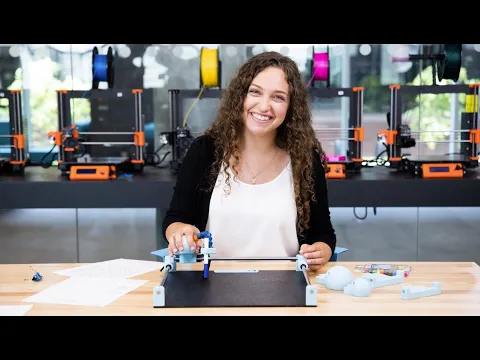

What started as inexpensive materials assembled to test a movement is now being manufactured in the Hamilton region of Ontario and distributed internationally.
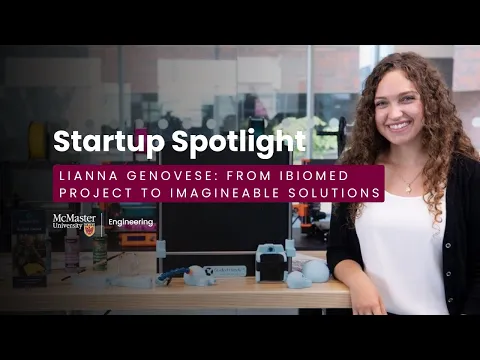
Recognition of Lianna Genovese Continued After the Award
The 2021 achievement was not the last.
In 2023, Lianna was included in the Forbes 30 Under 30 Local Toronto list, a recognition highlighted by McMaster University itself.
The following year, she received the Muhammad Ali Humanitarian Award for her work related to inclusion and the quality of life for people with disabilities.


