





 Portuguese
  English
  Spanish
  5 min of reading
  3 comments


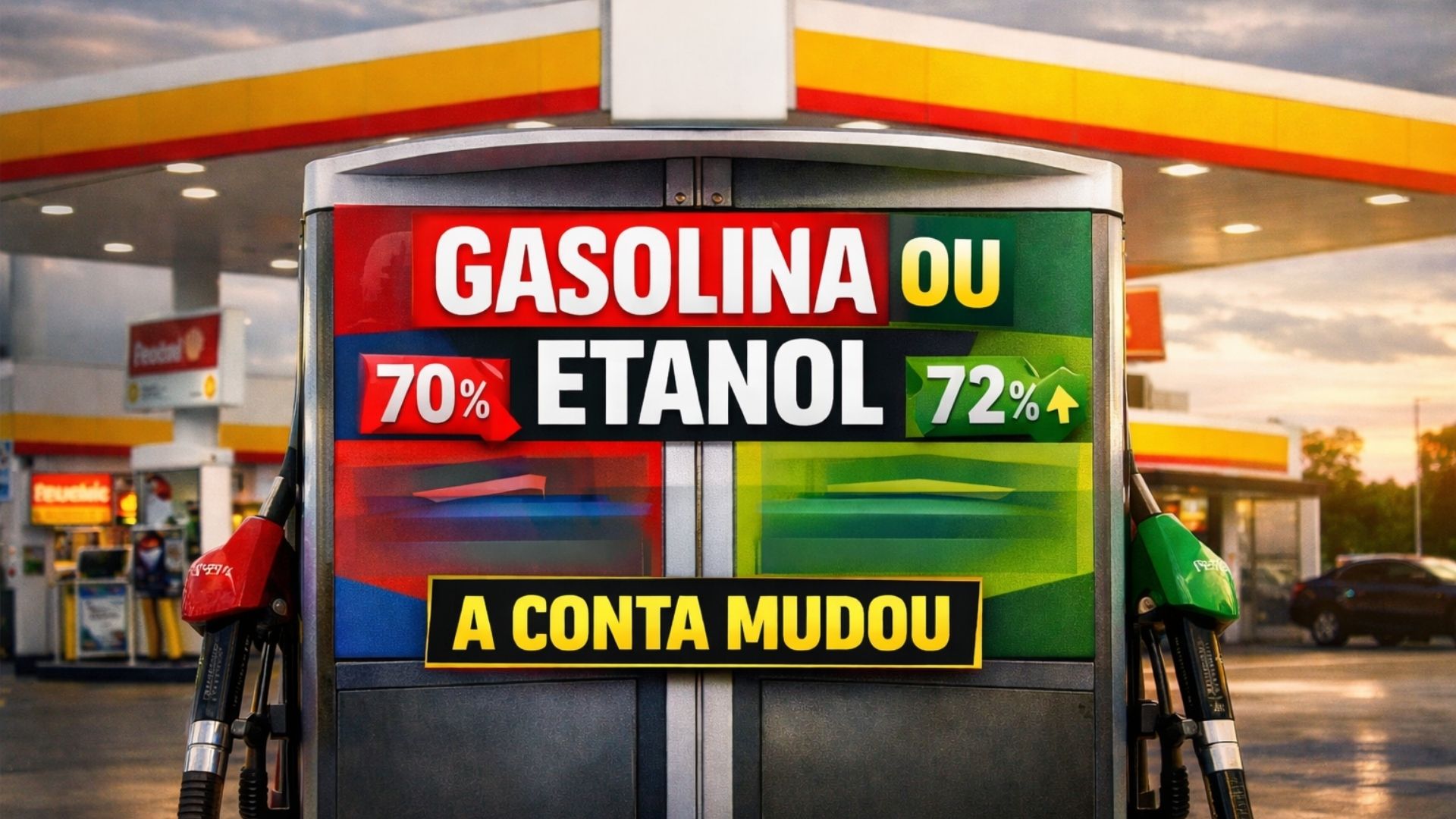


Common Question Among Flex Drivers Takes on New Forms in 2026, with Changes in ICMS, Regional Price Variations, and Engine Evolution, Making the Account Between Gasoline and Ethanol More Dependent on the Actual Consumption of Each Vehicle.
The choice between gasoline and ethanol has returned to the center of the decision for those driving flex cars in 2026, especially after the update of the ICMS that came into effect at the beginning of the year and changed the final cost displayed at the pump.
With different prices between regions and even between gas stations in the same city, the equation that defines what is truly worth it is no longer just the luminous panel but now requires attention to the specific consumption of each vehicle.
In practice, the traditional parameter that compares the price of ethanol with that of gasoline still works as a quick shortcut, but it no longer serves as a universal rule.
-
With a cost per shot close to zero, the DragonFire laser could change naval warfare in 2027 and provide British ships with nearly unlimited defense against drones.

-
A British startup creates tires that generate electricity in electric vehicles when passing over potholes, speed bumps, and cracks.

-
Scientists have created robots made with living cells that have their own nervous system, swim on their own, explore the environment, and self-organize without any genetic engineering, and now they want to do the same with human cells.

-
Students create a solar-powered ambulance that operates without a plug, without fuel, and still keeps medical equipment running in remote areas.

This happens because the difference in efficiency between fuels varies depending on the type of engine, the electronic tuning, and even the daily usage pattern of the car.
Thus, while some models accept ethanol paying more than 70% of the value of gasoline, others only offer savings when the distance between prices is greater.
Changes in ICMS and Impact on Fuel Prices
The ICMS on gasoline, diesel, and LPG began to be charged at a fixed amount per unit, and no longer as a percentage of the final price, in the model known as the “ad rem” rate.
With the update valid in 2026, the gasoline charge was set at R$ 1.57 per liter, while diesel went to R$ 1.17 per liter, and LPG was set at R$ 1.47 per kilo.
This type of adjustment does not automatically translate into a uniform increase for all gas stations, as the final price also depends on factors such as product cost, logistics, distribution, and resale margins.
Still, the state tax represents a significant portion of the amount paid by consumers and tends to influence price formation throughout the year.
Average Price of Gasoline and Ethanol at the Beginning of 2026
To understand the scenario more accurately, the national surveys by ANP help visualize the relationship between gasoline and ethanol.
In the week from 01/04/2026 to 01/10/2026, the national average indicated common gasoline at R$ 6.29 per liter and hydrated ethanol at R$ 4.53 per liter.
With these values, ethanol stood at around 72% of the price of gasoline, a level that already escapes the classic limit adopted by many drivers.
This data helps explain why the “70% rule” can lead to different decisions, depending on the car used.
In some vehicles, this percentage still represents savings, while in others it can mean higher spending over the month.
Why the 70% Rule is No Longer Absolute
The logic of the percentage exists because ethanol has lower energy density than gasoline, which means the consumption per liter is higher in most engines.
To simplify this difference, it became a habit to use 70% as a reference, comparing only the prices displayed at the pump.
The problem is that the increase in consumption with ethanol is not the same for all cars.
There are models where the efficiency of ethanol reaches 75% of what is obtained with gasoline, raising the price limit at which the vegetable fuel is still worthwhile.
In practice, if a car achieves 10 km/l with gasoline and 7.5 km/l with ethanol, the real parity is 75%, not 70%.
Thus, the most reliable calculation ceases to be a fixed number and starts to reflect the actual behavior of your vehicle.
How to Do the Correct Calculation at the Gas Station
There are two simple and equivalent ways to arrive at a more accurate result, depending on the information available.
When the comparison is made only with the prices at the station, the calculation consists of dividing the price of ethanol by that of gasoline.
If the result is below the real parity of the car, ethanol tends to be the more economical option at that moment.
The reference of 0.70 remains useful as a general guideline, but it may not represent the actual consumption of your vehicle.
The more precise method involves the car itself.
In this case, one divides the average consumption of ethanol by the average consumption of gasoline, obtaining the specific parity percentage for that model.
If the car yields 8 km/l with ethanol and 11 km/l with gasoline, for example, the limit is around 73%, and it is this number that should guide the choice at the station.
Practical Examples to Avoid Mistakes at the Fueling
Considering gasoline at R$ 6.29 and ethanol at R$ 4.53, as indicated by the national average from ANP at the beginning of 2026, ethanol appears at around 72% of the value of gasoline.
For a car whose real parity is 70%, this scenario tends to favor gasoline.
On the other hand, in vehicles that operate with a parity of 73% or 75%, ethanol may break even or even take an advantage, depending on the consumption observed on a daily basis.
In a different scenario, with gasoline at R$ 5.80, a car with a parity of 70% would require ethanol close to R$ 4.06 to be worthwhile.
If the parity is 75%, that ceiling rises to around R$ 4.35.
The difference per liter may seem small, but it adds up quickly in the tank and over weeks of use.
Autonomy, Daily Use, and Route Profile
Even when ethanol wins in the calculation, the decision may change depending on the driver’s usage profile.
On long trips, gasoline typically offers greater range per tank, reducing the number of stops and providing more convenience.
In urban use, especially on short trips and in heavy traffic, consumption can vary significantly and alter the car’s real parity.
Therefore, relying solely on a fixed percentage tends to generate errors in very different routines.
Attention to Actual Consumption and Regional Differences
It is worth paying close attention to the data from your own vehicle.
Many cars display separate averages by fuel on the onboard computer or allow tracking variation right after switching between gasoline and ethanol.
As short-term measurements can fluctuate, it is ideal to observe the behavior over several days under similar conditions.
Another decisive factor is the regional price variation.
Surveys by ANP show significant differences between states and capitals, which completely change the competitiveness of ethanol.
In some regions, vegetable fuel approaches the economic limit, while in others, it deviates, making gasoline the more advantageous choice for long periods.
In everyday life, when the driver crosses the price at the station with the actual consumption of their car, the 70% rule remains a quick reference but ceases to be the final word.
Have you compared what seems cheaper at the pump with what actually weighs less on your budget over the month?







Obrigado pelas boas dicas, no Brasil somos submetidos (consumidores contribuintes) a usar e consumir os combustíveis com pouca segurança tipo fraudes do produto e roubo na bomba! O sistema só visa arrecadar.
Bom dia. Faço a conta diferente, normalmente cálculo o valor por km rodado.
O preço de 6,29 refere-se a 70 por cento de gasolina. Se for considerar 100 por cento de gasolina, o preço real dela é de quase 9,00.