





 English
  Francês
  Alemão
  Italiano
  Japonês
  Norueguês
  Portuguese
  Spanish
  4 min of reading
  5 comments


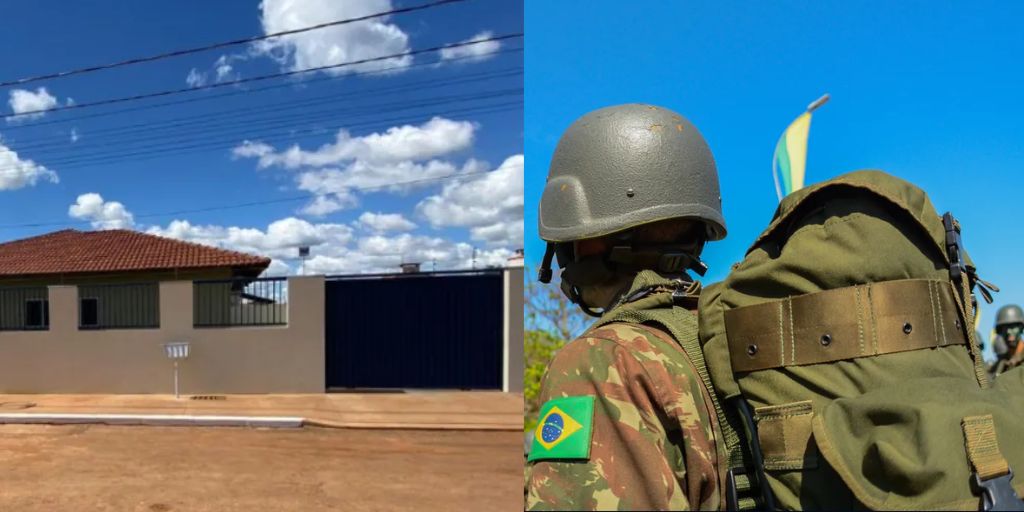

The Brazilian Army invested R$ 547 million in functional housing for military personnel between 2020 and 2023, with an average of R$ 1.18 million per residence.
Meanwhile, a high-standard house in Brasília, designated for a general officer, cost more than three times this amount, raising questions about the use of public resources.
The revelation of the costs involved in the construction of functional housing for military personnel has sparked a heated debate about the use of public resources in Brazil.
Although the construction of residences for officers and enlisted personnel is justified as ensuring dignified housing conditions for military members, the amount spent is striking.
-
Abandoned house for 15 years disappears in the woods, shocks owner with unrecognizable scenery and is reborn in an intense transformation after almost 90 hours of work in just 10 days.
-
In just three hours, a natural stone floor transforms the entrance of the house with an organic effect, immediate drainage, and a sophisticated non-slip finish that doesn’t puddle water, dries quickly, and impresses with the final result.
-
Valued at over $2 billion, the B-2 Spirit bomber requires meticulous inspection, bombs calibrated in a controlled environment, and extreme preparation to disappear from radar and launch attacks with lethal precision.

-
Chinese giant worth nearly R$ 4 billion that manufactures cables for electric cars, solar energy, and robotics wants to open a factory in SC.


With an average of R$ 1.18 million per residence, the Brazilian Army invested millions in this project. However, this information reveals only the surface of a larger issue involving luxury, inequality, and the challenge of balancing public accounts.
Details of the Million-Dollar Investments in Functional Housing
On Monday (12), the Army announced that between 2020 and 2023, R$ 547 million was invested in the construction of 463 functional residences for enlisted personnel and military officers.
These units, known as National Residential Properties (PNR), are properties owned by the Union and aim to provide dignified housing conditions for active military personnel.
These functional housing units arose to meet a specific need of military personnel: high geographical mobility.
According to the Ground Force, constant movement to different regions of the country means that military personnel need a housing solution that follows their transfers.
Functional residences are viewed as an appropriate response to this challenge, especially in remote areas or those with limited infrastructure.
The justification for building these residences is clear: to ensure adequate support for military families, especially in places where the rental market is scarce or prices are incompatible with salaries received.
Moreover, these frequent movements, according to the Army, generate stress and logistical difficulties for families, making the existence of these residences even more crucial.
Inequality in Housing Standards Generates Controversy
Despite the apparent need for these constructions, the distribution and standards of housing vary according to military hierarchy, which has sparked discussions.
While the average cost per residence is R$ 1.18 million, some high-ranking officers have access to luxury housing, whose costs far exceed this average.
An example of this is the residence of a general officer in Brasília, whose cost reached R$ 3.8 million, more than three times the average value of other functional residences built.
This disparity raises questions about equity in resource usage and the real need for such high investment in high-standard housing for a small portion of the personnel.
It is worth noting that the average expenditure does not necessarily reflect the exact cost of each residence. Some housing may have a higher cost, while others may be built for lower amounts. This occurs due to factors such as location, type of residence (house or apartment), and the size of the military family.
Maintenance and Additional Costs of Military Residences
In addition to the initial construction cost, military personnel occupying these functional residences are also responsible for paying usage permission fees, maintenance of the PNRs, and condominium fees.
In Brasília, for example, instruction number 4 from the Command of the 11th Military Region determines that the deductions from military salaries for these expenses range from 3.5% to 5%, depending on the type of residence.
Another relevant point is that only a small portion of active military personnel has access to these functional residences. This is because the number of available PNRs is insufficient to meet the total demand.
In response to this situation, the Army stated that it is committed to building more housing in different regions of the country, seeking to expand the availability of functional residences.
Conclusions and Reflections on the Million-Dollar Costs
The construction of functional housing for military personnel in Brazil involves a series of complexities that go beyond the disclosed numbers.
While it is crucial to ensure dignified housing conditions for those who serve the country, the high amounts invested, especially in high-standard residences, raise questions about the priority of public resource use.
Is it justifiable to invest millions in luxurious residences for high-ranking officers while other military personnel face difficulties in finding housing? Leave your opinion in the comments.








Nenhum soldado da caserna porá os pés numa dessas residências, isso é só para a “elite” do exército, q já ganha mais q o suficiente para adquirir ou construir do seu próprio bolso.
Eu não aceito ter de pagar pelo luxo de militares q nunca foram a guerra alguma !
chora ****, paga a casa que eu to morando
É assim que o marginal “Nine” e quadrilha compraram os Militares boiolas, traidores do povo brasileiro.
Da justiça divina esses traidores não escapam.
Esse gasto aconteceu entre 2020 e 2023, ou seja, 3 anos durante o desgoverno do bozó e 1 do nine, portanto, Paulino Filho, seu Minto tem os dois pés na lama.
Não deveriam fazer casa nenhuma para militar.