





 Portuguese
  English
  Spanish
  5 min of reading
  0 comments


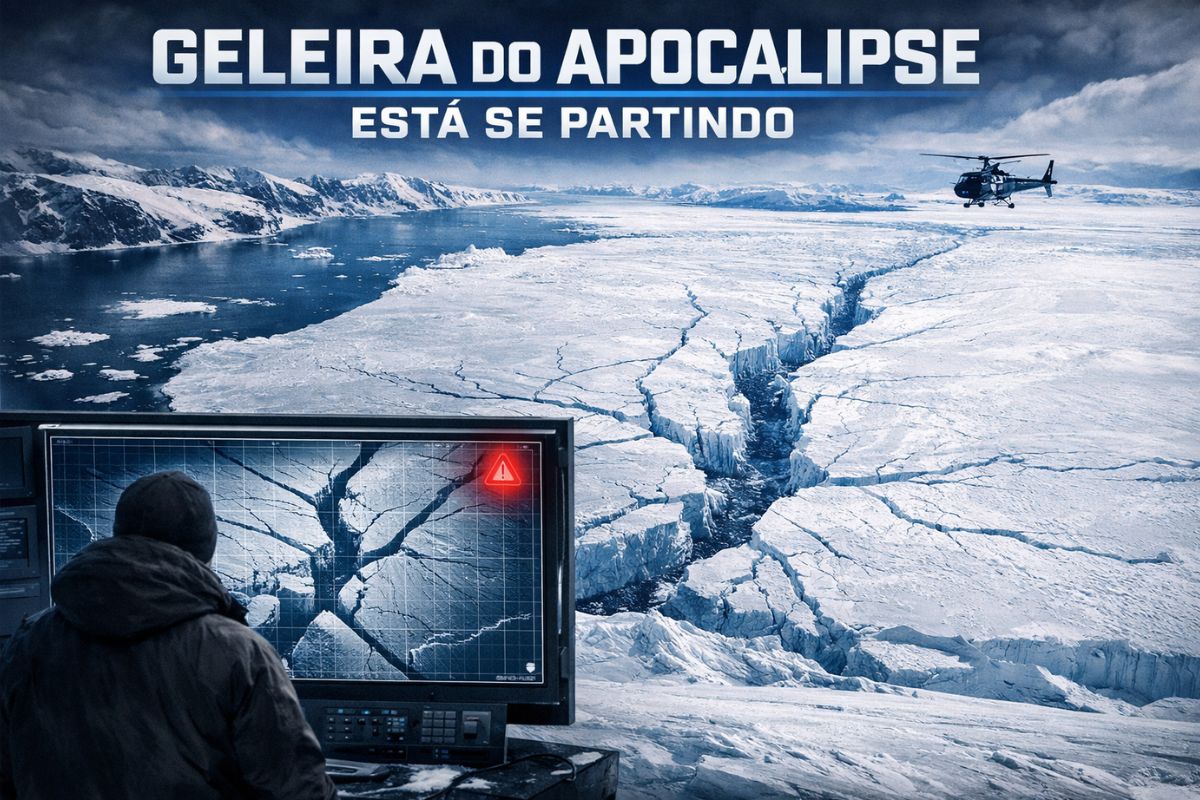
Published on December 28, 2025, International Collaboration Report of Thwaites Shows That the Apocalypse Glacier in Antarctica Has Accumulated More Than 320 Kilometers of Fractures Since 2002, Weakened Its Ice Shelf and Could, Upon Collapse, Raise Sea Levels by Up to 3.35 Meters, Threatening Coastal Cities Worldwide
The Thwaites Glacier, nicknamed the Apocalypse Glacier in Antarctica, has returned to the center of scientific concerns following the release of new satellite data. Researchers analyzed the evolution of the ice shelf between 2002 and 2022 and found that the total extent of fractures has doubled from about 160 kilometers to over 320 kilometers, a sign that the structure is fragmenting at an accelerated and potentially irreversible rate.
The study is part of the 2025 report from the International Thwaites Glacier Collaboration, ITGC, which has been warning that the retreat of the glacier has significantly accelerated over the past 40 years. The conclusion is straightforward: although a total collapse is considered unlikely in the coming decades, the Apocalypse Glacier in Antarctica is expected to retreat more and faster over the 21st and 22nd centuries, increasing its contribution to global sea level rise.
What Is the Apocalypse Glacier in Antarctica

The Thwaites is a massive ice shelf located in West Antarctica.
-
Rigid bags with their days numbered: new trend prioritizes comfort in 2026.

-
YouTuber creates an excavator equipped with a giant 4.5-meter sword to challenge his brother to a rematch, and the invention quickly goes viral on social media.

-
The U.S. Army surprises the world by presenting the UH-60MX Black Hawk helicopter capable of flying without pilots, controlled by a tablet, featuring the MATRIX system, smart sensors, and full autonomy in real combat and rescue missions.

-
Heineken’s factory in Brazil produces 300 million beer cans in just 4 months, reaches 1 million hectoliters, received R$ 2.5 billion, and is already projecting an annual capacity of 5 million with sustainable technology.
It has earned the nickname the Apocalypse Glacier in Antarctica because its stability is considered critical to the balance of the entire ice layer in the region.
If the glacier collapses under its own weight, current estimates suggest a possible sea level rise of up to 3.35 meters, sufficient to reshape coastlines and impact tens of millions of people in low-lying coastal areas.
In practice, the Thwaites acts as a kind of “brake” that helps hold back ice masses from the interior of the continent.
When the Apocalypse Glacier in Antarctica loses structural integrity, it creates space for even larger volumes of ice to slide into the ocean, increasing the risk of accelerated sea level rise.
Fractures Double from 160 to Over 320 Kilometers

The core of the recent alert lies in the fracturing pattern.
The team from the University of Manitoba examined two decades of satellite images from 2002 to 2022 around a major shear zone, an area where ice experiences intense stresses.
The analyses show that the “total length of the fracture area” has increased from approximately 160 kilometers to over 320 kilometers during this period.
At the same time, the average length of the fractures has decreased, indicating not only isolated cracks but a denser and more complex mosaic of ruptures in the Apocalypse Glacier in Antarctica.
In technical terms, this means that the ice shelf is more segmented and vulnerable, with smaller ice blocks that are more susceptible to breaking off under the combined action of gravity, the ocean, and the warmed atmosphere.
Melting from Below and Giant Swirls Under the Ice
The fragility of the surface is not the only issue.
Recent studies highlight that warming ocean waters are melting the underside of platforms like the Thwaites Glacier on timescales ranging from years to hours.
Under the Apocalypse Glacier in Antarctica, water whirlpools up to six miles in diameter have been observed, which carve cavities beneath the ice and accelerate melting from below.
Researchers have also identified a concerning feedback loop: the cold water released by the melting ice shelf mixes with warmer, saltier ocean waters, creating turbulence that intensifies the contact between the warm ocean and the base of the Apocalypse Glacier in Antarctica.
This turbulence, in turn, accelerates melting and feeds back into the cycle, creating a positive feedback mechanism in a warming climate.
What Does the 2025 ITGC Report Say
The 2025 ITGC report synthesizes the views of dozens of teams monitoring Thwaites using satellites, ocean sensors, and numerical modeling.
The document points out that the glacier’s retreat “has considerably accelerated over the last 40 years” and that the physical processes sustaining the Apocalypse Glacier in Antarctica are becoming more unstable as the ocean and atmosphere accumulate heat.
Despite this, the authors consider a total collapse “unlikely” in the coming decades.
The dominant scenario is of a continuous retreat, with mass loss and retreat of the grounding line over the 21st and 22nd centuries.
This combination of slow yet persistent evolution complicates public communication of risk, as the Apocalypse Glacier in Antarctica does not provide a precise timeline for collapse but a cumulative threat horizon for entire generations.
Potential Impact of Up to 3.35 Meters on Sea Level
The most frequently cited figure in studies on Thwaites is the potential for sea level rise of up to 3.35 meters if the glacier and associated parts of West Antarctica collapse over time.
This magnitude does not mean an instant rise, but rather the sum of gradual contributions over decades and centuries.
Still, even fractions of that total would be sufficient to exacerbate coastal flooding, beach erosion, aquifer salinization, and the displacement of vulnerable populations.
It is important to highlight that the Apocalypse Glacier in Antarctica does not act alone.
It is part of a larger system that includes other platforms and glaciers supported by beds below sea level.
A prolonged instability in Thwaites could trigger chain effects, altering the balance of broader sectors of West Antarctica with combined impacts on ocean levels.
Decarbonization as the Only Way to Slow the Collapse
In the most prescriptive section, the ITGC report states that “immediate and sustained mitigation of climate change (decarbonization) offers the best hope of delaying this ice loss”.
In other words, there is no localized technical solution to stabilize the Apocalypse Glacier in Antarctica if global warming continues to elevate ocean and atmospheric temperatures.
Reducing greenhouse gas emissions does not automatically prevent the ongoing retreat but can avert entering an unstable retreat regime in other marine sectors of East Antarctica.
For scientists, the case of Thwaites is a precautionary warning about the physical limits of the climate system, not a fictional scenario.
The decision about the speed of this process, they argue, is directly linked to energy, transportation, industry, and land use policies adopted over the coming decades.
In light of all this, in your opinion, is the alert from the Apocalypse Glacier in Antarctica already sufficient to change how governments approach decarbonization or is the world still underestimating this silent climate risk?







-

Uma pessoa reagiu a isso.