





 Portuguese
  English
  Spanish
  6 min of reading
  7 comments


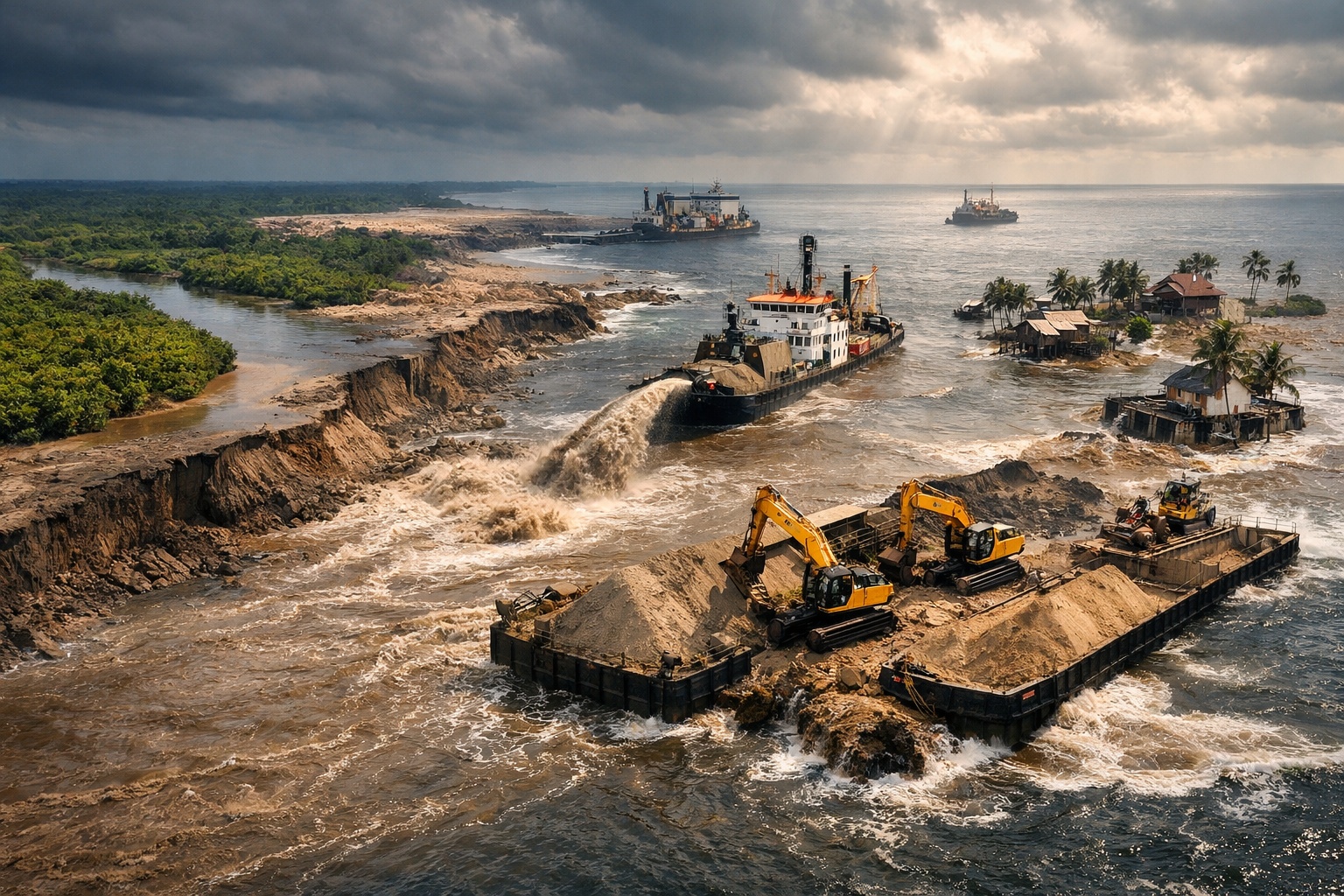


Sand: The Invisible Resource That Sustains Concrete, Glass, Chips, and Cities and Is Being Extracted from the Planet Faster Than Rivers Can Replenish
There is a material without which modern civilization simply would not exist. It is not oil, it is not lithium, and it is not any of the rare minerals often cited in discussions about energy transition. This material is sand. Sand is present in the concrete of practically every building and bridge on the planet. It is in the asphalt that covers highways and avenues, in the glass of windows, facades, and cell phone screens, in solar panels, and in optical fibers. In practically all physical structures that support modern infrastructure, sand appears as a fundamental raw material.
The role of this material goes even further. The foundation of the semiconductor industry — responsible for processors, memory chips, and digital sensors — depends on silicon, which is obtained from purifying quartz sand. In highly controlled industrial processes, this material can achieve purity of 99.9999999% silicon atoms, becoming the physical substrate upon which the entire digital economy has been built.
In other words, sand does not only support cities. It also supports digital networks, artificial intelligence, telecommunications, and practically the entire contemporary technological infrastructure. The problem is that global sand extraction occurs at a much faster rate than natural processes can replenish.
-
While the world looks at oil, the war with Iran is already disrupting helium supply from Qatar, affecting car and iPhone chips, threatening AI expansion, and putting pressure on aluminum packaging at the highest value in four years.

-
Global warming will expose a treasure hidden under the ice of Antarctica and may spark an international dispute over gold and valuable minerals.

-
A street vendor from Praia Grande built a robot made of scrap from scooters and washing machines that pulls his popcorn cart on the beach, emits sounds, and interacts with customers, becoming an attraction on the coast of São Paulo.

-
The specifications of the Xiaomi 18 Pro Max have been leaked, and the highlight is a dual 200 MP camera with a new 22-nanometer technology that promises to consume less energy and capture details in shadows and bright areas using LOFIC HDR.


Sand Scarcity in the World: UN Report Reveals Extraction of 50 Billion Tons per Year
In 2019, the United Nations Environment Program published the report Sand and Sustainability: Finding New Solutions for Environmental Governance of Global Sand Resources. The study aimed to estimate the scale of global sand extraction, a resource that is rarely systematically monitored.
As few countries officially record sand mining, researchers used indirect indicators, primarily the global consumption of cement. Cement is mixed with sand to produce concrete, and concrete is the most widely used construction material on the planet.

The resulting estimate was impressive: about 50 billion tons of sand are extracted from the Earth every year. To visualize this number in physical scale, researchers provided a comparison: this amount would be enough to build a wall 27 meters wide and 27 meters high around the entire circumference of the planet — every year.
The global demand for sand has tripled in the last two decades. Much of this growth comes from accelerated urbanization in emerging economies. Between 2011 and 2014, for example, China produced more cement than the United States did throughout the 20th century. India is following a similar trajectory and is expected to surpass China as the largest consumer of sand in the coming decades.
With the world population approaching 10 billion, every new city, every new road, and every new bridge requires additional tons of sand for construction.
River Sand Extraction Exceeds Natural Sediment Replenishment Capacity
The planet’s rivers can naturally replenish only 15 to 20 billion tons of sand per year. This means that the natural system operates with an annual deficit of 30 to 35 billion tons, more than double what geological processes can regenerate.


This imbalance creates a silent global sediment crisis. Sand mining is altering entire river ecosystems, changing river courses, accelerating coastal erosion, and threatening densely populated deltas.
Despite the magnitude of the problem, sand extraction remains one of the least regulated natural resources on the planet.
Why Desert Sand Is Not Suitable for Concrete and Construction
One of the most common questions when discussing sand scarcity is why not use the abundant sand in deserts. The answer lies in the shape of the grains.
Desert sand is mainly shaped by the wind. Over thousands of years, sand particles are transported and continuously collide with each other. This process rounds them and makes them extremely smooth. The result is almost spherical grains, with little friction between them.
This type of sand is not suitable for concrete. For concrete to have structural strength, the grains need to be irregular and angular, allowing them to fit together when mixed with cement. The sand suitable for construction is mainly found in rivers, beaches, and ocean floors, where hydraulic erosion creates irregular particles.
It is precisely this sand — the most valuable for civil engineering — that is being extracted on an industrial scale.
River Sand Mining Causes Bank Erosion and Delta Collapse
A river is not just a flow of water. It is also a continuous transportation system for sediments. Over thousands of years, rivers transport sand and mineral particles from the mountains to the oceans. This process creates river deltas, fertile plains, and highly productive coastal ecosystems.
When large volumes of sand are removed from the riverbed, this system goes out of balance. Geologists call this phenomenon “hungry water.” Without enough sediments to transport, the river begins to erode its own bed and banks. This process causes deepening of the channel and collapse of slopes.
Mekong Delta: Sand Mining Causes Bank Collapse and Community Destruction
The Mekong Delta in Vietnam is one of the most dramatic examples of this process. Covering about 41,000 square kilometers and home to 18 million inhabitants, the delta is responsible for more than half of the country’s agricultural production. Historically, the delta advanced about 10 meters per year toward the sea due to natural sediment accumulation.
Today, the process has reversed. Between 50% and 66% of the delta’s coastline is actively eroding. In just two years — 2018 and 2020 — 1,808 houses collapsed into the river due to bank erosion.
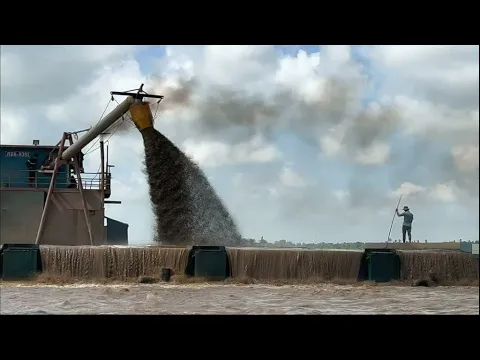
Before the construction of large dams, about 160 million tons of sediment per year reached the delta. By 2012 and 2013 this number had dropped to 40 million tons. The combination of hydroelectric dams and sand mining has drastically reduced the sediment flow. The average altitude of the delta is only 0.8 meters above sea level, making the area extremely vulnerable to erosion and ocean level rise.
Sand Extraction Threatens the Ganges-Brahmaputra Delta and Bangladesh
In the Ganges-Brahmaputra river system, which supports Bangladesh and parts of Eastern India, the scenario is similar. WWF research indicates that up to 90% of the sediments that used to flow through the river system are held back in hydroelectric reservoirs or removed by sand mining.
Three islands in the Hooghly estuary near Kolkata have disappeared over the last few decades.
Experts estimate that hundreds of thousands of people may be displaced in the coming decades due to river erosion associated with sand mining.
Global Sand Trade Generates Billions and Drives Territorial Expansion
Sand extraction also fuels giant coastal engineering projects. In the last five decades, Singapore has increased its territory by about 25% through land reclamation projects built with sand imported from neighboring countries.
Large artificial projects, such as the Palm Islands in Dubai, have also been constructed with sand dredged from the seabed.
The international sand trade generates approximately US$ 2.3 billion per year, and projections indicate that demand could double by 2060. Concerned about environmental impacts, countries like Indonesia, Malaysia, and Cambodia have already restricted exports.
Illegal Sand Mining Grows in Over 70 Countries
Illegal sand mining has become a global phenomenon. Research indicates that clandestine operations occur in over 70 countries. In India, the phenomenon has become known as “sand mafia,” organized groups that illegally exploit river deposits to meet construction demands.
In the Mekong Delta, estimates suggest illegal extraction of 16.7 million cubic meters of sand per year. In parts of West Africa and Cape Verde, entire communities have lost access to fresh water and fishing due to the destruction of coastal ecosystems caused by mining.
Global Sand Crisis Threatens Infrastructure and Ecosystems
Despite its strategic importance, sand rarely appears in public debates about natural resources. It lacks the visual impact of spilled oil, nor does it have the geopolitical relevance of strategic minerals like lithium and cobalt. But the sand used in civil construction, glass industry, and semiconductor manufacturing is concentrated in ecosystems that take centuries to form.
According to Pascal Peduzzi, director of GRID-Geneva at the UN:
“We cannot extract 50 billion tons per year of any material without causing massive impacts on the planet.”
The latest UNEP report directly classifies the problem: a global sand crisis is already underway. Deltas are shrinking, islands are disappearing, rivers are deepening their beds, and coastal cities are losing the sediments that kept them above sea level.
Sand supported the first human structures over 10,000 years ago and continues to be the basic material of civilization. But today it is being removed from the planet at the same speed that cities grow, without a global system capable of accurately measuring how much is still left.








All along the Costa del sol in southern Spain the beaches are being washed away into the deep water – which is very close to the shore for geological reasons – and will never be seen again. Very few of the rivers get even close to the sea, because they are dammed for human use, agriculture, and a bit of hydroelectric power. And here is the reason, spelled out clearly.
But behind this is the real reason for this and the lack of water we read about last week.
There are too many people on the planet.
Só posso dizer que gostei muito da matéria pois apresenta conteúdo.
É só lembrar do projeto de lei do Flávio Bolsonaro querendo “privatizar” o litoral brasileiro. Esse projeto do Flávio Bolsonaro além de facilitar essa degradação, ainda vai ajudar que futuros Jeffrey Epstein possam comprar terras no litoral brasileiro para a construção de hotéis para futuras **** de menores.
Pior é vender nosso território aos chineses….vc não acha?
Luiz Carlos de Jesus a China está investindo pesada em alta tecnologia. Logo ela não vai precisar de ninguém.