





 Portuguese
  English
  Spanish
  4 min of reading
  0 comments


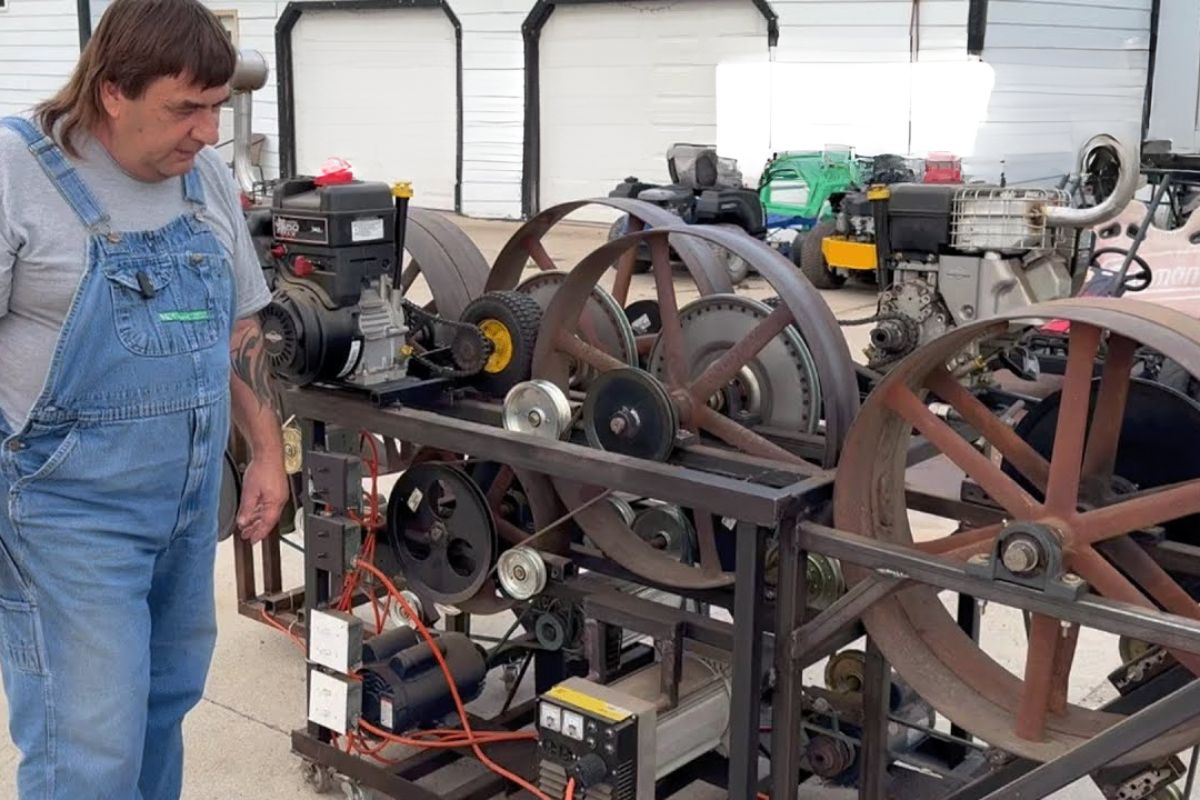
The Search for Free Energy Leads a Builder to Assemble a System with Dual Motors, 10 Thousand Watt Heads, Dozens of Pulleys, and Real Bench Tests, Exposing Why Perpetual Motion Projects Fail Even When They Seem Robust, Expensive, and Technically Well-Executed
The promise of free energy always reappears in videos, forums, and DIY projects suggesting a simple solution to end electricity bills, fuels, and dependence on utilities. This time, the proposal took shape in a large homemade generator, manually assembled over months of nighttime work.
The project does not rely on digital tricks or editing cuts. It relies on real motors, industrial generators, heavy pulleys, and direct voltage measurements, practically testing the idea that mechanical systems could generate free energy without a continuous external source.
The Origin of the Idea and the Fascination for Free Energy

The starting point of the project arises from observing popular videos showing motors coupled to generators, linked by belts, supposedly capable of self-sustaining.
-
Scientists have captured something never seen in space: newly born stars are creating gigantic rings of light a thousand times larger than the distance between the Earth and the Sun, and this changes everything we knew about stellar birth.

-
Geologists find traces of a continent that disappeared 155 million years ago after separating from Australia and reveal that it did not sink, but broke into fragments scattered across Southeast Asia.
-
Samsung launches cordless vertical vacuum cleaner with up to 400W of suction and relies on AI to automatically recognize corners, carpets, and different surfaces.

-
The lost continent beneath Europe: separated from North Africa about 240 million years ago, comparable in size to Greenland, Greater Adria was crushed over 40 million years and left geological marks from the Alps to the Balkans.

The logic seems simple: the generator would produce enough energy to keep the motor spinning, creating a closed loop of free energy.
Annoyed by the superficiality of these demonstrations, the builder decides to test the concept on a larger scale and with redundancy.
Instead of a single motor and a single generator, the system now uses two complete sets, positioned on opposite sides, each supposedly powering the other.
The Engineering Behind the Giant Homemade Generator

The equipment consists of two generator heads of 10,000 watts, coupled to five horsepower motors.
Each side of the system has push and pull motors, operating at speeds close to 3,400 to 3,600 RPM, a critical range for stable electricity generation.
To minimize losses, the project incorporates multiple pulleys of varying sizes, guide pulleys to maintain constant tension on the belts, and fine rotation adjustments.
Nothing is electronic or digital: all control is manual, reinforcing the intention to eliminate arguments about manipulation or software failures.
Real Tests, Direct Measurements, and the Shock of Reality
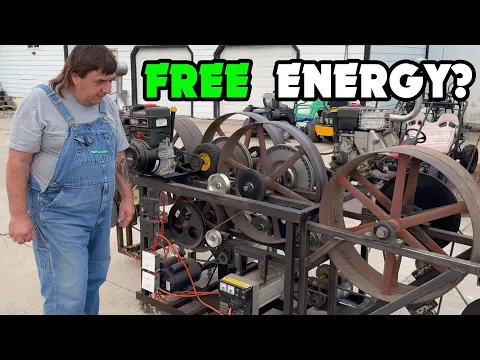

During the tests, the system effectively generates voltage. Measurements show outputs in the range of 110 to 120 volts, sufficient to power light loads.
In operation, it is possible to turn off an auxiliary motor and temporarily keep the assembly spinning with the other side active.
However, when the test advances to the central goal — turning off all auxiliary motors and letting the system sustain itself — the concept of free energy collapses.
Both sides begin to consume exactly the energy they produce, with no surplus capable of maintaining autonomous operation.
Why Perpetual Motion Fails Even with Heavy Engineering
The project practically highlights something that theories have pointed out for centuries: losses are inevitable.
Mechanical friction, heating, electrical resistance, minimal sliding of belts, and internal inefficiencies of generators constantly consume energy.
Even with balanced pulleys, synchronized motors, and the elimination of excessively heavy flywheels, the system cannot escape these losses.
The idea of free energy collides directly with the laws of physics, regardless of the financial investment or mechanical complexity involved.
Costs, Frustration, and the Dismantling of a Popular Myth
Throughout the process, the project’s cost grows significantly.
The acquisition of pulleys, motors, generators, and inverters far exceeds initial expectations, reinforcing that this is not a simple or cheap experiment.
The final result is not a technical failure but an honest demonstration.
The builder concludes that videos promising free energy with similar solutions are misleading, often ignoring losses, omitting hidden external sources, or exploiting strategic image cuts.
Free Energy as a Recurring Promise on the Internet
The conclusion of the experiment is straightforward: if such a system really worked, entire sectors of the energy economy would collapse.
Utilities, fuel companies, and generator manufacturers would be quickly replaced by homemade solutions.
The fact that this does not happen reinforces the central lesson of the project.
The search for free energy remains just another myth fueled by hope, technical ignorance, and misinformation, not by real and reproducible solutions.
By turning curiosity into practical testing, the project delivers something rare: concrete evidence.
Instead of empty promises, it shows, in practice, where and why the idea of free energy fails, even when executed with seriousness, investment, and real technical effort.
After seeing this experiment, what part stands out to you the most: the size of the system, the costs involved, or the fact that there are still so many people believing that perpetual motion solutions work? Have you seen or believed in any similar project?







-

-

2 pessoas reagiram a isso.