





 Portuguese
  English
  Spanish
  5 min of reading
  0 comments


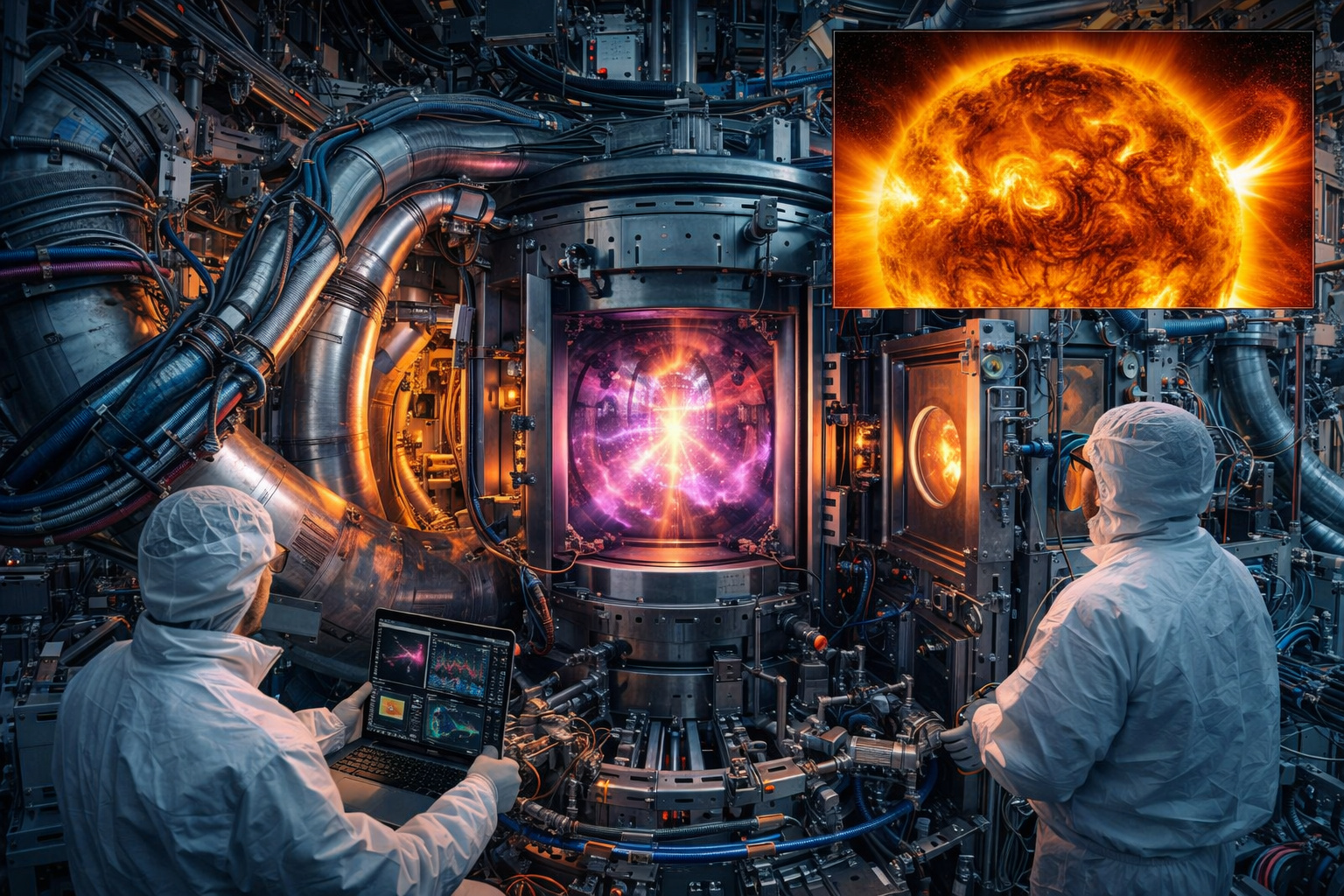
German stellarator Wendelstein 7-X reaches milestone in fusion by generating high-energy helium ions, advance may help control plasma and understand the Sun.
In 2025, scientists from the Max Planck Institute for Plasma Physics in Germany announced a significant advancement in the Wendelstein 7-X stellarator, one of the most complex machines ever built to study nuclear fusion. According to reports published by outlets such as Science News and Interesting Engineering, the experiment successfully produced, for the first time, high-energy helium ions under controlled conditions, simulating the behavior of so-called alpha particles, which are essential for sustaining continuous fusion reactions.
The experiment represents a relevant technical step because these particles are responsible for keeping the plasma heated inside fusion reactors. Without this self-heating mechanism, the reaction loses energy and becomes unviable for continuous energy generation, which has always been one of the main challenges of nuclear fusion.
The Wendelstein 7-X, located in Greifswald, is one of the largest stellarators in the world and was designed to test an alternative approach to the more well-known model of fusion reactors, the tokamaks.
-
Long before modern medicine, an artificial leg made of bronze and wood buried in Italy showed that amputees were already receiving complex prosthetics around 300 B.C., at a technical level that seems unlikely for antiquity.

-
Scientists identify a unique cell that appears only during pregnancy and acts in the connection between the placenta and blood flow, revealing an essential mechanism for fetal development and possible causes of gestational complications.

-
It took just two days of walking in the jungles of New Guinea to find the plane that historians had been searching for for 80 years: the legendary Marge still had its original red paint and the face of the woman who named the most feared fighter of World War II.

-
On a rocky stretch of just 40 meters in South Africa, scientists found dozens of footprints that are 132 million years old hidden beneath the tide, revealing the youngest record ever identified in the southern part of the African continent.

Stellarator uses twisted magnetic fields to stabilize plasma
Unlike tokamaks, which use intense electric currents to confine plasma, the stellarator employs an extremely complex system of three-dimensional magnetic fields. In the case of Wendelstein 7-X, there are 50 superconducting magnetic coils with highly twisted geometry, designed to keep the plasma stable without relying on internal currents.
This difference is crucial. In tokamaks, currents can generate instabilities that disrupt plasma confinement. In the stellarator, stability is achieved directly through the shape of the magnetic field.
This architecture allows for continuous operation for longer periods, an essential requirement for making nuclear fusion a viable energy source. The reactor is about 16 meters in diameter and weighs hundreds of tons, being considered one of the most sophisticated machines ever built for energy research.
Production of helium ions simulates alpha particles essential for fusion
Inside a fusion reactor, when hydrogen nuclei fuse, they generate alpha particles, which are highly energetic helium nuclei. These particles remain confined in the plasma and transfer energy to other particles, maintaining the high temperature.
In the experiment conducted in 2025, scientists managed to generate high-energy helium ions artificially, reproducing this behavior without relying on complete fusion reactions.
This type of simulation is essential because it allows the study of how these particles move, interact, and, importantly, how they can escape from the plasma, causing energy loss.
The ability to reproduce this phenomenon in the laboratory paves the way to understand and control one of the most critical points of nuclear fusion.
Controlling energetic particles is key to continuous fusion
One of the biggest challenges of nuclear fusion is to keep the plasma confined and heated long enough for the reaction to sustain itself. Alpha particles play a central role in this process.
If these particles escape the magnetic field before transferring their energy, the plasma cools down and the reaction stops. Controlling the behavior of these particles is, therefore, a fundamental requirement for achieving stable and continuous fusion.
The experiments at Wendelstein 7-X allow for the observation of exactly this behavior under controlled conditions, providing data that can be applied in the development of commercial reactors in the future.
Experiment helps explain phenomena observed in the Sun
In addition to applications in fusion engineering, the results of the experiment have implications for solar physics. The behavior of energetic particles in the reactor’s plasma is similar to that observed inside the Sun.
Clouds of helium-rich particles detected in solar studies can be better understood from these experiments, which replicate similar conditions on a reduced scale.
This demonstrates how nuclear fusion research not only seeks to generate energy but also contributes to the understanding of astrophysical phenomena.
Wendelstein 7-X represents a promising alternative to tokamaks
Historically, most investments in nuclear fusion have been directed toward tokamaks, such as ITER, currently under construction in France. However, the stellarator has been gaining attention as a viable alternative. The Wendelstein 7-X was designed to demonstrate that it is possible to maintain stable plasma for long periods without the limitations of tokamaks.
The results obtained so far indicate that this approach may offer significant advantages in terms of stability and continuous operation, two critical factors for the commercial viability of fusion.
Extreme engineering involves millimeter precision in magnetic components
The construction of Wendelstein 7-X required a level of precision rarely seen in engineering projects. The magnetic coils were manufactured with extremely tight tolerances to ensure the exact shape of the magnetic field.
Any deviation could compromise plasma confinement. This complexity reflects the challenge of reproducing, in the laboratory, conditions similar to those inside stars. The design took decades to develop and involved international collaboration, as well as significant investments.
Nuclear fusion promises clean, practically unlimited energy
Nuclear fusion is often described as the “energy of the stars” because it reproduces the process that occurs in the Sun. Unlike nuclear fission, it does not generate long-lived radioactive waste and does not pose a risk of uncontrolled chain reactions.
Furthermore, the fuels used, such as deuterium and tritium, can be obtained relatively abundantly. If the technical challenges are overcome, fusion could provide a clean, safe, and practically unlimited energy source capable of meeting global electricity demand.
Although nuclear fusion is not yet commercially utilized, advancements like those achieved at Wendelstein 7-X indicate consistent progress. Each new experiment provides data that helps solve technical problems and brings the technology closer to real-world application. The production of high-energy helium ions represents one of these advancements, allowing the study of fundamental aspects of plasma physics under conditions relevant to future reactors.
Next steps include longer tests and greater control of plasma
Researchers plan to continue experiments at Wendelstein 7-X, seeking to increase plasma confinement time and improve control of energetic particles. These tests will be crucial to validate the feasibility of the technology on a larger scale. The ultimate goal is to demonstrate that the stellarator can operate continuously and efficiently, meeting the requirements of a commercial fusion reactor.
Leave your opinion in the comments and tell us if advancements like those of Wendelstein 7-X represent the most promising path for the energy of the future.










Seja o primeiro a reagir!