





 Portuguese
  English
  Spanish
  8 min of reading
  1 comment


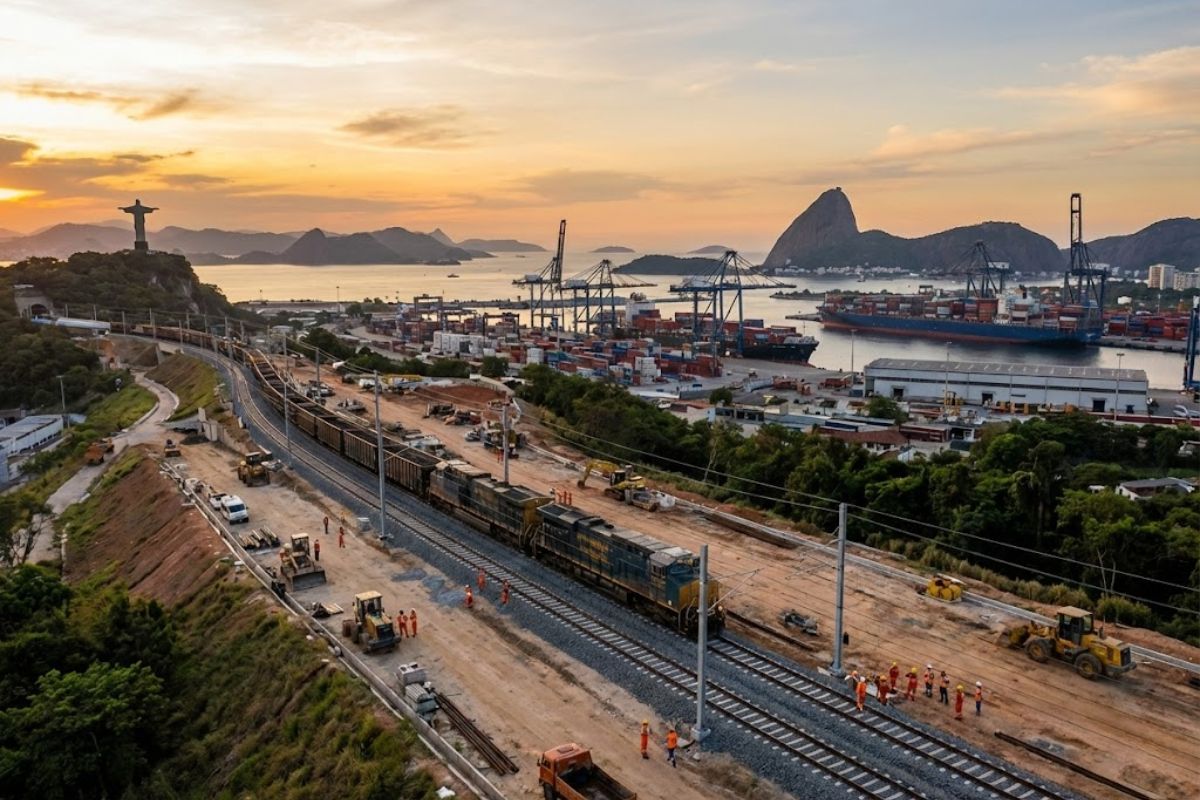

The EF-118 Railway, also known as the Southeastern Railway Ring, was approved by ANTT and plans to connect Nova Iguaçu (RJ) and Santa Leopoldina (ES), with implementation in stages. The total estimated investment is R$ 6.6 billion, and the concession’s auction is scheduled for June 2026 in Brazil.
The EF-118 Railway was highlighted on 12/31/2025 as a project of R$ 6.6 billion and up to 575 kilometers that promises to disrupt the logistics landscape of the Southeast. The proposal connects Rio de Janeiro and Espírito Santo, integrates strategic ports, and already has the concession auction scheduled for June 2026.
In addition to the auction announcement, the plan works with phased implementation and long-term goals: the priority stage, with 246 km, is expected to be completed by 2035. The design also includes significant changes in responsibility for critical sections, such as the Anchieta Branch, officially incorporated into the project.
What Is the EF-118 Railway and Why Is It Called the “Logistics Giant”

The EF-118 Railway, also referred to as the Southeastern Railway Ring, is born with a clear objective: to create a new rail integration corridor in a region where logistics and connectivity between networks make a huge difference in transportation costs.
-
In A European City, The Country’s Largest Railway Junction Was Modernized Without Closing Its Doors, Kept Trains Running During Years Of Construction, Now Serves Up To 60,000 Passengers Per Day, And Installed Solar Panels That Generate About 30% Of Its Energy

-
Famous Brazilian Railway May Become a Parking Lot

-
The Country of “Punctual As a Train” Admits It Has Lost Control: High-Speed Trains Delay, Stop, Disappear from the Map and Turn 6-Hour Trips into 10, While Deutsche Bahn Promises Restructuring in 2026 But Faces 19th Century Infrastructure, Staff Shortages and Sections Closed for Months
-
With an Investment of R$ 700 Million in One of the Country’s Main Rail Networks, VLI Reinforces Infrastructure, Receives 8 New Locomotives, and Expands the Corridor Connecting 7 States, Boosting Jobs and the Transportation of Grains, Ore, and Oil Products to the Port of Santos

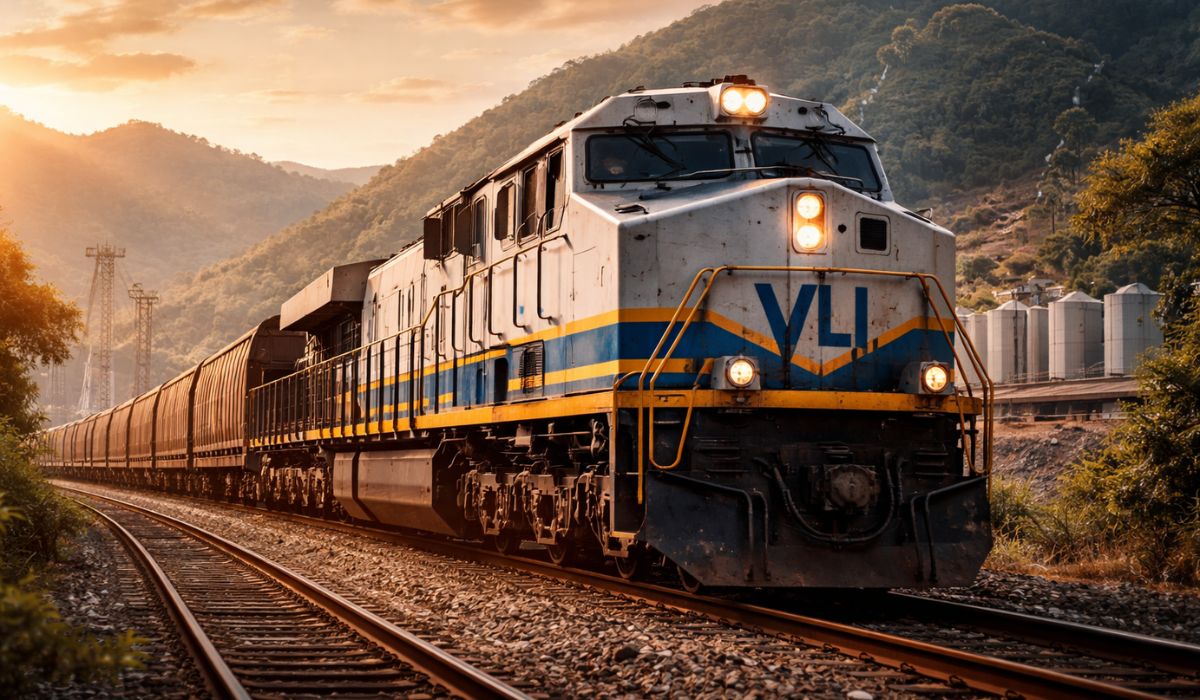

The central numbers of the project, according to the presented base, are:
Total Estimated Investment: R$ 6.6 billion
Total Length: up to 575 km
Connection Between States: Rio de Janeiro and Espírito Santo
Integration and Connection Points: strategic ports, with emphasis on Açu Port
Expected Auction of the Concession: June 2026
Phased Implementation: with one priority stage and another conditioned to demand and feasibility
Regulatory Milestones Already Mentioned: project approved by ANTT and forwarding for analysis to TCU
What makes the project “giant” is not just its size, but its ability to fit into an already existing network.
Instead of an isolated line, the railway was designed to connect with structures that are already operational, creating a more integrated route for freight circulation.
Planned Route and Key Connection Point: Nova Iguaçu and Santa Leopoldina
According to the base, the project plans to connect:
- Nova Iguaçu (RJ)
- Santa Leopoldina (ES)
This second point, Santa Leopoldina, is described as a key point because it allows connection with two already established railway structures:
- Vitória-Minas Railway (EFVM), operated by Vale
- Southeastern Railway Network (MRS)
Here is an essential detail to understand the logic of the undertaking: it is not just about laying tracks, but about connecting logistical circuits.
When a new stretch meets an already operational network, it tends to generate efficiency gains because it expands route options and, in theory, reduces reliance on bottlenecks.
Therefore, the base points to the expectation of creating a new route for the flow of agricultural and mineral production, with direct impact on costs and logistical bottlenecks.
This is a point that appears as a premise of the project.
Strategic Ports: The Role of Açu Port in the Priority Stage
The base text highlights Açu Port, located in São João da Barra (RJ), as a reference integrated port in the plan.
This appears directly in the first stage, which connects the port to Espírito Santo.
In practice, Açu Port plays a traction element in the project because:
It is on the axis of the priority stretch
It connects to the integration design with larger railway networks
It can support the flow logic, which is one of the justifications of the undertaking
The base also mentions “ports such as Açu,” but does not list other names. Therefore, the concrete data here is the presence of Açu Port as an explicit element in the priority stage.
Phased Implementation: What Happens in Stage 1 and What Is Left for Later
The EF-118 Railway has been structured in phases, and this completely changes the reading of the project’s timeline and risk. Instead of promising everything at once, the concession moves forward in parts.
Stage 1, Considered Priority
The initial stage is presented as the most important and “priority,” with the following parameters:
- Length: 246 km
- Section: São João da Barra (RJ) to Santa Leopoldina (ES)
- Explicit Logistical Milestone: includes the region of Açu Port
- Indicated Deadline for Completion of This Section: by 2035
Here, two points deserve attention:
- 246 km is an objective number that already defines the backbone of the first delivery.
- 2035 serves as the completion horizon for the priority stretch, reinforcing that it is a long-term project and concession.
Stage 2, Conditioned to Demand and Feasibility
The second phase connects:
- São João da Barra to Nova Iguaçu
But the base is clear in tying this stage to conditions:
- It will be evaluated after the start of the concession of the initial stage
- It depends on demand
- It depends on economic viability
In other words, the EF-118 Railway has a complete design, but the “closure of the circuit” with Nova Iguaçu, in this scope, is conditioned to the performance and economic fundamentals confirmed after the concession is in place.
Anchieta Branch: The 80 km Segment That Unlocks a Historical Bottleneck
One of the most relevant points, because it affects governance and execution, is the Anchieta Branch.
The base describes this branch as:
- A connection of about 80 km
- Between Santa Leopoldina and Anchieta (ES)
- Essential to integrate the new railway to EFVM
The text also states that this branch has historically been a bottleneck for the EF-118. The decisive change is that the section:
- Has been officially incorporated into the concession project
This detail is significant because integration with an already operated network is often what differentiates a project “on paper” from a project capable of generating real traffic.
Change of Responsibility: From Previous Obligation to Future Concessionaire
The Anchieta Branch carries another critical aspect: who executes and who finances.
The base informs that:
- Initially, the construction of the branch would be an obligation of Vale, as a condition for the renegotiation of the Vitória-Minas concession
- With the change approved by ANTT, responsibility shifts to the future concessionaire of the EF-118
- Part of the resources to enable this execution will be guaranteed by Vale
In simple terms: the project repositions the risk and execution obligation to whoever wins the concession of the EF-118 Railway, but anticipates a partial financial cushion from Vale.
Vale’s Contribution: R$ 826.1 Million Within the Project Structure
The base states, directly:
- Vale will contribute R$ 826.1 million to enable the project
This amount also appears in the list of funding sources that comprise the financial package.
Here, it is worth noting the practical sense: Vale’s contribution is part of the viability of the concession design, especially after the incorporation of the Anchieta Branch and the need to integrate the railway with EFVM.
Who Pays the Bill: How the Model Closes the Investment of R$ 6.6 Billion
To sustain the total estimated investment of R$ 6.6 billion, the federal government structured a model with specific sources. The base lists four points, three of which have defined values.
The cited sources are:
- R$ 2.8 billion from the renegotiation of the MRS Logística contract
- R$ 502.5 million from the renewal of the Rumo Malha Paulista concession
- R$ 826.1 million as Vale’s contribution
- The remainder completes the total estimated at R$ 6.6 billion
With the reported numbers, it is possible to see the composition more clearly:
- Adding the three detailed parts: R$ 2.8 billion + R$ 502.5 million + R$ 826.1 million = R$ 4.1286 billion
- As the estimated total is R$ 6.6 billion, the “remainder” corresponds, by difference, to approximately R$ 2.4714 billion
This calculation does not create a new data point, it merely clarifies what the base has already indicated as “remainder”. The central point is that the EF-118 Railway does not rely on a single source: it is supported by a resource arrangement to sustain the auction and execution.
Decisions at ANTT and Next Step at TCU: How the Project Advances in Practice
The base informs that the project and associated pieces moved in parallel within the regulatory agency:
- The advancement of the EF-118 Railway project was approved at an ANTT board meeting
- The contract addendum of MRS was also approved in the same meeting
- ANTT’s board authorized the sending of the process for analysis to the Tribunal de Contas da União (TCU)
This process is important because it shows that the project, in addition to being announced, is tied to formal institutional steps. In a concession, the regulatory and oversight part is usually decisive for the auction to occur on the scheduled date.
What Changes in the Flow: Expectation of a New Route and Reduction of Bottlenecks
The base places the expectation of impact objectively: to create a new route for the flow of agricultural and mineral production, reducing costs and logistical bottlenecks.
Without inventing projections or volumes, it is possible to detail the meaning of this promise based on the presented design:
When the EF-118 Railway connects ports and networks, it tends to reduce “breaks” in the route, that is, points where the cargo needs to change modes or make long detours.
By linking to systems such as EFVM and MRS, the railway can increase routing options and decrease dependence on a single corridor.
An integrated port along the rail axis can gain access efficiency, depending on how the concessionaire operates and the actual demand.
The key point is that the EF-118 Railway is presented as infrastructure to reduce logistical friction. This is the structuring logic of the project, according to the base.
Timeline in Three Milestones: 12/31/2025, June 2026, and 2035
To mentally organize what has been informed, the most relevant temporal milestones are:
- 12/31/2025: date when the EF-118 Railway appears as a “new railway highlighted,” with values, length, and connection design
- June 2026: month scheduled for the concession auction
- By 2035: horizon indicated for the conclusion of the priority stretch of 246 km
This timeline reinforces one aspect: the project has a relatively close decision and contracting phase, and a lengthy execution phase, with staggered delivery.
What to Observe from Here On: Viability, Demand, and Phased Execution
Based on what has been presented, three variables are decisive for the actual outcome of the EF-118 Railway:
Concession and Funding Structure: the model needs to close in an attractive way for the auction to occur and attract interest.
Effective Integration with Networks and the Anchieta Branch: without integration, the project loses part of its logistical sense. That’s why the 80 km branch appears as a strategic piece.
Demand and Viability of Stage 2: the text base itself conditions the second phase to these two words, indicating that the “complete project” depends on the initial performance.
In other words, the base describes a railway with great ambition and clear institutional connections, but with execution guided by stages and economic criteria.
Quick Question: Do you believe that the EF-118 Railway will come to fruition with strength right after the June 2026 auction, or does the fact that the priority stage aims for 2035 make the practical impact “too slow” for the Southeast?









Tenho pequeno lote de terreno há poucos mt da estação ferroviária de rio dourado, rj sabe informar alguma coisa?