





 Portuguese
  English
  Spanish
  11 min of reading
  0 comments


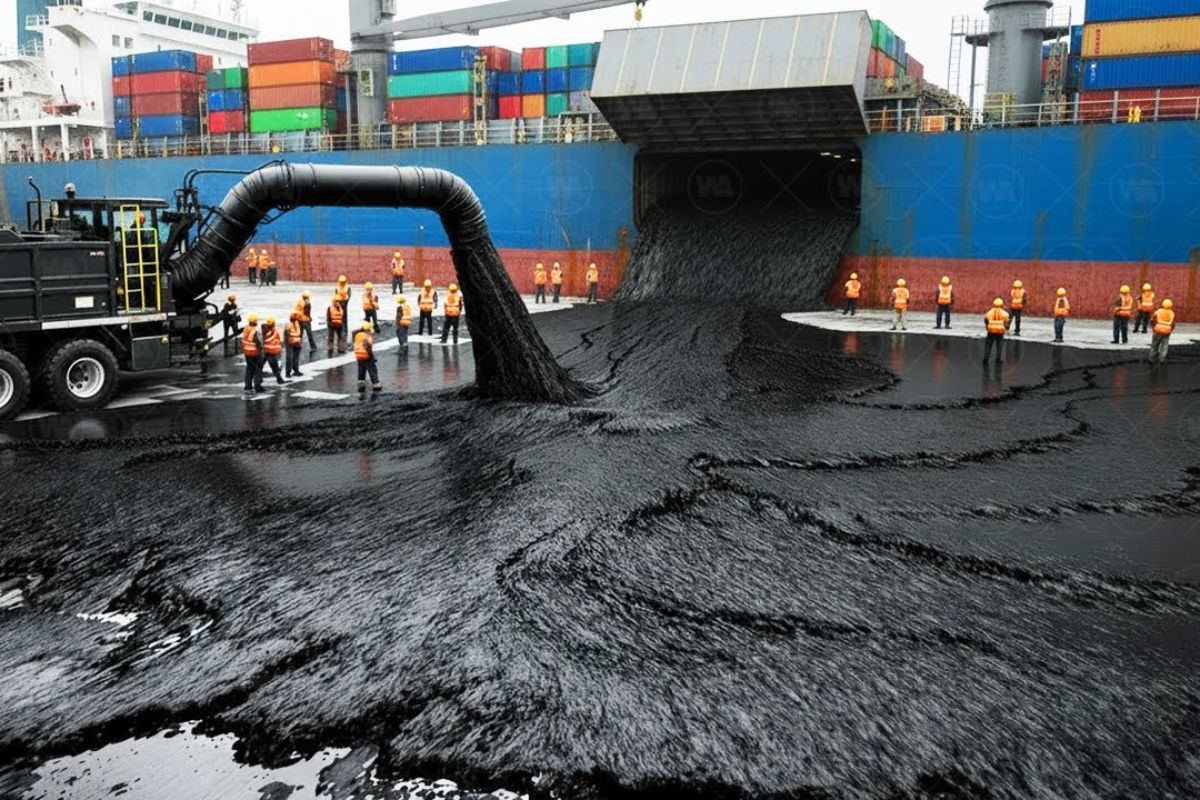
On 15 to 20-Day Trips, Ocean Giants Rely on Heavy Fuel Oil Heated in Tanks and Filters to Keep Each Cargo Ship Moving. The Low Cost Supports Trade, But the Risk of Oil Spills and Toxicity Opens the Way for Ammonia Fuel.
Ocean giants can drift in the middle of the Pacific Ocean and still carry the expectation of crossing from the USA to China in 15 to 20 days without stopping. The detail that almost no one imagines is what moves this advance: it’s not ordinary diesel, but heavy fuel oil, a mixture so thick that it needs to be heated before entering the engine.
Behind the calm appearance of a cargo ship, there is an internal chain of heaters, pumps, filters, and separators working tirelessly to turn a black sludge into useful energy. The fuel is cheap and keeps global trade running, but it takes its toll in aggressive emissions and oil spill scenarios that can become lasting catastrophes.
The Fuel That Looks Like Asphalt

When a cargo ship leaves the coast and disappears over the horizon, it carries more than just containers, ore, or grains.
-
A forgotten cord on the floor of a basement in Vienna leads a plumber to a box containing 30 kilograms of gold with Mozart’s face, hidden before World War II. The treasure, worth 2.3 million euros, was just centimeters away from a worker who ignored the sign a day earlier.

-
A couple buys an old chalet, breaks the kitchen floor for renovation, and finds over a thousand coins of gold and silver hidden since the English Civil War over 4 centuries ago.

-
Rigid bags with their days numbered: new trend prioritizes comfort in 2026.

-
YouTuber creates an excavator equipped with a giant 4.5-meter sword to challenge his brother to a rematch, and the invention quickly goes viral on social media.


It also carries the fuel that will keep everything running. In the Ocean Giants, this choice is often heavy fuel oil, a product that resembles hot asphalt, black, sticky, and elastic.
This mixture does not behave like automotive fuel. At room temperature, it can become too dense to circulate through the pipes. At 20°C, according to operational logic described in navigation, you simply cannot pump it properly.
If the heating system fails, the heavy fuel oil can solidify like cold fat, blocking the internal supply of the cargo ship and leaving the vessel unable to keep the engine fueled.
To complicate matters, the sector uses various names for the same family of products. You might hear fuel number six, marine bunker, IFO, and even low-sulfur fuel oil.
The nomenclature changes, but the essence remains: a heavy fraction of refining, prepared to burn within colossal engines.
How Heavy Fuel Oil Is Born in the Refinery

The story begins in refining. When crude oil goes through the separation processes, the lighter fractions are extracted first, those that become gasoline, kerosene, and other common fuels.
What remains at the end is a thick residue, resembling sludge. It is from this “leftover” that heavy fuel oil used by Ocean Giants is born.
However, this residue alone is not suitable for operating a cargo ship. It needs to be diluted with lighter fuels to gain some fluidity and not turn into a solid block.
These mixtures generate commercial variations, such as intermediate oils classified by viscosity, basically the thickness of the mixture.
The more heavy residue the mixture carries, the closer it approaches classic heavy fuel oil, with a consistency almost like glue.
This detail helps explain why the fuel looks like “asphalt.” It’s not an aesthetic exaggeration. It is a direct consequence of extracting the most valuable from the oil and pushing the residue to the sea as cheap energy.
Heating, Filters, and Separators: The Power Plant Inside the Ship
For heavy fuel oil to turn into energy, the cargo ship needs a preparation pathway before combustion.
The fuel is stored in a tank where it is heated with steam by internal coils. The operational reference mentioned is to keep the product around 104°F so that it can at least flow.
Then, it is pumped to a settling tank and heated again to the proper point to enter the separators. After separation, the fuel reaches the service tank already heated above 176°F, thin enough for the engine to burn.
Along the way, filters and constant measurements control purity, temperature, and quality because any variation can raise viscosity, clog filters, and force the crew to perform repeated cleanings.
This is why stories of loading “with shovels” do not apply to Ocean Giants. On an oceanic scale, fueling, called bunkering, is done with thick hoses, pumps, and meters, at the dock, anchored with specialized barges, or at dedicated terminals.
And there is a practical distinction: when a tanker loads crude oil, that is cargo; bunkering is the fuel of the cargo ship itself.
Without this preparation system, the vessel stops, because heavy fuel oil is not made to go straight from the tank to the engine without treatment.
Why The World Accepted This Fuel
The simplest answer is price. Heavy fuel oil is described as being about 30% cheaper than cleaner alternatives. This created a structural habit. Since the 1960s, with refineries extracting more valuable fractions and repurposing the residue as cheap fuel, the product became the standard for ocean propulsion.
The result is a systemic dependency: over 90% of global cargo transport relies on this logic. And about 60% of large long-haul ships, around 60,000 vessels worldwide, operate with heavy fuel oil.
That’s why the Ocean Giants continue to dominate routes, even when the substance seems incompatible with the idea of “modern technology.”
The cheap fuel lowers the cost per ton transported and supports supply chains. But it pushes a package of risks that doesn’t appear in freight into the atmosphere and the ocean.
The Problem Is Not Just Carbon: Sulfur, Particles, and Toxicity
The shipping industry often points out that it accounts for about 3% of global carbon emissions. However, the debate doesn’t end there.
Heavy fuel oil can contain a huge amount of sulfur, cited as around 35,000 parts per million. Because of this, approximately 8% of global sulfur dioxide emissions come from maritime transport.
When this gas mixes with water, it forms acidic compounds associated with acid rain, corrosion, and respiratory diseases.
Add to that nitrogen oxides, which pollute the air and attack the airways. At the beginning of the coronavirus pandemic, an observation was made: regions with high levels of nitrogen oxides had sicker people because the airways were already weakened by constant pollution.
Estimates suggest that particulate emissions from maritime transport are associated with around 400,000 premature deaths annually and over US$ 50 billion in health costs.
There is another critical point: heavy fuel oil contains polycyclic aromatic hydrocarbons, known as PAHs, linked to cancer risks. Under ultraviolet light, toxicity can significantly increase. In extreme reported cases, exposure under UV can be so aggressive that shells and corals begin to dissolve in minutes.
For the Ocean Giants, this means that the discussion is not just about climate: it is about chemistry, health, and entire ecosystems.
When An Oil Spill Happens, Everything Gets Worse
If combustion is already a problem, an oil spill is the ultimate nightmare. Because it is thick and sticky, heavy fuel oil clings to surfaces, takes a long time to spread in a treatable manner, and can persist for years.
In cold water, the situation becomes even more difficult: evaporation is slow, and the fuel tends to solidify, like trying to wash cold grease off a plate.
An emblematic case occurred in 2020 when the Japanese freighter MV Wakashio strayed off course and ran aground on a coral reef near the coast.
The impact occurred on July 25, and after almost two weeks under strong waves, the breach gave way. On August 6, the fuel began to leak. More than a thousand tons entered the water, affecting lagoons, protected wetlands, a bird sanctuary, and habitats of rare animals.
The response included mobilizing volunteers who improvised barriers with cloth, sugarcane leaves, empty bottles, and even hair, because hair absorbs oil.
The recorded explanation for the grounding was as banal as it was shocking: the crew had gotten close to the coast to get a cell signal.
The leaked fuel was described by a representative as “skin cream,” a comparison that does not hold up against the behavior of the product in water. The ship was carrying VLSFO, a fuel mixed from refinery leftovers combined with lighter products like gasoline or diesel.
This type of mixture can harden in water and remain on the surface for a long time, making cleanup slow and difficult.
In another episode, in December 2024, two tankers carrying derivative products sank in the Kerch Strait. About 3,000 tons of fuel leaked into the sea, out of a total exceeding 9,000 tons on board, something close to one-third.
Part of the problem is physical: this fuel can start to solidify around 77°F. It does not just float like crude oil; it can sink and mix in the water column and even reach the seabed.
The consequence is brutal: there is no technology described for collecting fuel from the water column, and what remains is to clean beaches and collect what the sea returns.
The drama continues even after the initial impact. Sunken tankers may retain large volumes inside, but once solidified, they are impossible to pump without heating. And heating a tank on the seabed is not a realistic plan.
Therefore, the mentioned alternative is to raise the entire vessel, with the frozen fuel inside. Even then, there is no total guarantee because different fuels solidify at different temperatures: sometimes the oil hardens completely, sometimes it only forms a crust.
If there is still liquid beneath the crust, raising it can cause a new oil spill.
The same viscosity that cheapens freight can turn the accident into a years-long nightmare.
The Arctic as a Breaking Point
The debate over heavy fuel oil has gained a specific focus: the Arctic. G7 leaders have already classified the transport of this fuel as the greatest threat to the Arctic marine environment. The concern is based on two combined factors.
First, the toxicity of heavy fuel oil can increase under high exposure to ultraviolet radiation. Second, in cold water, it does not decompose, does not evaporate and can turn into solid pieces that sink and remain trapped for years, harming the environment for a long time.
There is also black carbon, soot that, when deposited on snow and ice, accelerates melting and interferes with climatic processes.
A joint statement on climate and energy in March 2016 mentioned the need to address the risks associated with using heavy fuel oil in Arctic maritime transport and with black carbon emissions.
From a regulatory standpoint, there are two paths. One is the direct prohibition of fuel in certain areas.
The other is the creation of emission control zones, where ships are required to use cleaner fuels or install gas cleaning systems, known as scrubbers. In a control zone around the English Channel, the permitted sulfur content in fuel consumption has been reduced by 90%.
According to the cited normative reference known as the Polar Code, about 10% of vessels in Arctic waters operated with heavy fuel oil.
And traffic continues to grow: between 2021 and 2023, the number of unique vessels in the region reportedly increased by 37%. With the ice receding and resource extraction increasing, more Ocean Giants are entering these routes.
On July 1, 2024, the introduction of a ban on the use of heavy diesel fuel in the region was mentioned, highlighting the intensification of the debate.
Antarctica has already banned the use and transport of heavy fuel since 2011. In the north, after pressure from environmental groups, the member states of the International Maritime Organization agreed to a ban in 2021, applicable in Arctic waters.
But there are loopholes: the rule may not apply to ships with protected fuel tanks, and countries with control over territorial waters may decide whether or not to apply the ban to their own vessels.
The result is uneven. One cited example is Russia, with over 800 vessels operating in northern waters, many still operating with heavy fuel oil without following the new rules.
In contrast, Norway has reportedly adopted strict rules and implemented a total ban on the use of heavy fuels in the area around Svalbard. In this context, an Irish ship was caught and fined US$ 93,000, a sign that when there is a will to enforce, compliance happens.
For a cargo ship, this becomes operational uncertainty. For the environment, it is a reminder that the risk is still active.
Competing Alternatives: Ammonia Fuel, LNG, and Methanol
If heavy fuel oil is the standard, alternatives seem, for now, an incomplete mosaic. The listed options include liquefied natural gas, methanol, biofuels, and with growing emphasis, ammonia fuel.
At a testing center in Copenhagen, engineers are working with an engine the size of a three-story building trying to operate with liquid ammonia.
The bet is clear: ammonia does not emit carbon when burned, and if produced from hydrogen with green energy, it could approach a zero-emissions scenario.
In 2024, at one of the largest ports in Western Australia, ammonia was transferred from one container to another for the first time, as a rehearsal for logistics. And there is a promise that ammonia-powered cargo ships will appear starting in 2026.
But ammonia fuel is controversial for hard-to-ignore reasons. It is highly toxic, dangerous when inhaled, irritates skin and eyes, and any leak can kill surrounding organisms. Additionally, it has been pointed out that there are no fully consolidated rules or standards for maritime use, and the infrastructure is limited.
The picture of this is reflected in the orders: in 2024, there were only 25 vessels ordered worldwide capable of operating with a mix of ammonia and common fuel. By comparison, there were at least 722 LNG-powered ships and 62 methanol-powered ships, combining those that are in operation and those that were ordered.
The obstacle is also economic. Industry estimates suggest that fueling a cargo ship with ammonia fuel could cost two to four times more than with common fuel.
The energy density of ammonia is also described as about two and a half times lower than that of traditional fuels.
This means that, to cover the same distance, the ship needs to carry more volume or refuel much more frequently. Add in corrosion, extra maintenance, and the need for special tanks and piping, and it’s clear why the change is not immediate.
Even so, projections like those from the American Bureau of Shipping suggest that by 2050, about one-third of maritime fuel could be ammonia.
If this happens, it will not just be a fuel switch: it will be a reconstruction of infrastructure and operational responsibility.
What Is at Stake for the Ocean Giants
The story of heavy fuel oil is the story of a cheap solution that gained scale before it was fully addressed.
It explains why a cargo ship can cross oceans for weeks, carrying tens of thousands of tons, and also why the risk of oil spills haunts ports, reefs, birds, and remote areas.
The industry tries to balance cost, reliability, and environmental rules. Regulators are trying to reduce sulfur, particles, and black carbon.
Coastal communities and ecosystems deal with what remains when the chain fails.
And, in the midst of all this, alternatives like ammonia fuel emerge as both a promise and a warning: the transition may cut carbon, but it may increase toxicity risks if the infrastructure is not ready.
Do you think the use of heavy fuel oil by the Ocean Giants should be banned where an oil spill is practically impossible to clean up?








Seja o primeiro a reagir!