





 Portuguese
  English
  Spanish
  4 min of reading
  1 comment


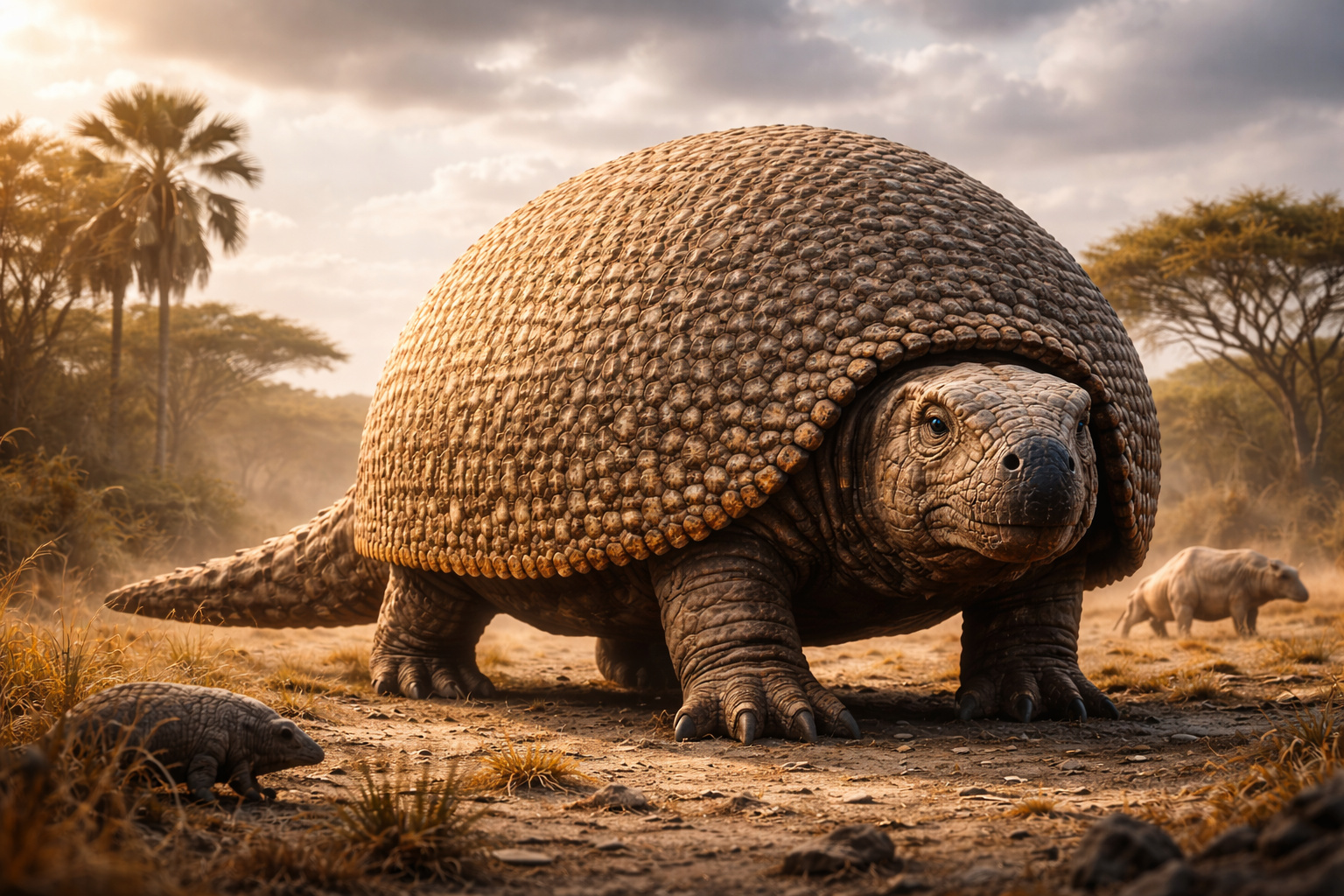


Glyptodon Was The Largest Armadillo In History: Nearly 1 Ton, Massive Shell, Armored Tail, And Decisive Role In The Ecosystems Of Prehistoric South America.
When talking about armadillos, the common image is of a small, burrowing, and discreet animal. The Glyptodon, however, completely dismantles this idea. This extinct mammal from South America was one of the most impressive herbivores of the Pleistocene, combining colossal mass, extreme natural armor, and physical resistance at a level unmatched by modern armadillos.
The Glyptodon lived until about 10,000 years ago, coexisting with primitive humans and other giants of the megafauna, such as giant sloths and mastodons. Its body resembled less of an animal and more of a walking fortress, a result of millions of years of evolution focused on defense.
Dimensions That Place The Glyptodon In A Different Category
Fossils indicate that the Glyptodon reached between 3 and 3.5 meters in length, with an estimated weight between 800 kg and 1,000 kg, depending on the species. This made it hundreds of times heavier than a modern armadillo, which rarely exceeds 50 kg.
-
Motorola launched the Signature with a gold seal from DxOMark, tying with the iPhone 17 Pro in camera performance, Snapdragon 8 Gen 5 that surpassed 3 million in benchmarks, and a zoom that impresses even at night.

-
Satellites reveal beneath the Sahara a giant river buried for thousands of kilometers: study shows that the largest hot desert on the planet was once traversed by a river system comparable to the largest on Earth.

-
Scientists have captured something never seen in space: newly born stars are creating gigantic rings of light a thousand times larger than the distance between the Earth and the Sun, and this changes everything we knew about stellar birth.

-
Geologists find traces of a continent that disappeared 155 million years ago after separating from Australia and reveal that it did not sink, but broke into fragments scattered across Southeast Asia.



Its height was not great when compared to other herbivores, but its width and body volume made it a practically immovable block when stationary. The low center of gravity, combined with its extreme weight, ensured stability even on uneven terrain.
In practice, it was an animal impossible to be flipped or knocked down by any known terrestrial predator of its time.
The Most Resistant Shell Among Mammals
The most striking feature of the Glyptodon was its massive shell, formed by thousands of fused bony plates, creating a rigid structure, unlike the articulated shell of modern armadillos. This armor could reach several centimeters in thickness, covering practically the entire back and sides of its body.
Unlike modern armadillos, the Glyptodon could not curl up. In compensation, it did not need to. Its shell acted as a permanent shield, capable of absorbing impacts and resisting bites from large predators.
Some fossils even show marks of attacks, indicating that predators attempted to pierce the shell unsuccessfully.
Armored Tail: Real Defensive Weapon
In addition to its shell, the Glyptodon possessed a heavy and armored tail, in some species reinforced by rigid bony rings. This structure functioned as a true impact weapon, capable of causing serious injuries.
A well-aimed strike could break bones or easily drive away predators. Unlike many herbivores, the Glyptodon did not rely solely on passive defense: it could counterattack physically.
This combination of passive and active defense helps explain why healthy adults had virtually no natural enemies.
Feeding And Ecological Role
The Glyptodon was herbivorous, feeding on grasses, low leaves, and other plants close to the ground. Its dentition was adapted to crush large volumes of plant material, which required constant feeding.
By intensively grazing, it helped control ground vegetation, directly influencing the composition of the environment. This behavior shaped the ecosystem, favoring certain plant species and hindering excessive growth of others.
Like other members of the megafauna, the Glyptodon acted as an ecological engineer, altering the landscape simply by existing in large numbers and size.
Direct Comparison With Modern Armadillos
To understand the scale of the Glyptodon, just compare it to the largest living armadillo today, the giant armadillo. Even this modern giant measures about 1.5 meters in length and weighs, on average, 30 to 50 kg.
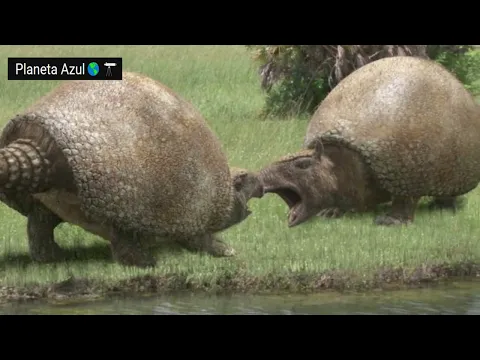
The Glyptodon could be 20 times heavier and more than double the length. Additionally, while modern armadillos rely on digging and fleeing, the Glyptodon relied on armor and brute strength.
This difference shows how evolution followed completely distinct paths after the extinction of the megafauna.
Predators And Survival Strategies
During the Pleistocene, South America was home to large predators, such as saber-toothed cats. Nevertheless, attacking an adult Glyptodon was an extremely risky bet.
The combination of rigid armor, armed tail, and high weight made hunting nearly unfeasible. Predators likely focused on juveniles or weakened individuals, while adults remained practically immune.
This defensive advantage allowed the Glyptodon to thrive for thousands of years without significant offensive adaptations.
Why The Glyptodon Was Extinct
The extinction of the Glyptodon coincided with the end of the last Ice Age and the expansion of humans throughout South America. Climate changes altered vegetation, reducing suitable grazing areas for a large herbivore.
Moreover, archaeological evidence indicates that humans hunted these animals, possibly attracted by the large amount of meat and the shell, which could be reused for shelter or protection.
For a slow-growing species with limited reproduction, this combination was fatal.
A Living Tank Of Prehistory
The Glyptodon represents one of the most extreme examples of natural defense among mammals. It did not need to run, climb, or hide. Its strategy was simple and effective: resist everything. No modern armadillo, no matter how large, comes close to this combination of mass, armor, and defensive strength.
The Glyptodon shows that nature has already created mammals so well protected that they resembled true biological war machines. Its disappearance was not just the loss of a curious species, but the end of an entire model of extreme defense in the evolution of mammals.
In the face of this prehistoric “tank,” it becomes clear that the Earth’s past was much more radical — and much larger — than the present suggests.








Muito interessante esse tatuzão, ele não cavava! E a sua aparência está mais próxima de um quelônio do que pra um tatú!