





 Portuguese
  English
  Spanish
  4 min of reading
  0 comments


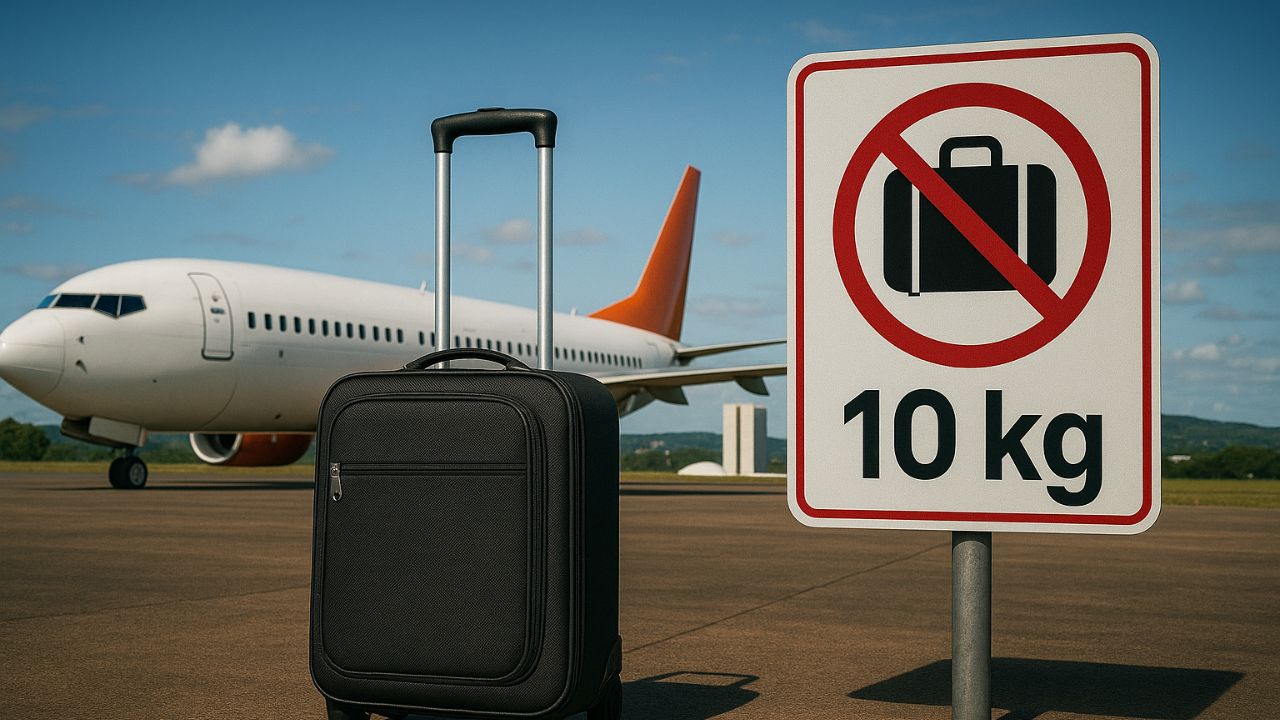
Gol and Latam Create “Basic” Fares That Restrict the Type of Free Carry-On Baggage on International Flights; Procon, Anac, and Congress Respond.
The airlines Gol and Latam will have to provide formal clarifications to consumer protection agencies and the National Civil Aviation Agency (Anac) regarding the recent creation of new fares that restrict the free transport of carry-on baggage. As reported by Agência Brasil and CNN, the change, initially applied to international flights, prompted an immediate reaction from regulatory bodies and the National Congress.
The controversy centers around the new “basic fare,” which allows passengers to carry only one personal item (such as a purse or backpack) that fits strictly under the seat in front, excluding the traditional 10-kilogram suitcase stored in the overhead compartment. In response, the President of the Chamber of Deputies announced that he would prioritize a bill to prohibit this limitation and ensure the free transport of carry-on baggage.
Consumer Protection Agencies Demand Transparency
The Procon Foundation of São Paulo notified Azul, Gol, and Latam, setting a deadline for companies to detail the new policy, as reported by Agência Brasil. The primary concern of the agency is the clarity of the information provided to customers at the time of purchase. Technical advisor Renata Reis questioned whether the change will actually result in a lower fare, what the exact limits of volume and weight associated with the new price are, and crucially, “how will the airline control the arrangements of backpacks and small suitcases on the same flight?”.
-
The noise law will no longer be in effect at 10 PM starting in June with a new rule valid during the 2026 World Cup.

-
The Chamber opens a debate on driver’s licenses at 16 years old as part of a reform that includes around 270 proposals to change the Brazilian Traffic Code and may redesign rules for licensing, enforcement, and circulation in the country.

-
The new Civil Code could revolutionize marriages in Brazil with “express divorce” and changes that could exclude spouses from inheritance.
-
Banco do Brasil sues famous influencer for million-dollar debt and intensifies debate on delinquency, risks of seizure, and direct impact on Gkay’s credibility.


Similarly, the National Consumer Secretary (Senacon), linked to the Ministry of Justice, also notified Gol and Latam. In a statement, Senacon admitted that companies may be legally protected by current regulations but assessed that the “conduct does not bring benefits to the consumer, and therefore deserves review”. Anac, in turn, sent a formal letter to the airlines requesting explanations on “how these charges are being made, what the rules are, and on which flights,” according to the agency’s president, Tiago Faierstein, in a statement to CNN.
The Justification of the Airlines
The airlines, through the Brazilian Association of Airlines (Abear), argue that there are no extra charges for carry-on baggage. According to the association, the new basic fares are, in fact, a “discount” offered to passengers traveling only with personal items (bags and backpacks) that do not require space in the overhead compartments. The justification is that this practice is already adopted by other international low-cost airlines operating in Brazil.
Gol detailed to Agência Brasil that its “Basic” fare, launched on May 14, is available only on specific international routes and allows the customer to bring a personal item of up to 10 kg in the cabin, as long as it is stored under the seat. Latam, which implemented a similar fare in October 2024 for some South American destinations, follows the same logic, allowing one personal item under the seat. Latam, however, emphasized that all its other fares sold in Brazil “allow the passenger to carry 10 kg of baggage free of charge in the cabin” (the traditional carry-on bag). Azul stated that it will not implement this charge.
Congress Responds and Proposes the “Bagage Bill”
The fare change sparked a strong political reaction. The President of the Chamber of Deputies, Hugo Motta (Republicanos-PB), stated that “the Chamber will not accept this abuse” and announced that he will prioritize Bill 5041/2025, known as the “Bagage Bill.” Authored by Deputy Da Vitória (PP-ES), the bill seeks to ensure that passengers can carry a carry-on baggage (within Anac limits) and one personal item (bag or backpack) on domestic and international flights operated in Brazil, at no additional cost.
The text of the bill, released by CNN, classifies the additional charge for carry-on baggage as a “practice that violates the principles of transparency and good faith in consumer relations”, arguing that it “removes a right that has always been recognized for the passenger.” The justification for the bill further highlights that the measure “disproportionately affects lower-income passengers”, who depend on basic fares and would not be able to afford additional costs to carry their belongings.
What Does the Current Rule of the Anac Say?
The confusion surrounding the legality of the charge for carry-on baggage hinges on the interpretation of current regulations. Resolution No. 400 of Anac, implemented in 2016, establishes that every passenger has the right to transport a carry-on baggage of up to 10 kilograms for free, respecting the dimensional limits defined by the airline. Additionally, the regulation recognizes the right to a personal item (bag, backpack, or briefcase) to be stored under the seat.
However, the same regulation allows the airline to “restrict this weight and the contents of carry-on baggage for security reasons or due to the capacity of the aircraft.” As explained by the president of Anac to Agência Brasil, there is no charge for carry-on baggage on domestic flights, but rather a “distinction” between backpacks (personal items) and the 10 kg suitcase (stored in the overhead compartment), which is the focus of the new international fares. The agency is awaiting formal explanations from the companies to assess the situation.
Do you agree with this change? Do you think it impacts the market? Share your opinion in the comments; we want to hear from those who experience this firsthand.








-

-

-

-

-

16 pessoas reagiram a isso.