





 Português
  Inglês
  Espanhol
  5 min de leitura
  0 comentários


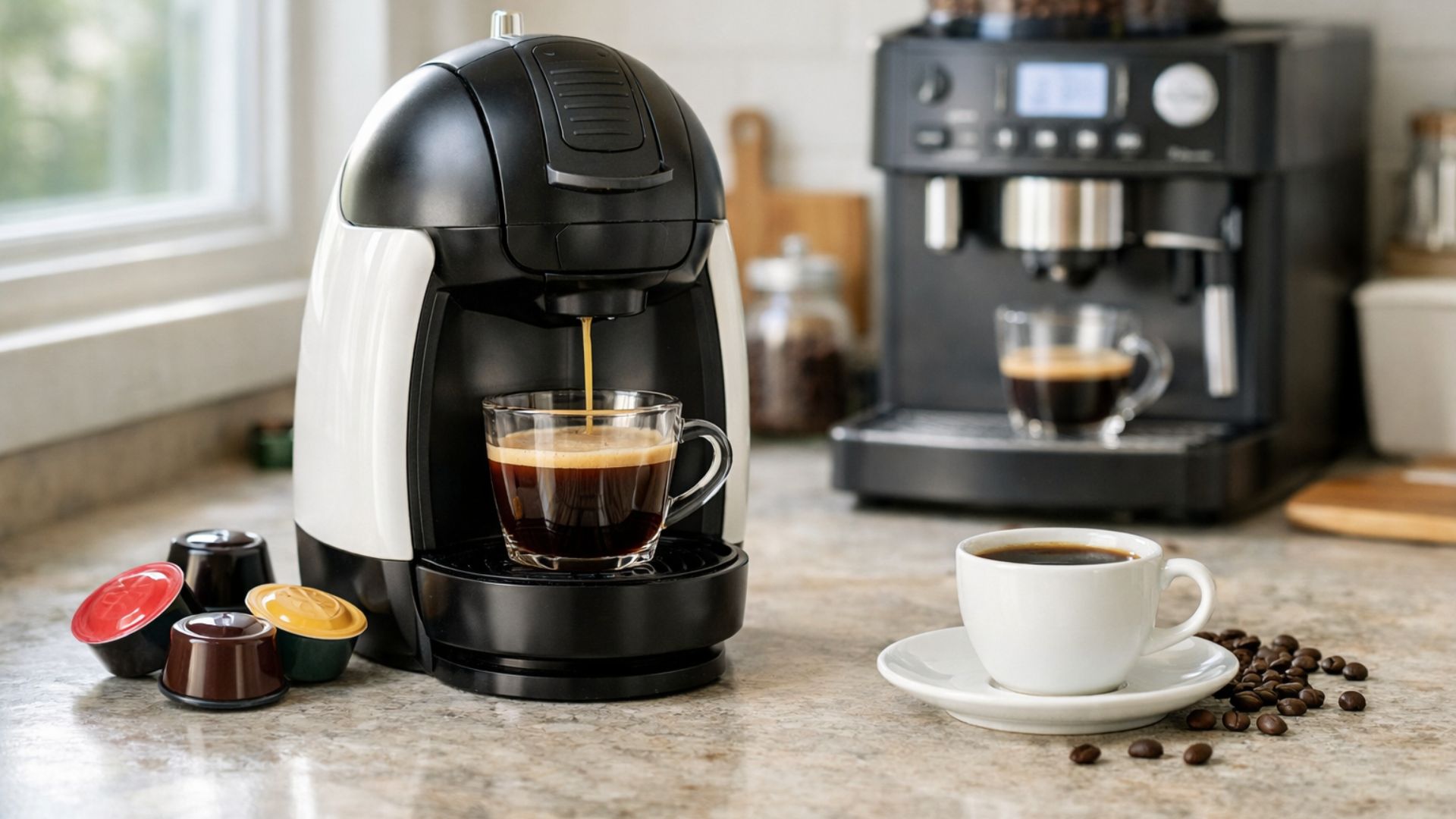
Silent change in domestic coffee consumption gains strength with machines that prioritize economy, freshness, and lower environmental impact, while consumers begin to reconsider habits in light of the accumulated cost of capsules and the search for more autonomy in preparation.
Capsule coffee machines still lead a significant part of the domestic market, but they now share space with bean-to-cup machines, which grind the beans at the time of preparation and advance precisely where many consumers have begun to weigh their purchasing decisions more: cost per cup, freedom of choice, and volume of waste.
In an updated report, Mordor Intelligence points out that capsule and pod models accounted for 38.86% of global revenue in the residential market in 2025, while bean-to-cup machines appear as the fastest expanding segment until 2031.
This change does not mean the disappearance of capsules, which remain attractive due to their speed, compact size, and simple operation.
-
The daily shower that seems harmless now worries specialists: a shower uses 6 to 15 liters per minute and is at the center of the water crisis.

-
Measuring about 44 meters in length, with a nuclear reactor and retractable wheels in its hull, the NR-1 was the only atomic research submersible in the world capable of moving along the ocean floor and remaining submerged for weeks.

-
Millions of people eat oats without knowing that this simple cereal contains a fiber called beta-glucan, which studies have linked to lower bad cholesterol and smaller spikes in blood sugar.
-
Nestlé said it always encourages people to take a break with KitKat, but the thieves took the message too far by stealing 12 tons of chocolate from a truck that disappeared between Italy and Poland.

Still, the debate has shifted from focusing solely on immediate practicality to including the accumulated expense over the months, especially in households where coffee is part of the routine more than once a day.
Cost per cup changes consumer decision
The difference becomes clear when the consumer compares the entry price with the recurring expense.
A survey by Which? calculated that, in a scenario of two espressos per day over five years, a capsule machine would cost around 1,153 pounds, while a bean-to-cup machine would be around 867 pounds, a result primarily driven by the constant cost of refills.
In the same comparison, the publication estimated that an entry-level Nespresso capsule cost 36 pence per drink, while an espresso made with ground coffee cost just over 15 pence.

In other words, the capsule coffee maker may seem cheaper on the shelf, but it loses competitiveness when the daily usage cost is calculated.
Not surprisingly, Which? itself treats the initial price as only part of the story.
In its buying guide, the organization describes bean-to-cup machines as equipment with an integrated grinder, capable of grinding coffee on demand, heating water, and preparing the drink automatically, in some cases with cleaning and milk steaming also automated.
Automatic machines reduce practicality gap
It was precisely the “one-touch” experience that transformed capsules into a consumption phenomenon in recent years.
However, this differential has become less isolated as super-automatic models have begun to combine grinding, dosing, extraction, and, in more complete versions, milk beverage preparation in an almost fully automatic flow.
A Perfect Daily Grind notes that the evolution of super-automatic machines has brought home coffee closer to a standard more associated with coffee shops, without requiring the user to have the technical knowledge of someone operating a traditional espresso machine.
Advancements in grinding, temperature control, milk texturing, and programming are at the heart of this change.
As a result, part of the convenience that previously functioned as an almost exclusive advantage of the capsule system has migrated to another type of equipment.
Instead of relying on a closed portfolio of pods compatible with a specific platform, consumers have begun to see the possibility of using their preferred beans and adjusting intensity, profile, and purchase frequency.
Environmental impact of capsules enters the debate

Another sensitive point in this comparison is disposal.
A study published in the journal Scientific Reports highlighted that conventional pods generate a waste stream that is difficult to resolve on a large scale because many are made with combinations of plastic materials, and recycling depends on the separation of components and the removal of coffee grounds.
The researchers also noted that the existence of technically recyclable capsules does not guarantee effective recycling, as the lack of accessible collection and the technological limitations of some facilities mean that many of these items end up in landfills.
In the same work, the authors observe that the small size of pods complicates industrial sorting.
In a similar vein, Wageningen University in the Netherlands states that recycling plastic capsules remains a difficult process and that, without separate collection, much of the coffee grounds associated with this system ends up incinerated.
The institution maintains that compostable capsules made from biological materials performed better in terms of circularity and carbon footprint in the study cited by its researchers.
There are also studies indicating an increase in waste per serving when preparation depends on single-serve packaging.
An article published in the Virtual Journal of Chemistry found greater waste generation per 50 mL cup using K-Cups compared to simpler methods of home preparation.
Specialty coffee and freedom of choice drive change
The advancement of bean-to-cup machines is not solely based on cost savings and disposal.
It also aligns with a phase where consumers want to experiment with origin, roast, and sensory profile with more freedom.
In this environment, machines that work with whole beans offer a greater margin of choice than closed systems based on compatible capsules.

The Specialty Coffee Association reported, in a report released in June 2025, that 64% of people aged 25 to 39 consumed specialty coffee in the week prior to the survey.
The same survey shows that specialty coffee continues to grow within the total consumption of the beverage in the United States.
This data helps to understand why the discussion about home machines has become more sophisticated.
It is no longer just about quickly making an espresso, but about deciding whether it is worth paying for the predictability of a ready refill or making room for a machine that costs more upfront but allows for bean variety and reduces usage costs.
Capsules still resist, but lose exclusivity
Even with the expansion of bean-to-cup machines, the capsule system retains objective advantages.
It takes up less space, requires less cleaning in the immediate routine, and continues to attract consumers who prioritize speed, drink standardization, and operation without adjustments.
What has changed is the relative weight of these attributes in the purchasing decision.
As more consumers compare spending per drink, dependence on proprietary inputs, and disposal, the capsule machine ceases to be the automatic answer for those seeking convenience.
In practice, the switch from one system to another reveals less of a total rupture and more of a reassessment of priorities within the domestic kitchen.
Where it once sufficed to press a button, now the cost of refills, the flexibility to choose the bean, and the concrete difficulty of dealing with the waste generated by each prepared serving come into play.




Seja o primeiro a reagir!