





 Portuguese
  English
  Spanish
  4 min of reading
  0 comments


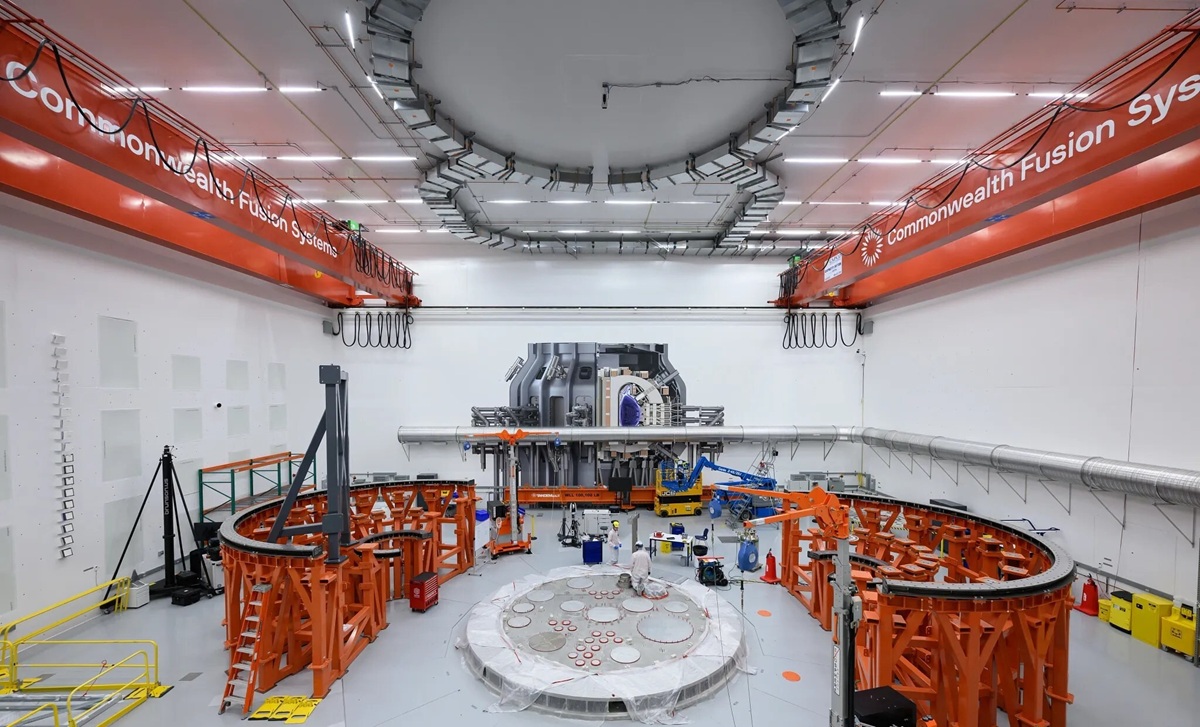
Company Will Buy 200 Megawatts from ARC Plant, First Grid-Scale, with Expected Operation in the Early 2030s
Google has announced a historic agreement with Commonwealth Fusion Systems (CFS) for the acquisition of nuclear fusion energy. The tech giant will purchase 200 megawatts of electricity from the future ARC plant, which will be located in Chesterfield County, Virginia, United States.
This is Google’s first commercial commitment to fusion energy and the beginning of a long-term bet on the technology.
First Grid-Scale Fusion Plant
The ARC will be the world’s first nuclear fusion power plant at grid scale. It is expected to begin generating electricity in the early 2030s.
-
While the world looks at oil, the war with Iran is already disrupting helium supply from Qatar, affecting car and iPhone chips, threatening AI expansion, and putting pressure on aluminum packaging at the highest value in four years.

-
Global warming will expose a treasure hidden under the ice of Antarctica and may spark an international dispute over gold and valuable minerals.

-
A street vendor from Praia Grande built a robot made of scrap from scooters and washing machines that pulls his popcorn cart on the beach, emits sounds, and interacts with customers, becoming an attraction on the coast of São Paulo.

-
The specifications of the Xiaomi 18 Pro Max have been leaked, and the highlight is a dual 200 MP camera with a new 22-nanometer technology that promises to consume less energy and capture details in shadows and bright areas using LOFIC HDR.

When fully operational, the facility is expected to provide 400 megawatts of carbon-free energy. This volume is enough to power around 150,000 homes or large industrial facilities.
Under the agreement, Google will receive half of the production from the ARC plant. The company will also have priority to purchase energy from future plants of the same type.
In addition to the energy purchase, Google is participating in a new funding round for CFS. The investment amounts have not been disclosed by either party.
Michael Terrell, head of advanced energy at Google, stated: “We are excited to make this long-term bet on a technology with transformative potential to meet global energy demand.”
Nuclear Fusion: Clean and Abundant Energy
Fusion energy is produced by merging light atomic nuclei at extremely high temperatures — above 100 million degrees Celsius. The process generates plasma and releases large amounts of energy. Unlike nuclear fission, used in traditional reactors, fusion does not emit carbon and generates less hazardous waste.
CFS is a spin-off from MIT (Massachusetts Institute of Technology) and is among the most advanced and funded companies in the fusion sector. In 2021, it raised US$ 1.8 billion in a Series B round, with support from Google itself. Now, according to CFS CEO Bob Mumgaard, the new funding round will be “comparable” in scale.
For Mumgaard, the new agreement is a strong indication of demand. “This investment allows us to carry out part of the R&D that will enable us to enter the ARC more quickly,” he explained.
Projects in Progress and Global Scaling
Currently, CFS is building the Sparc demonstration reactor in the Boston area. It is expected to be completed by 2026. After that, the commercial ARC plant will be installed near the city of Richmond, Virginia.
With the new contract, Google becomes the second major company to sign an agreement with a fusion startup. The first was Microsoft, which signed with Helion in 2023 to acquire fusion energy starting in 2028.
The bet of big tech on nuclear fusion is linked to the rapid growth of data centers, used for artificial intelligence, cloud computing, and digital infrastructure. Electricity consumption at these centers is expected to double by 2030.
“To drive all of this, we know we will need to make significant bets on this next frontier of energy innovation,” Terrell stated.
Google’s Clean Energy Plan Includes Fusion as a Long-Term Bet
According to Terrell, Google thinks about its energy strategy in three phases: short-term, medium-term, and long-term. In the short term, the focus is on solar, wind, and batteries. In the medium term, the company invests in geothermal energy and small nuclear reactors. Fusion is on the long-term horizon.
In 2024, Google acquired 8 gigawatts of renewable energy, double that of the previous year. However, even with these advancements, solar and wind sources cannot ensure a continuous energy supply, especially in locations with low solar incidence or little wind.
“There is definitely a path with wind, solar, and storage in regions where the resource is very strong,” Terrell said. However, he pointed out that areas like the southeastern U.S. or countries in the Asia-Pacific face significant challenges with these sources.
Fusion May Reduce Costs and Increase Energy Security
Expanding solar and wind generation is possible, but it can be costly. Google’s assessment is that firm technologies, like nuclear fusion, may reduce overall energy costs, even if the price per megawatt-hour is still high.
“If you have these clean, firm technologies — even if they are more expensive per megawatt-hour — incorporating them into the portfolio will actually reduce the overall costs of the portfolio,” Terrell stated.
The CEO of CFS also highlighted the advantages of fusion: “It doesn’t depend on geography or climate, and it doesn’t rely on access to special materials. It’s something you can do 24 hours a day, 7 days a week.”
Technology with Global Potential
CFS’s expectation is that, after the ARC goes into operation, the technology can be scaled globally. “We expect fusion to have a really big return because, once it is demonstrated that it is possible to do this and the first plant is operational, it will be possible to scale it. It will be possible to build this around the world,” concluded Mumgaard.
Google’s bet on nuclear fusion represents a scale shift in the search for clean and constant energy. The project with CFS could become a milestone in modern energy history. If everything goes as planned, electricity generated by fusion will be powering the company’s servers by the early next decade.








Seja o primeiro a reagir!