





 Portuguese
  English
  Spanish
  7 min of reading
  13 comments


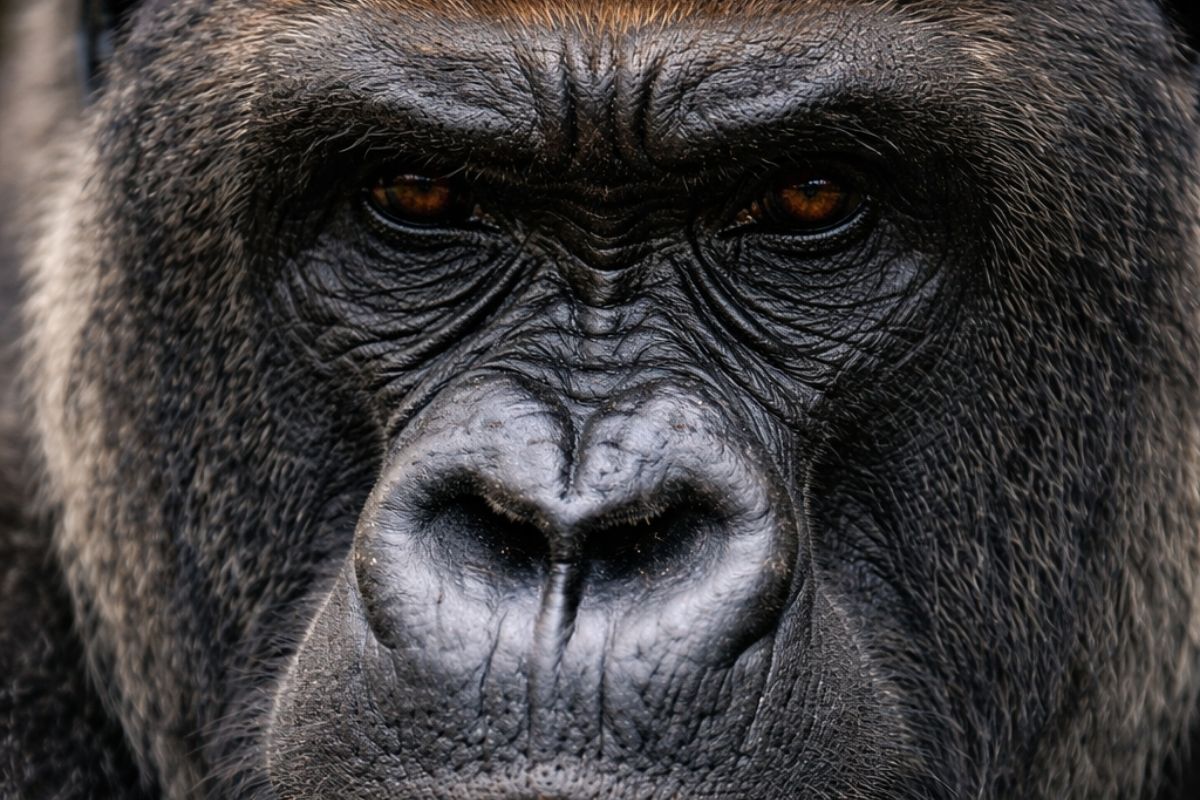


In Africa, The Gorilla Lives In Groups Led By A Silverback, Measures 1.20m To 1.80m, Can Weigh Up To 270 Kg And Has Arms Up To 2.60m. Feeds On Succulent Leaves, Rarely Drinks Water, Builds A Nest Every Day And Is Threatened By Hunting And Deforestation, With 316 Thousand In The West
The gorilla is the largest living primate and, at the same time, an animal that tends to avoid fights when there is another way to establish dominance. In Africa, where it occurs in specific regions, its size is impressive, but the survival of the group depends on routine, hierarchy, and communication to reduce the risk of confrontation.
Behind the caricature of a “monster” in films, the report from the Zoomundo channel indicates that the gorilla appears as a predominantly peaceful giant, with strong family ties, collective defense, and decisions that prioritize females and offspring. However, this social structure becomes fragile when forest, food, and territory lose stability.
Species, Subspecies, And Where The Gorilla Lives

Currently, two species are recognized: Gorilla gorilla, the western gorilla, and Gorilla beringei, the eastern gorilla.
-
Scientists have discovered a gigantic magnetic anomaly hidden beneath the soil of Australia that mirrors the shape of the entire continent and holds geological records of two and a half billion years that could change what we know about the Earth.

-
The heatwave that has been affecting Brazil in recent weeks is coming to an end: a cyclonic vortex is moving in during Holy Week with heavy rains, and a cold air mass is already threatening to lower temperatures in the South starting in April.

-
(VIDEO) Cameras from an astronomical observatory captured two meteors falling over Santa Maria in Rio Grande do Sul with only a one-minute difference and such close trajectories that scientists are now investigating whether the two objects have the same origin.

-
Fireballs shoot across the skies of the USA and meteor explosions draw attention: what is causing this mysterious wave of sightings?


Each species is divided into two subspecies, forming four lineages mentioned in the report: lowland-western-gorilla (Gorilla gorilla gorilla), Cross River gorilla (Gorilla gorilla diehli), mountain gorilla (Gorilla beringei beringei), and eastern lowland gorilla or Grauer’s gorilla (Gorilla beringei graueri).
The biogeographical distribution is described as limited.
The western gorilla lives near the Atlantic coast of Africa, including countries such as Nigeria, Cameroon, and Congo.
On the other hand, the eastern gorilla appears closer to the African rift region, in countries such as Uganda, Rwanda, and part of the Democratic Republic of Congo.
Size, Strength, And Identifying Marks Of The Gorilla

The report describes the gorilla with a typical height between 1.20m and 1.80m, but with a mass much greater than that of humans: between 100 and 270 kg, with mention of individuals reaching close to 300 kg in the wild.
The arms are long, with a wingspan of up to 2.60m, a characteristic that impacts locomotion and strength.
This strength is considered out of the ordinary: males can lift up to about 4 times their own body weight, while adult men would lift on average only 1 time their own weight or less.
Additionally, the gorilla has unique fingerprints for each individual, a biological detail that reinforces the closeness to other great primates.
The report also mentions a blood type characteristic: apparently, gorillas would only have type O, and not the complete ABO system cited for other hominids.
Evolution, Hominidae Family, And A Rare Fossil

The gorilla is part of the Hominidae family, alongside orangutans, chimpanzees, and humans.
The report indicates that the gorilla lineage separated from the lineage that would lead to humans about 7 million years ago.
It also mentions that the Homininae subfamily may have emerged around 12 million years ago, and that between 7 and 8 million years ago, the lineages of gorillas, chimpanzees, and humans would have diverged.
There is an important observation regarding fossils: more fossils of the human lineage are known than of the gorilla and chimpanzee lineages.
In the case of the gorilla, Chororapithecus appears, discovered between 2005 and 2007, represented by only nine isolated teeth, still with debate about its exact position on the evolutionary tree, although many researchers consider it close to gorillas.
Group Life, Silverbacks, And Territory Protection
The gorilla typically lives in groups with several females, offspring, and a dominant male called “silverback” or silverback, because the hair on their backs turns gray as they mature.
The report mentions that, although the common presence is of one silverback at a time, up to eight mature males have been reported in the same mountain gorilla group, suggesting greater tolerance among males in this subspecies, with a possible gain in collective protection.
The social cycle is also detailed.
Around 12 years, a male gorilla may mature and leave the natal group, seeking to form a new harem with migrating females from other groups to become a new silverback.
In other cases, the male remains as a subordinate until the dominant one dies, trying to replace him afterward.
After the death of a silverback, the report describes that females and offspring often disperse in search of another protector, but there are also records in which females remained united until the arrival of a new leader, reducing the vulnerability of offspring.
Diet, Why The Gorilla Rarely Drinks Water, And Where Water Comes In
The gorilla’s diet is presented as predominantly plant-based.
It feeds on foliage, including leaves, branches, and shoots, with fruit in smaller amounts.
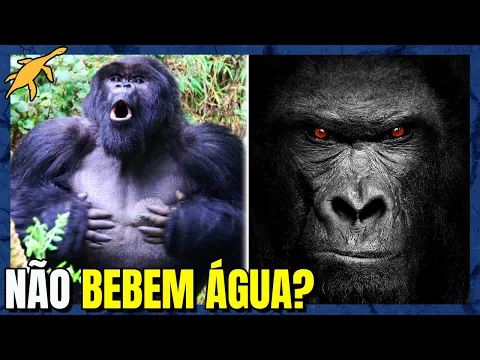
The central point is that the gorilla rarely drinks water, because the consumed leaves are succulent and, along with morning dew, cover a large part of its water needs.
Still, there are records of mountain and plains gorillas occasionally drinking water from rivers and lakes.
The report also differentiates subspecies: eastern lowland gorillas would include more fruit than any other population, while lowland western gorillas would be the most associated with the consumption of insects, including ants and termites.
Even so, the axis remains the same: water usually comes from what the gorilla eats.
Daily Nest, Long Sleep, And The Routine On The Forest Floor
The nest is one of the most striking routines.
The gorilla builds a nest to sleep using branches and leaves and makes a new nest every day, even when the old one is still nearby.
Unlike chimpanzees and orangutans, the gorilla would sleep on the ground, not in trees, which makes the choice of the nest site a gesture of safety and strategy.
The duration of sleep also stands out: the gorilla sleeps around 12 hours a day, above the human standard mentioned in the report.
Practically, this means that the stability of the territory and access to food and water are decisive to maintain this daily routine of rest, nesting, and movement.
Communication, Vocalizations, And The Chest Beating
The gorilla’s communication is described as less complex than that of chimpanzees and, obviously, humans.
Still, the survey points out 25 different types of vocalizations, used mainly when the group is out of visual contact, such as when passing through dense forest.
The most well-known gesture is the chest beating, usually accompanied by vocalization, something that may seem intimidating to observers.
The report emphasizes that the reason is not fully understood, but the cited hypotheses include demonstration of strength and dominance status, allowing individuals to establish dominance without resorting to dangerous fighting, reinforcing the idea that the gorilla tends to avoid fights when there is an alternative.
Chimpanzees, Leopards, And The Risks On The Territory Border
In nature, the natural predator cited for the gorilla is the leopard, capable of attacking young individuals and also feeding on carcasses. Direct attacks on adults are described as unlikely.
The most sensitive conflict, however, appears with chimpanzees.
The report states that gorillas and chimpanzees can coexist peacefully when there is enough food and that, in resource-poor areas, chimpanzees would tend to consume more fruit, while the gorilla would stick to foliage.
Still, episodes from 2021 involving groups of chimpanzees with 27 individuals attacking groups of gorillas with 5 and 7 individuals, resulting in the death of infants and injuries to chimpanzees in one of the cases, are cited.
The suggested scenario is territorial disputes among primates, in a region where food and space may vary over time.
Tools, Learning, And Sign Language
The gorilla is described as intelligent and capable of making and using tools.
The report cites the use of branches to cross swampy areas and pieces of wood as a bridge, as well as cultural variations associated with different ways of preparing food and making tools.
It also mentions a record from 2005 of a young gorilla using stones to crack nuts in a sanctuary, another example of tools in an observed situation.
In captivity, the most emblematic case cited is that of Koko, a western lowland gorilla who lived until 2018.
She reportedly learned over 1000 signs of an adapted sign language and understood over 2000 words in English, with a record of a visit from actor Robin Williams in 2001.
The central point is that, under specific conditions, the gorilla can expand its communication repertoire, without erasing the differences between animal communication and human language.
Longevity, Extreme Cases, And The Weight Of Conservation
The gorilla typically lives around 30 to 40 years and, in captivity, can exceed 50. The report cites two recent records, with deaths in 2017 and 2022 at 60 and 61 years.
The case of Snowflake, the only known albino gorilla, who died in 2003 at 39 years at the Barcelona Zoo, with vision problems and death from skin cancer associated with albinism, as well as the record of his family being killed by a hunter in Equatorial Guinea, also appears.
In conservation, the cited numbers are straightforward: about 316 thousand western gorillas and only 5 to 8 thousand eastern gorillas are estimated.
Therefore, the report states that all species and subspecies of gorillas are treated as threatened or critically endangered, with hunting, meat consumption, and deforestation as dominant vectors.
When The Forest Disappears, Water Becomes Detail And The Nest Loses Safety
When the forest loses continuity, the gorilla loses food, loses material for nest, and loses corridors for movement.
The water, which usually comes from succulent leaves and dew, begins to depend more on access to rivers and lakes, which may require crossings through more exposed areas, increasing the risk of encounters with humans and territorial tension.
The result is a cycle of vulnerability: less forest, less safe nesting, more pressure on family groups, and a greater chance of forced contact with chimpanzees in compressed areas.
For a gorilla that depends on routine and group protection, the instability of the environment weighs as heavily as predators, because it impacts the basics: eating, resting, obtaining water, and keeping offspring alive.
Which part of the gorilla’s life surprises you the most: not needing water, building a nest every day, or being able to use tools while living under the threat of extinction?







A falta de vida livre, sem ser perseguido. Assim como todos os outros animais eles compõem a natureza livre. Necessitam de respeito e proteção com urgência.
O que mais me surpreende é o Botafogo achar que o Flamengo é rival
Conheci gorilas na Guiné Equatorial e no Gabão. Faltou citar aí pois nos parques de Monte Allen na GE e no Park de lá Lope no Gabão, a presença de gorilas é importante.