





 Portuguese
  English
  Spanish
  4 min of reading
  2 comments


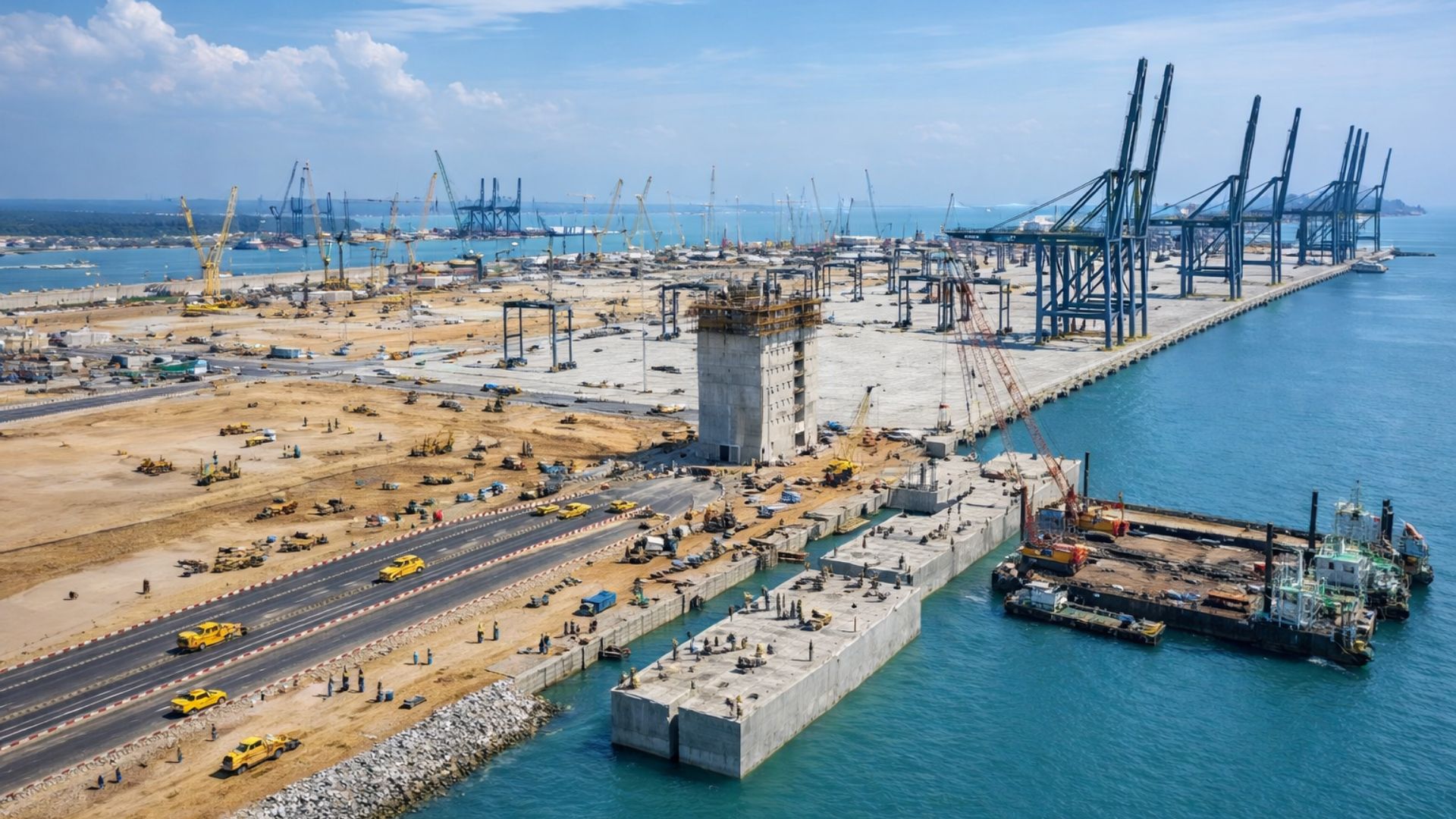


Project Focuses Logistics Ambition, Large-Scale Engineering, and Advanced Automation in a Single Port Complex Designed to Reorganize Singapore’s Maritime System, Expand Transshipment Capacity, and Sustain the Country’s Competitiveness on One of the Most Strategic Trade Routes on the Planet.
Singapore, one of the smallest nations in the world in terms of land area, decided to focus a central part of its economic strategy on a global-scale project: the Tuas Megaport, in the west of the island.
The project, developed in phases and expected to be completed by the 2040s, is designed to bring together a large portion of the container operations currently spread across different terminals into a single complex.
The stated goal is to achieve 65 million TEUs per year and 66 berths when all phases are completed.
-
Spain surprises the world by erecting 62 artificial dunes, mixing sand with natural remains of posidonia, and causing the structure to lose only 1.4% of its volume in 1 year.

-
With 16 Bulava missiles, improvements in acoustic stealth, and a design focused on silent patrols, Russia’s nuclear submarine was born to ensure Moscow’s invisible retaliation and has become one of the pillars of its maritime strength.

-
‘Populous’ city in Rio among the worst in Brazil in national ranking and exposes silent development crisis.
-
Couple buys house in the South Zone of São Paulo, opens a hidden door in the garage, and finds a secret wine cellar with dozens of old wines forgotten since the 1970s.
In practice, this constitutes a structural reconfiguration of Singapore’s port system.
Instead of maintaining fragmented terminals, the proposal is to concentrate the movement at Tuas, featuring a highly automated operation, use of autonomous vehicles in the internal area, and digital integration to coordinate ships, yards, and equipment.
Strategic Location and Role in Global Trade

The geography helps explain the scale of the investment.
Singapore is positioned next to the Strait of Malacca, one of the busiest shipping routes in the world, connecting the Indian Ocean to the Pacific.
A large portion of the trade between the Middle East, Africa, Europe, and East Asia passes through this corridor.
With limited natural resources and severe space constraints, the country has turned logistics, port services, and operational efficiency into central pillars of its economic competitiveness.
Since the second half of the 20th century, the maritime sector has been treated as a strategic infrastructure for the country’s survival and growth.
Over the decades, this positioning has consolidated Singapore as one of the world’s major transshipment hubs.
With the expansion of global trade and the increasing size of ships, existing terminals began to face physical and operational limits.
The decision to build Tuas emerged as a direct response to these constraints.
Consolidation of Terminals into a Single Megacomplex

Before the project, container operations were spread among areas like Tanjong Pagar, Keppel, Brani, and Pasir Panjang.
The Tuas Megaport was conceived to gradually absorb these activities, reducing internal movements and simplifying logistical planning.
The design of the port includes structures in the shape of “fingers” that extend over the sea, separated by deep-water channels.
This arrangement expands berthing fronts and accommodates the largest container ships in operation.
The terminal officially began operations in September 2022.
Since then, capacity has been gradually expanded as new areas are delivered.
Land Reclamation, Soil Elevation, and Coastal Protection
The construction of the Tuas Megaport required one of the largest land preparation projects ever undertaken in the country.
The plan involves large-scale land reclamation and soil improvement to create a foundation capable of supporting large port structures.
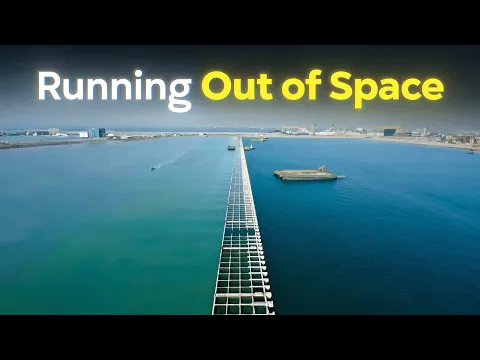
The ground level was raised several meters above the mean sea level as a preventive measure against the risk of rising ocean levels in the coming decades.
Concurrently, a continuous breakwater system was implemented to protect the port against strong waves and ocean currents.
Concrete Caissons and Precision Engineering
One of the central elements of the work is the use of prefabricated concrete caissons.
These structures function as retaining walls and the foundation of the docks.
Each unit can be around 28 meters tall and weigh up to 15,000 tons.
The caissons are constructed on solid ground, transported by floating platforms, and positioned with millimeter precision at the final location.
Once aligned, they form continuous segments that protect the port and create new operational areas.
The choice of this method allows for standardization, greater quality control, and speed in installation, provided there is strict coordination at all stages.
Automation, Data, and Artificial Intelligence at the Center of Operations

The Tuas Megaport was designed from the outset to operate with a high degree of automation.
Quay and yard cranes, as well as autonomous vehicles responsible for the internal transport of containers, operate in an integrated manner.
The operational logic is coordinated by digital systems that analyze data in real-time.
These systems set berthing priorities, movement sequences, and equipment allocation.
The main objective is to reduce wait times, increase predictability, and maintain a steady operational pace.
In this model, workers primarily take on supervisory, maintenance, and exception management roles.
The expected result is an operation capable of functioning 24 hours a day with less sensitivity to climatic variations or labor changes.
Projected Capacity and Regional Impact
When fully completed, Tuas is expected to reach an annual capacity of up to 65 million TEUs.
By comparison, Singapore’s port system already operates above 40 million TEUs per year, according to data released by port authorities.
The expansion aims to ensure that the country maintains relevance in the face of growing competition from other Southeast Asian ports.
By concentrating operations in a single intelligent megaport, Singapore aims to reduce transshipment times and reinforce its position as a global logistics hub.
In a scenario of supply chains pressured by costs, geopolitical instability, and technological changes, the hope is that efficiency and predictability remain decisive differentiators.






Crescimento de emprego na cidades vizinha ganha com este projeto do Porto
Meu Deus. Que Headline LIXO! Singapura usa Real ? BRL? Moeda brasileira? Se você que alguém investiu alguma soma em Reais, se infere que seja no Brasil. Mais uma , como milhares de matérias, feita só para ganhar clique…..