





 Portuguese
  English
  Spanish
 5 min of reading
  33 comments


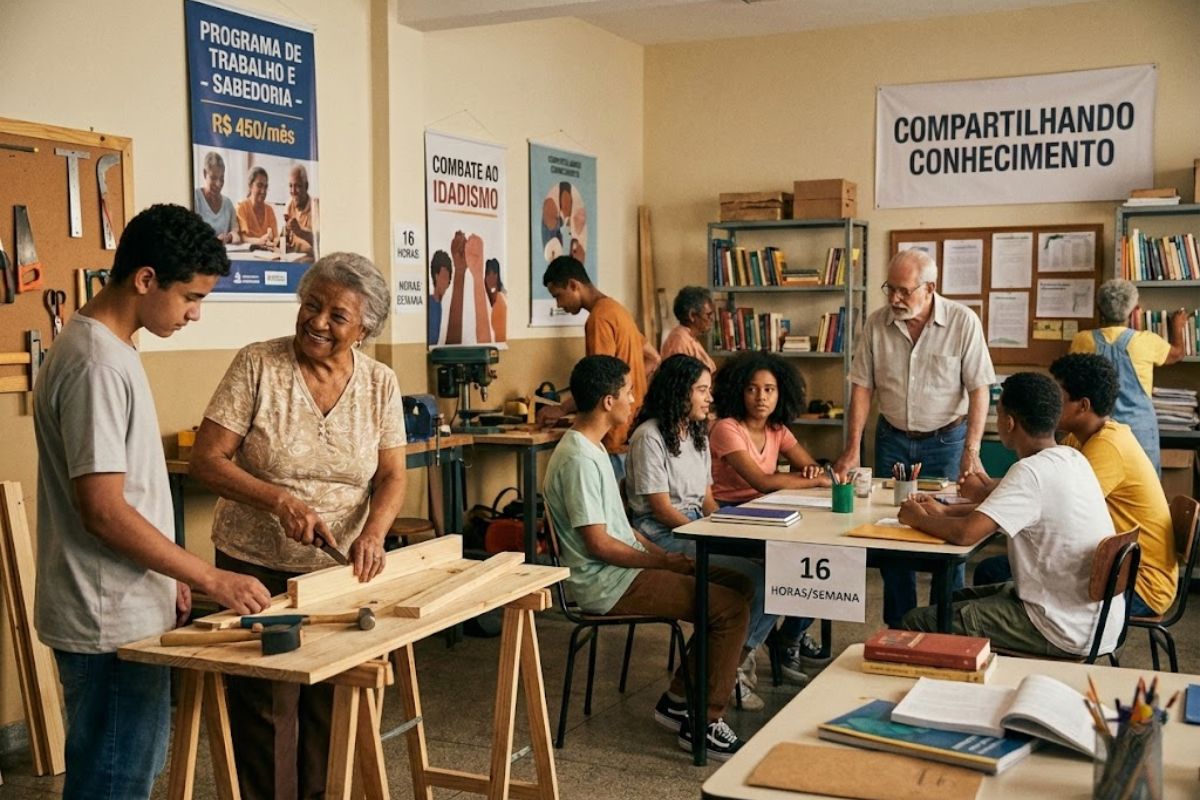


The Paraná Friend of the Elderly Program Launched the Agent of Knowledge Grant, Paying 450 Reais Per Month for Elders Selected by the Open University for the Elderly, in Actions to Combat Ageism and Strengthen Community Bonds in Paraná for the Whole State.
On December 2, 2025, Governor Carlos Massa Ratinho Junior signed decree 12.097/2025 that creates and regulates the Agent of Knowledge Grant, a program that compensates elders in socioeconomic vulnerability to act in their communities and share accumulated knowledge throughout their lives. The initiative is part of the Paraná Friend of the Elderly Program and is managed by the Secretariat for Women, Racial Equality, and Elderly People, Semipi.
In practice, the new program transforms elders into Agents of Knowledge, with a monthly grant of 450 reais for up to 12 months, extendable for an equal period, in exchange for 16 weekly hours of activities in public agencies, entities, and community spaces. The proposal is to use the experience of these elders as a structured tool to strengthen local bonds and combat ageism throughout Paraná.
How Much the Elders Receive and How the Agent of Knowledge Grant Works
The Agent of Knowledge Grant provides for the payment of 450 reais per month to each participant, for an initial period of up to 12 months, with the possibility of extension for an additional 12 months, according to the criteria defined by decree 12.097/2025.
-
Brazil produces too much clean energy and doesn’t know what to do with it: over 20% of solar and wind capacity was wasted in 2025 while investors flee and 509 renewable generation projects were abandoned in the last year.

-
Piauí will produce a new fuel that replaces diesel without needing to change anything in the truck’s engine and reduces pollutant gas emissions by half: truck drivers from all over the Northeast are already celebrating the news that will arrive later this decade.

-
A new Brazilian shopping center worth R$ 400 million will be built in an area equivalent to more than 4 football fields, featuring 90 stores, 5 cinemas, a supermarket, a college, and parking for 1,700 cars, potentially generating 3,000 jobs.

-
Larger than entire cities in Brazil: BYD is building a 4.6 km² complex in Bahia with a capacity for 600,000 vehicles per year, but the discovery of 163 workers in conditions analogous to slavery has shaken the entire project.


In return, the elders will work 16 hours per week, in shifts planned to avoid confusion with traditional employment relationships.
According to the regulation, the focus is to create a stable instrument of recognition for the knowledge of elders, without substituting existing professionals in public service or in partner organizations.
Therefore, the work of the Agents of Knowledge is linked to an Individual Social Asset Development Plan, a document developed with technical support from the Open University for the Elderly, Unapi, which organizes goals, activities, and responsibilities of each participant.
Who Are the Elders That Can Participate in the Program
The decree defines a specific target audience.
To access the grant, a person must be elderly, 60 years or older, have preserved autonomy, and be in a situation of socioeconomic vulnerability, proven by registration and an updated record in CadÚnico.
The idea is to prioritize elders who have both life experience and a concrete need for financial support.
There is also a requirement for minimum education.
Beneficiaries must have completed the initial years of Elementary School, from 1st to 5th grade, which allows them to follow formative activities and record content.
Another criterion is to have participated, or be participating, in training offered by the Open University for the Elderly in the last 12 months, which ensures that these elders are already included in ongoing training processes.
Role of Unapi and Universities in the Training of Elders
Unapi is a program developed by the Secretariat of Science, Technology, and Higher Education, SETI, in partnership with Semipi and the State University of Paraná, Unespar.
In this arrangement, it is the responsibility of Unapi to offer specific training for elders, combining content on memory, culture, citizenship, education, and social technologies.
These trainings serve as an entry point and methodological basis for the work of the Agents of Knowledge.
Elders who have gone through Unapi arrive at the program already prepared to act in community spaces, facilitating workshops, conversation circles, life story recording, and other activities outlined in individual plans.
The university structure also provides technical support for evaluating and monitoring the experience.
How the Elders Will Be Selected in the Municipalities
The selection of participants will be the responsibility of the Municipal Commissions of the Agent of Knowledge, COMAS, which must be created by each city hall interested in joining the program, following Semipi’s guidelines.
These commissions will be responsible for analyzing documents, verifying information, applying eligibility criteria, and defining priorities, always respecting the defined socioeconomic vulnerability criteria and other required requirements.
In the initial phase, only municipalities that have already joined Unapi and have structured units of the Open University for the Elderly will be able to receive the program.
Resolutions 216/2025 and 217/2025 detail that only cities that meet the criteria set by the Secretariat and have these structures have the minimum technical conditions to start the new phase.
The expansion to other municipalities will be gradual and contingent on the local capacity to support elders.
What Type of Work the Elders Will Develop in the Communities
The Agents of Knowledge will work in public agencies, entities, and community spaces, always within a load of 16 hours per week.
The activities may involve interaction, culture, education, memory, handicrafts, storytelling, and other actions that value the life experiences of the elders, in formats adapted to each municipal reality.
The regulation makes it clear that the work of these elders does not substitute for teachers, social workers, educators, or other existing professionals.
Instead, the Agents of Knowledge should complement policies and services, offering the community the perspective of those who have accumulated decades of experience, local culture, and territorial bonds.
The goal is to turn stories and knowledge into concrete inputs to strengthen support networks and generate new practices of coexistence.
Combating Ageism and Valorization of the Knowledge of Elders
In the program’s justification, Semipi emphasizes that the Agent of Knowledge Grant aims to value what the elderly have built throughout their lives, preventing this intangible heritage from becoming invisible.
At the same time, the design of the benefit seeks to combat ageism, that is, prejudice and discrimination based on age, still present in various social spaces.
According to the secretariat, elders still have much to contribute to society, and the public policy formally recognizes this capacity by offering a specific grant, defined tasks, and institutional support.
The combination of compensation, ongoing training, and monitored activity in collective spaces aims to transform these elders into local protagonists, rather than just passive recipients of assistance services.
Next Steps and Challenges to Consolidate the Program
In this first stage, the main challenge will be to structure the COMAS, organize the training offerings of Unapi, and ensure that municipalities have the technical capacity to support the elders.
The gradual expansion to other locations depends not only on budgeting but also on physical infrastructure, reference teams, and coordination with networks of social assistance, culture, and education.
Another critical point will be measuring results.
To consolidate as public policy, the Agent of Knowledge Grant will have to demonstrate concrete impacts on the quality of life of elders, reduction of isolation situations, and real progress in combating ageism. Indicators of community participation, strengthening family ties, and engagement in collective activities should guide future decisions about the expansion or adjustments in the program design.
In your opinion, programs that pay grants for elders to share their knowledge in communities are sufficient to combat ageism, or do they still need to be combined with other protection and inclusion policies?








Acho um absurdo, a pessoa idosa já trabalhou,estudou,criou seus filhos. Cumpriu seu papel na sociedade .
Seus ultimos anos de vida é pra viver junto com seus familares.
Fazer idosos trabalha é uma maneira de esploração. Vergonha
Olha e top ….sempre acreditei o Idoso tem muito a ensinar. Gostaria saber mais.
Acho ridículo, péssimo, mais um peso para o presidente,os filhos que cuidem dos seus idosos,!!!!!!
Mais uma falcatroa, pra roubarem dinheiro do governo!!!!
Simplesmente rídiculo.