





 English
  Francês
  Alemão
  Italiano
  Japonês
  Norueguês
  Portuguese
  Spanish
  4 min of reading
  0 comments


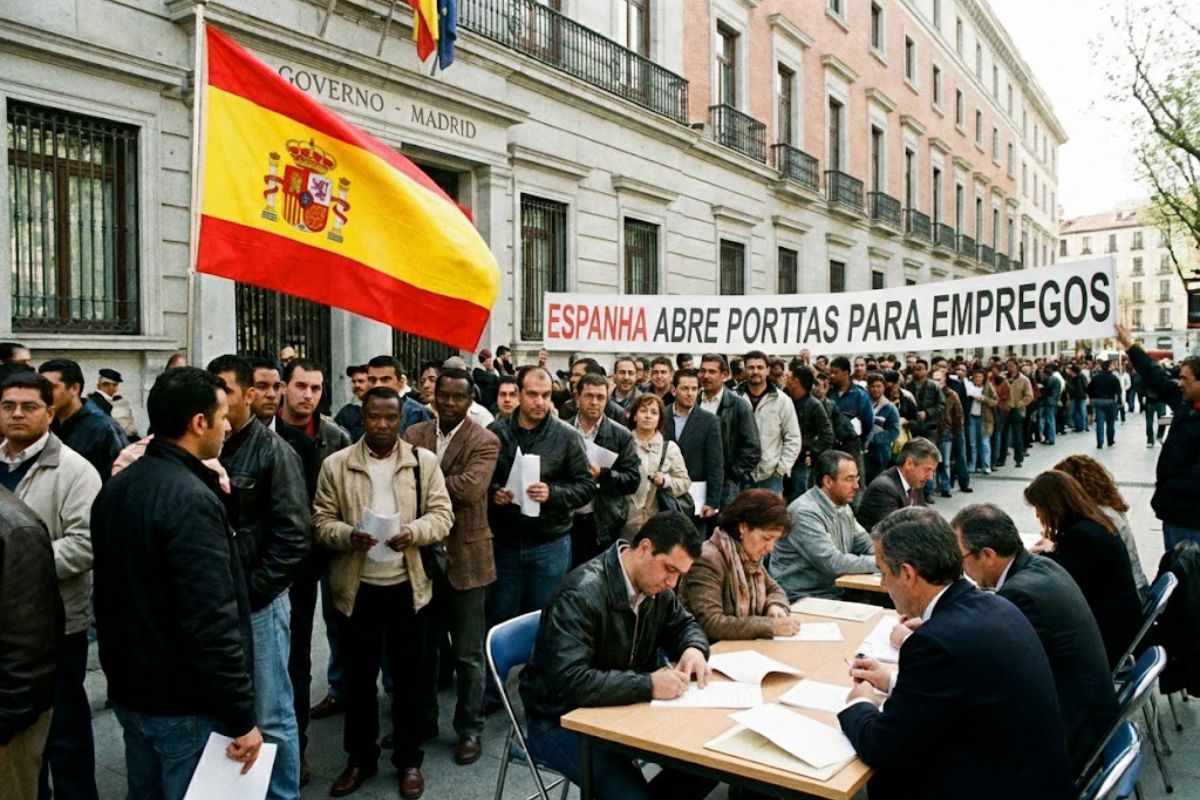
With Royal Decree, Spain Announced Regularization of About 500 Thousand Undocumented Immigrants, As Long As They Arrived Before December 31, 2025, Prove Five Months of Residence and Have No Criminal Record. Requests Can Be Made From April to June, Focusing on Work and Social Integration
Spain has put on the table a decision that changes the lives of thousands of people and, at the same time, meets a concrete demand from the market. Under the government of Prime Minister Pedro Sánchez, Spain announced the regularization of about 500 thousand undocumented immigrants, many coming from Latin America.
The measure combines residence and work as the central axis and has been presented as a direct response to two pressures that go hand in hand: reducing informality and filling vacancies in sectors that rely on foreign labor. In practice, Spain is trying to put on paper those who are already part of the economy’s daily life.
What Spain Is Regularizing and By Which Instrument
Spain announced the initiative through a royal decree, promising to grant residence and work permits to those who meet the criteria.
-
Chinese giant worth nearly R$ 4 billion that manufactures cables for electric cars, solar energy, and robotics wants to open a factory in SC.

-
Many employers do not know, but the law guarantees domestic workers a 25% increase in salary during trips, 50% for overtime, 20% for night shifts, and 17 additional benefits that can lead to labor lawsuits if not paid.

-
Gasoline prices soar and the question arises: is ethanol more advantageous? The 70% rule reveals the limit with gasoline.

-
The government has made a decision and is starting a test with more ethanol in gasoline, anticipating a mixture of up to 35%, diesel with 25% biodiesel, and a study to assess the impacts on engines.


The declared objective is to socially integrate and strengthen the economy by formalizing ties that currently operate outside the rules.
From an economic perspective, Spain views regularization as a tool to bridge the gap between need and supply.
Instead of relying solely on new arrivals, the government aims at those who are already in the country and seeks to transform presence into regular contribution, with contracts, contributions, and formal access to the market.
Who Can Apply, What Dates and What Requirements Are Involved
Eligibility in Spain has been tied to three objective criteria.
The person must have arrived in the country before December 31, 2025, prove residence for five months, and have no criminal record.
The time frame and the documentary package serve as a filter, focusing on recent and verifiable permanence.
The application window has also been set: from April to June 2026.
This framework makes the deadline a sensitive point, as the interested party needs to gather proof of residence and regularity before filing.
In parallel, Spain has indicated that the measure aims to prevent administrative instabilities from harming those who were already part of the flow of work and residence.
Why Spain Links Immigration to Tourism, Agriculture, and Essential Services
Spain recognizes an annual dependency on about 300 thousand foreign workers, with a greater emphasis on agriculture, tourism, and services.
The reasoning is straightforward: these sectors operate with seasonality, high demand for labor, and routines that require constant replenishment of personnel, including in operational roles.
By connecting regularization to these segments, Spain signals that the problem is not abstract.
It is a practical scarcity, at the counter, in the field, and in service, where the lack of workers creates production bottlenecks and pushes hiring into informality.
Regularization, in this scenario, serves as an attempt to stabilize supply and reduce the social cost of a parallel market.
Informality, Contributions, and the Effect on Social Security
Regularization in Spain has been presented with an additional ambition: to tackle the informal economy.
When work remains outside of formalization, there are two immediate effects: the worker becomes more vulnerable, and the state loses revenue, especially in contributions linked to social security.
The government points out that formalization increases contributions to social security and improves the predictability of the system in an expanding economy.
The thesis is that the same work, when regular, helps sustain public policies, as well as reducing disputes and fraud associated with fragile and hard-to-audit ties.
What Divides Politics in Spain and Why Europe Enters the Debate
The decision has sparked criticism from conservative parties, who argue that regularization could encourage illegal immigration and divert focus from internal problems.
This type of reaction exposes the most sensitive point: the fear of “invitation effect,” even when the government claims there are criteria and cutoff dates.
On the other hand, Spain maintains a discourse of human rights and social inclusion, contrasting with European countries that are tightening migration policies.
The measure becomes an ideological marker in Europe, with Spain positioning itself as a relevant entry route while also trying to control what is already happening within its territory.
In 2025, Spain itself indicated that immigrants represented almost 20% of the country’s total population.
In your daily life, do you think regularizing those who are already working is a practical solution or a dangerous incentive? If you had to choose one criterion for Spain to prioritize, would it be length of residence, work sector, or contribution history, and why?









Seja o primeiro a reagir!