





 Portuguese
  English
  Spanish
  4 min of reading
  0 comments


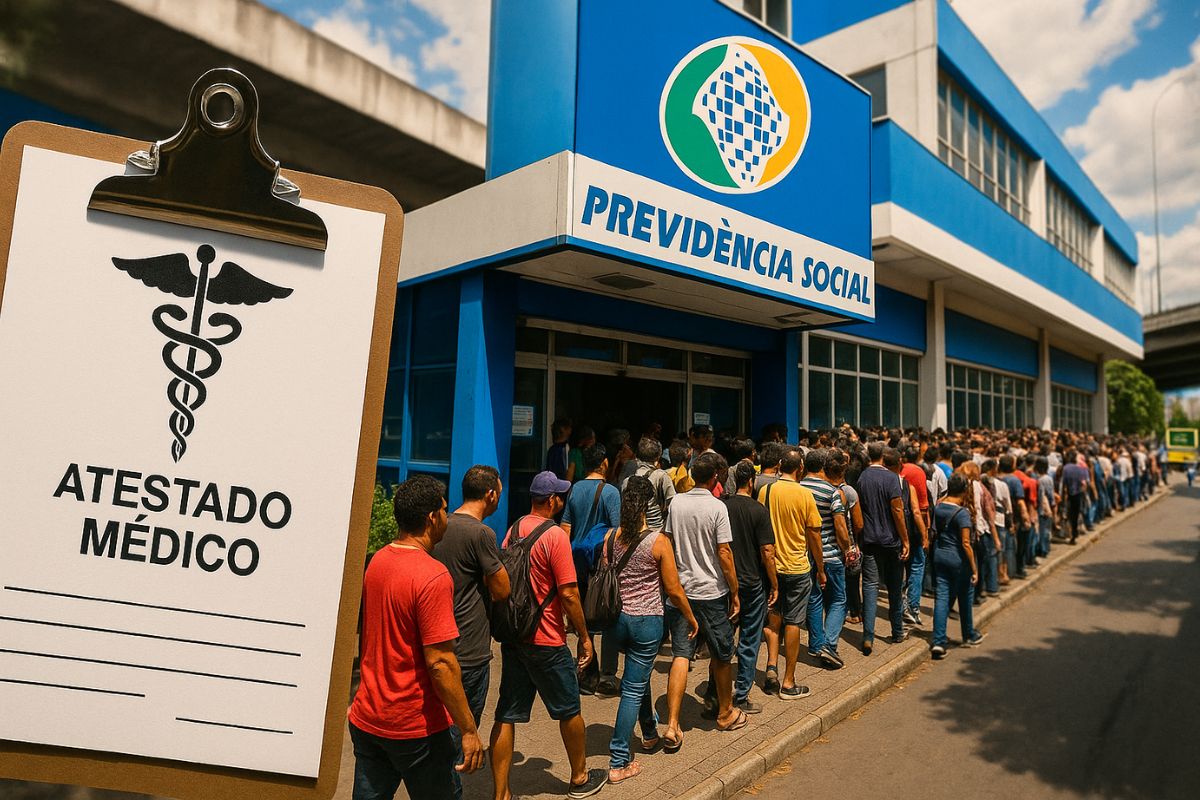
Government Changes Sick Leave Benefit Rules: Granting Based on Medical Certificates Decreases to 30 Days (With Temporary Exception of 60) and Medical Expert Returns to the Center of Decisions.
Government changes sick leave rules and restricts the duration of leave granted only through document analysis (Atestmed). Provisional Measure No. 1,303/2025 set a 30-day limit for the benefit without an in-person medical examination; after this period, the insured person is required to undergo evaluation by an INSS medical expert either in person or via telemedicine.
In exceptional circumstances, a joint ordinance temporarily increased the Atestmed limit to 60 days, valid for 120 days starting from June 2025 (until October 16). After this deadline, the limit returns to 30 days. The change reopens a sensitive debate: speed vs. security and the expectation of additional pressure on the INSS queue.
What Changes in Practice
Under the permanent rule, Atestmed only covers up to 30 days of leave based on documents (certificates and reports).
-
The Senate approves a bill that criminalizes misogyny, hatred, or aversion towards women, and includes the crime in the Racism Law with a penalty of up to 5 years.

-
Chamber Approves Bill That Allows Pepper Spray for Women Over 16 and Imposes Strict Rules for Purchase, Possession, and Use as Self-Defense

-
Chamber Approves Law to Combat Leucaena, Fast-Growing Plant That Dominates Land and Threatens Native Species in Various Regions of the Country

-
Asset Division: Know What Cannot Be Divided in Case of Divorce


If the incapacity exceeds this period, a medical examination becomes mandatory for the continuation of the benefit. This is the central change of the new framework.
Until October 16, 2025, by exception, the limit is 60 days through document analysis. Attention: this “breathing space” is temporary.
Those who need an extension beyond the current limit should already seek to schedule the examination to avoid payment interruption.
Why the Rule Was Changed
Atestmed was created during the pandemic to avoid crowds and streamline care when examinations were suspended.
Over time, it was expanded and, in some cases, allowed up to 180 days without an in-person evaluation, accelerating grants in simple and predictable cases.
MP 1,303/2025 shrinks this space, citing the need for cost control and greater rigor in long-term leaves.
At the same time, the measure mentions fraud prevention and standardization of criteria with subsequent reinforcement of telemedicine examinations as a controlled alternative. In practice, the expert returns to arbitrate the continuity of the benefit in prolonged cases.
Expected Impact on INSS Queues
The official promise is to reduce bottlenecks by focusing examinations on truly prolonged and complex cases.
However, there is an inverse risk: with the cut of Atestmed to 30 days (after the exception), more people will have to go for examinations, which may further pressure the schedules.
Experts and organizations warn that already long queues could “explode” if the capacity for service does not grow in proportion.
Without reinforcement of experts, extended hours, and effective triage, the restriction could delay grants and interrupt benefits due to logistics, not medical merit.
How In-Person and Telemedicine Examinations Work
In-person examinations remain the standard for leaves exceeding the documentary limit.
Complete documents, CID, suggested leave duration, and updated tests speed up analysis and reduce additional demands.
The telemedicine examination has been reinforced by the MP as a possibility in certain scenarios. It is not an automatic right, depending on operational and eligibility criteria.
For the insured, it means a second option for continuing the benefit without travel when available.
Insured Rights and Steps to Avoid Losing the Benefit
1) Organize your medical file. Readable certificate, with CRM, CID when possible, leave period, signature, and contact of the doctor, plus reports, tests, and clinical evolution.
The quality of documents weighs in the decision.
2) Watch the clock. If the leave will exceed the current limit (60 days until 10/16, then 30), schedule the examination in advance.
Do not let it expire: interruption for duration is common and avoidable.
3) Attend (or connect) on the date. Missed the examination? Justify immediately and request rescheduling.
Absence without justification may suspend payments.
4) Appeal is a right. Denied? Request reconsideration with new documents.
If it persists, file an administrative appeal. Robust and coherent documentation increases the chances.
Timeline of Atestmed
The Atestmed was emergency in 2020, gained traction in 2023–2024 to alleviate queues and allowed up to 180 days without examination.
In June 2025, with MP 1,303/2025, the limit falls to 30 days as a permanent rule.
Shortly after, Joint Ordinance MPS/INSS No. 60/2025 temporarily increased to 60 days for 120 days (until 10/16/2025).
Once the deadline is over, the limit returns to 30 days. The focus of the policy shifts from speed to control, especially in long leaves.
Who Gains and Who Loses from the Change
Control wins: continuity of aid beyond the deadline requires examination, reducing decisions based solely on paperwork in long cases.
Technical transparency wins when direct clinical evaluation is essential to gauge incapacity and leave duration.
Fluidity loses: legitimate cases requiring more than 30/60 days may face additional waiting.
Without capacity reinforcement, workers risk being without income while awaiting examinations. The critical point is operational, not legal: queue and schedule.
What to Observe Moving Forward
Examination capacity (hiring, task forces, tele-examinations), quality of certificates (including validation on official platforms), and management of deadlines will be decisive.
If the supply of examinations does not grow, friction with the insured is likely to increase and litigation may rise again.
For companies, internal occupational health policies and early case monitoring can prevent longer leaves and support the worker in compiling the medical file.
Prevention and rehabilitation are the best strategy in light of stricter rules.
Government changes sick leave rules and pulls the brake on Atestmed. Have you ever needed the benefit? Did you manage to resolve it only with a certificate or did you encounter the expert examination? In your view, does the new limit provide more security or just increase the queue?
Tell us in the comments how this impacts your life, your company, or your practice. We want to hear from those who live by the rule on a daily basis.










-

-

-

-

-

-

70 pessoas reagiram a isso.