





 Portuguese
  English
  Spanish
  3 min of reading
  0 comments


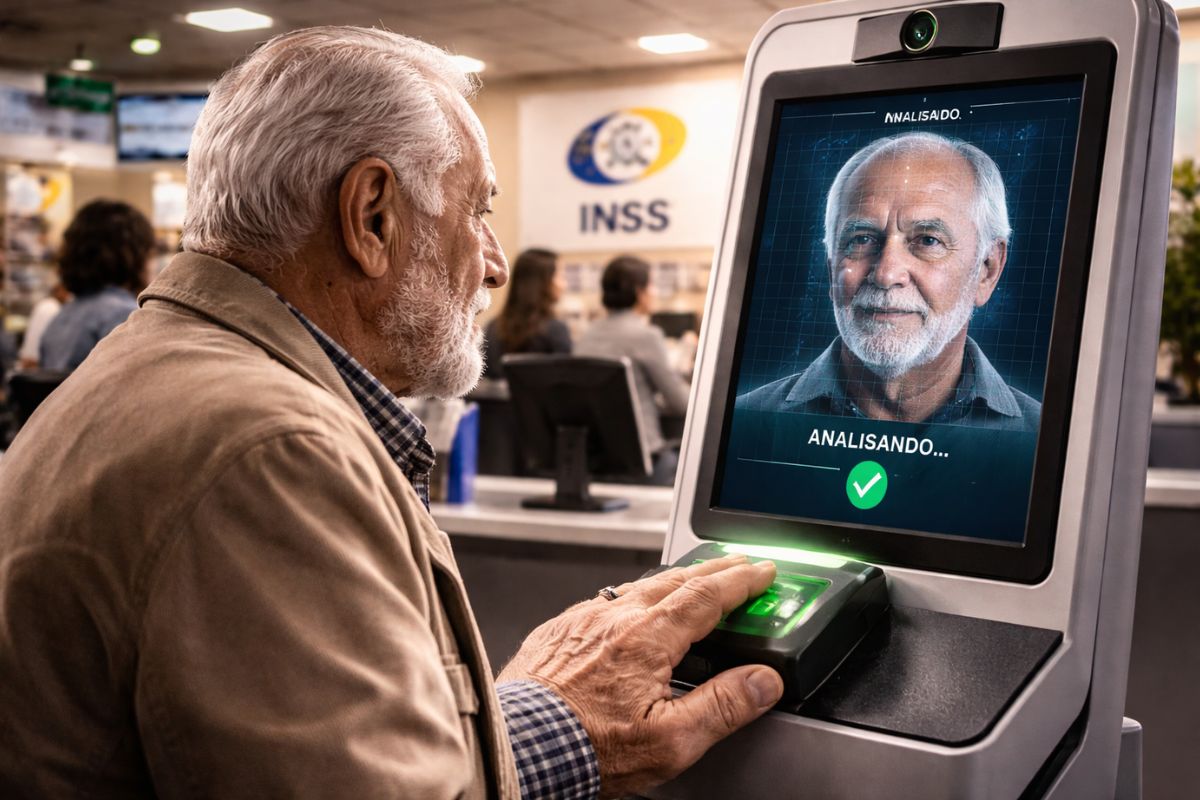
The Adoption of Mandatory Facial Scanner Alters the Release of Retirement Pensions and BPC in Brazil Reinforces Digital Biometrics at INSS Combats Fraud Expands State Control and Changes Forever How Millions of Beneficiaries Receive Social Security and Assistance Resources Throughout the National Territory
The mandatory facial scanner has officially become part of the benefit granting process of the INSS throughout Brazil, affecting retirements, pensions, and the Continuous Cash Benefit. Since November 2025, new requests already require biometric validation, marking a structural change in the way access to payments is granted.
With the mandatory facial scanner, the government seeks to enhance the security of the social security and assistance system, using biometric data already present in official documents. The measure alters routines, creates new digital requirements, and redefines the relationship between beneficiaries and the State.
Mandatory Facial Scanner Becomes Effective for INSS Requests
The mandatory facial scanner has become a requirement for new benefit applications to the INSS as of November 21, 2025.
-
A new Brazilian shopping center worth R$ 400 million will be built in an area equivalent to more than 4 football fields, featuring 90 stores, 5 cinemas, a supermarket, a college, and parking for 1,700 cars, potentially generating 3,000 jobs.

-
Larger than entire cities in Brazil: BYD is building a 4.6 km² complex in Bahia with a capacity for 600,000 vehicles per year, but the discovery of 163 workers in conditions analogous to slavery has shaken the entire project.

-
With an investment of R$ 612 million, a capacity to process 1.2 million liters of milk per day, Piracanjuba inaugurates a mega cheese factory that increases national production, reduces dependence on imports, and repositions Brazil on the global dairy map.

-
Brazilian city gains industrial hub for 85 companies that is equivalent to 55 football fields.


Biometric validation is based on records already collected in official documents, such as the National Identity Card, the National Driver’s License, and the Voter’s Registration Card.
The cross-referencing of these databases allows for the automatic confirmation of the beneficiary’s identity.
Digital biometrics will be the primary filter for the release of payments, reducing reliance on traditional in-person procedures.
Gradual Transition Avoids Immediate Lockouts
The implementation of the mandatory facial scanner occurs progressively to avoid interruption of already granted benefits.
Those who started receiving retirement, pension, or BPC before the change will continue with active payments until notified by the INSS.
The government has defined that the adaptation will be done in a scaled manner.
The requirement will only take effect directly when the beneficiary is formally notified, ensuring time for regularization.
Groups Temporarily Exempt from Biometrics
Some groups are exempt from the mandatory facial scanner at this initial stage.
People over 80 years old, residents of hard-to-reach areas, and individuals with severe mobility limitations do not need to perform biometric validation until alternatives are implemented.
The exception seeks to avoid social exclusion during the digital transition.
The government acknowledges logistical difficulties and promises specific solutions for these cases, keeping payments active.
Schedule Defines Key Dates Through 2028
The process of consolidating the mandatory facial scanner follows an official schedule divided into stages.
In November 2025, biometrics became effective for new requests with already existing data. Starting in May 2026, those without valid biometrics will need to issue the National Identity Card.
In January 2028, the CIN will become the only accepted document.
This milestone consolidates the unified biometric system at the INSS, ending outdated validation models.
Combating Fraud and Monitoring Public Resources
The adoption of the mandatory facial scanner responds to accumulated fraud over the years, which has resulted in significant financial losses.
Biometrics make it difficult to access funds unlawfully and to make payments to third parties, strengthening control over social security and assistance resources.
With digitalization, the government now has greater traceability of the benefits.
The aim is to ensure that retirement, pensions, and the BPC reach only the legitimate holders.
In light of this definitive change, do you believe that the mandatory facial scanner will really reduce fraud, or could it end up making it more difficult for some beneficiaries to access payments?










Seja o primeiro a reagir!