





 Portuguese
  English
  Spanish
  5 min of reading


The Development Of Graphene-Based Technologies Will Drive The Weapons Market In Brazil. Understand How The Applications Happen.
Graphene in the weapons market is starting to gain traction in Brazil. The company Taurus, one of the largest manufacturers of light weapons on the planet, officially signed an agreement in 2021 with the University of Caxias do Sul (UCS) to conduct research and development of armaments with this material, which is made up of an extremely thin layer of graphite.
Carbon-based, light, flexible, impact-resistant, and bend-resistant, graphene is 200 times stronger than steel. It even surpasses diamond, according to technology investment specialists. It can be added to the composition of various industrial products, with one of them being the arms and defense sector.
The partnership between Taurus and UCS occurs through UCSGraphene, the first and largest industrial-scale graphene production plant in Latin America. The structure will allow for rapid testing and development of weapon prototypes.
-
50 viaducts, 4 tunnels, 28 bridges, and 40 kilometers of bike paths: BR-262 in Espírito Santo will receive 8.6 billion reais for the largest engineering project in the state’s history, inspired by the Immigrant Highway in São Paulo.

-
Brazil produces too much clean energy and doesn’t know what to do with it: over 20% of solar and wind capacity was wasted in 2025 while investors flee and 509 renewable generation projects were abandoned in the last year.

-
Piauí will produce a new fuel that replaces diesel without needing to change anything in the truck’s engine and reduces pollutant gas emissions by half: truck drivers from all over the Northeast are already celebrating the news that will arrive later this decade.

-
A new Brazilian shopping center worth R$ 400 million will be built in an area equivalent to more than 4 football fields, featuring 90 stores, 5 cinemas, a supermarket, a college, and parking for 1,700 cars, potentially generating 3,000 jobs.


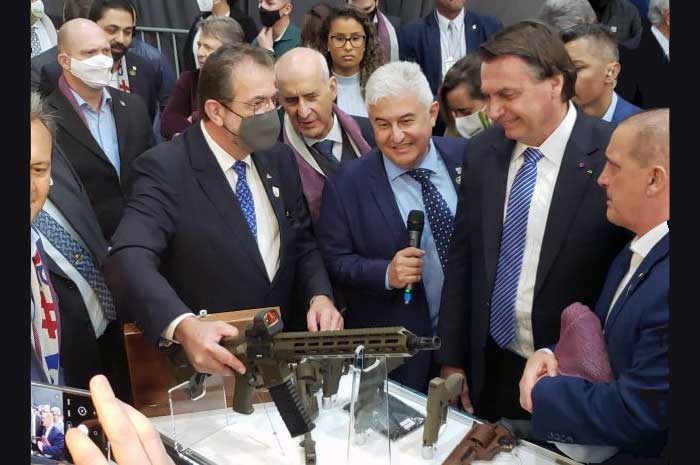
This Friday (09), the president, Jair Bolsonaro, made a point of being present at the ceremony that was also marked by the opening of the first Brazilian Graphene Fair, which enables contact between companies interested in utilizing the material in their businesses.
On the occasion, without a mask, Bolsonaro, who as everyone knows is a military officer and an enthusiast of the use of weapons by the population, received as a gift a .38 caliber revolver from the Global CEO of Taurus, Salesio Nuhs, as well as a prototype of the G3 weapon, which uses graphene in its composition, and a graphene helmet.
The UCSGraphene facilities also had armored vehicles and other items where the material appears to be even more resistant. The president praised this future perspective on graphene in the weapons market and other applications.
“We have evolved in science and technology. Now a great crack has appeared, a great horizon, an immeasurable frontier, that as I passed through here I saw something fantastic for our homeland. Many, demonstrating ignorance, mocked the idea. Today, we can say that graphene and niobium are the future of Brazil. In a decade, products from these minerals will generate trillions of dollars for the economy,” Bolsonaro said in a statement.
Production Capacity of UCSGraphene and The Relationship of Graphene in The Weapons Market
UCSGraphene is the largest graphene generation plant in Latin America, with the capacity to produce five tons of the product per year. To give you an idea, the MGGrafeno project, one of the pioneers in the country, which has been active in Minas Gerais since 2018, achieves around 300 kilograms of the substance per year.
There is an investment of R$ 20 million in graphene technology. The venture has managed to develop it at a lower cost and adaptable to the Brazilian reality. Therefore, it attracts the interest of various companies, including those in the automotive sector and now the weapons market.

Graphene and The Revolution in The Weapons Market Under The Eyes of Specialists
Graphene in the weapons market tends to compete with existing technologies and can replace materials with decades of traditional use. The applications allow for the development of products with high mechanical resistance, data transmission capacity, and energy savings. According to the coordinator of UCSGRAPHENE, Professor Diego Piazza, graphene is the future for numerous sectors, including the arms industry.
“Weapons containing graphene in their composition are lighter and more resistant. This partnership between UCS and Taurus opens doors for the research and manufacturing of much more modern and technological products,” says Professor Piazza.
The Global CEO of Taurus, Salesio Nuhs, emphasizes that the use of graphene in the production of firearms will be a revolution in this market.
“The main strategic pillar of Taurus is Research, Development, and Innovation led by CITE (Integrated Center for Technology and Engineering). The application of graphene will further enhance the quality and efficiency in the production of our products. The development of graphene applications in firearms will be a turning point, a very relevant fact, for the global market of handguns,” Nuhs states.
Read More
Graphene factory in Rio Grande do Sul becomes a target of interest for Chinese investments
The Revolution of Graphene in The Defense Industry
Graphene in the weapons market and as a whole, as we can already notice, tends to receive investments from the industry for a technological change. Regarding the defense sector, there are plenty of opportunities for the application of the material. See:
Being one of the best electrical conductors ever discovered on Earth, graphene presents itself as a perfect solution for the construction of microchips, much smaller and faster. The defense sector requires increasingly fast and advanced circuits.
In terms of ballistic protection, such as bulletproof vests, the application of graphene should make the material even more resistant to large-caliber projectiles while being more comfortable and made from a material the thickness of a t-shirt, since graphene is flexible.
With this same application perspective, graphene provides even more resistance for the armor of vehicles, filling spaces between layers of ceramic and steel. The result is also faster and lighter vehicles.
When it comes to communication among the military, such as GPS, computers, and radios, the batteries of these devices could store much more information with graphene, which also promotes much faster charging.
Advancing even further into the possibilities, the military envisions the use of heavy combat vehicles with electric charging and the construction of stronger, lighter prosthetics with natural movements.
However, it is worth noting that for all of this to happen here in Brazil on a large scale, more investments are still needed.








Seja o primeiro a reagir!