





 Portuguese
  English
  Spanish
  4 min of reading
  1 comment


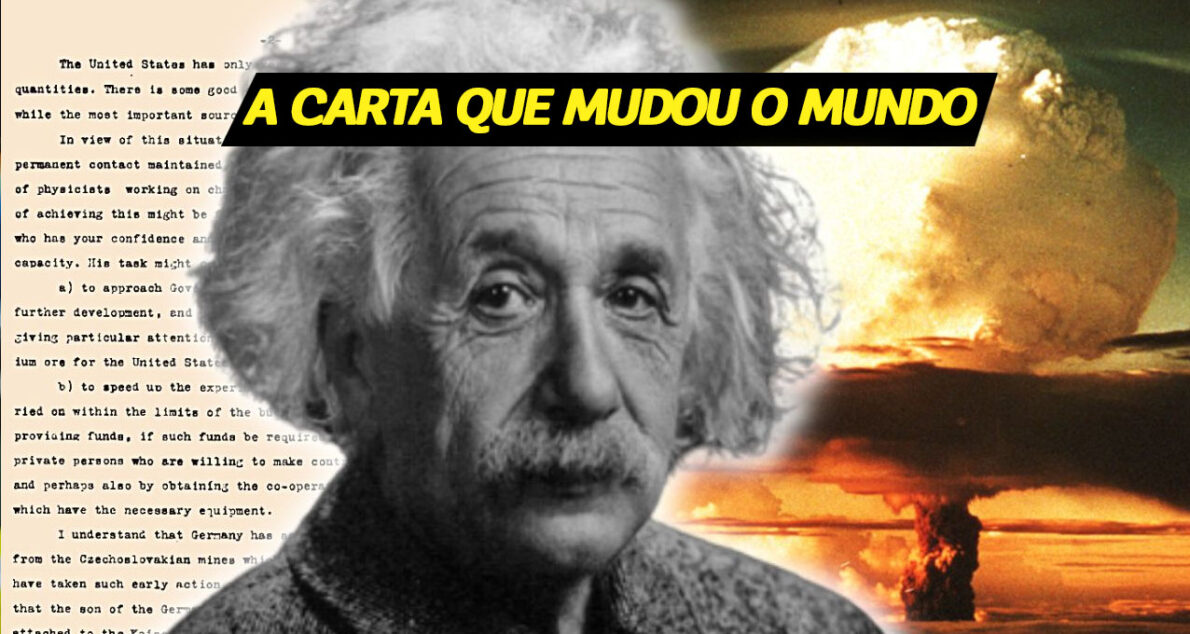

Einstein’s Letter to Roosevelt in 1939 Triggered the Manhattan Project, Resulting in the Creation of an Item That Shaped the Global Scenario Until Today. Einstein, Who Later Regretted This Decision, Tried to Alert the World to the Dangers, but the Shadow of His Action Still Hangs Over Humanity.
In early August 1939, one of the greatest scientists in history made a mistake that changed the course of humanity forever.
In an apparently simple letter, Albert Einstein, the genius of relativity, set off a chain of events that would culminate in the creation of one of the most destructive weapons of all time: the atomic bomb.
This decision, made out of necessity and fear, resonates to this day, shaping the world we live in and reminding us of the immense power that science can have in our lives.
-
While the world looks at oil, the war with Iran is already disrupting helium supply from Qatar, affecting car and iPhone chips, threatening AI expansion, and putting pressure on aluminum packaging at the highest value in four years.

-
Global warming will expose a treasure hidden under the ice of Antarctica and may spark an international dispute over gold and valuable minerals.

-
A street vendor from Praia Grande built a robot made of scrap from scooters and washing machines that pulls his popcorn cart on the beach, emits sounds, and interacts with customers, becoming an attraction on the coast of São Paulo.

-
The specifications of the Xiaomi 18 Pro Max have been leaked, and the highlight is a dual 200 MP camera with a new 22-nanometer technology that promises to consume less energy and capture details in shadows and bright areas using LOFIC HDR.


A Request That Could Not Be Ignored
On August 2, 1939, Einstein drafted a letter that would be crucial for the fate of humanity. Addressed to then-President of the United States, Franklin D. Roosevelt, the message warned of the advancement of nuclear physics and the possibility of turning uranium into a new source of energy.
Einstein, however, did not limit himself to praising scientific discoveries. He went further and suggested that this new form of energy could be used to build “extremely powerful bombs.” This alert was enough for Roosevelt to make a decision that would mark history: to initiate the Manhattan Project.
The project, conducted under a shroud of absolute secrecy, was a race against time to ensure that the United States would be the first to develop an atomic weapon.
At a cost of US$ 2 billion (equivalent to R$ 11.2 billion today), the project led by Robert Oppenheimer culminated in the creation of the bomb that would change the course of World War II and the history of the world.
The Letter That Propelled the Manhattan Project
Einstein expressed his concerns clearly and decisively. He feared that Nazi Germany, which had occupied Czechoslovakia, was developing its own nuclear weapons program.
According to BBC News, the letter suggested that the United States should act quickly to prevent Hitler from gaining a decisive military advantage. This was the kick-off for the development of the atomic bomb, which would be used against Japan in Hiroshima and Nagasaki in 1945.
On September 10, 2024, Einstein’s historic letter will be auctioned at Christie’s in New York, with selling estimates surpassing US$ 4 million. The letter, which was written in two versions, is an invaluable artifact of modern history.
The shorter version, which will be auctioned, is the one that was personally delivered to Roosevelt, while the longer one is part of the permanent collection of the Franklin D. Roosevelt Library.
The Consequences of a Tragic Error
Despite having been the author of the letter that initiated the Manhattan Project, Einstein deeply regretted his decision. In 1946, he co-founded the Emergency Committee of Atomic Scientists, which sought to alert the world to the dangers of nuclear war.
In 1954, shortly before his death, Einstein confessed to fellow Nobel laureate Linus Pauling that the letter to Roosevelt was “the greatest mistake of my life”. This regret was marked in his biography and reflects the complexity of the decisions involving science, morality, and politics.
The Lasting Impact of the Atomic Bomb
The detonation of the bombs in Hiroshima and Nagasaki caused unprecedented destruction. It is estimated that 200,000 people were killed or injured immediately, and many more died years later due to the effects of radiation.
To this day, these are the only instances of direct use of nuclear weapons in conflicts, but the threat of new usage continues to haunt humanity.
The development of the atomic bomb not only changed the course of World War II, but also initiated the arms race among world powers, creating a climate of tension that persists to this day.
Einstein spent the rest of his life advocating for nuclear disarmament, but the legacy of his letter remains one of the greatest ethical and moral dilemmas of modern history.
Einstein and Popular Culture
Albert Einstein is more than a science icon; he has become a legendary figure in popular culture. His equation, E = mc², has become synonymous with nuclear energy, and his involvement, albeit indirect, in the development of the atomic bomb was immortalized in films like “Oppenheimer.”
In the 2023 film, a striking scene features a fictional dialogue between Oppenheimer and Einstein, reflecting the scientist’s fear of the catastrophic consequences of his calculations.
The Legacy of a Decision
Einstein’s letter to Roosevelt remains one of the most influential and controversial documents in modern history.
Although the Manhattan Project would likely have happened anyway, Einstein’s intervention accelerated the process and ensured that the bomb was ready in time to be used in 1945.
This decision, however, brought with it a shadow that still hangs over humanity.
The atomic bomb changed the balance of power in the world and placed humanity on a dangerous path.
Today, nine nations possess nuclear weapons, and the fear of a nuclear war continues to be a real threat. Einstein’s letter serves as a grim reminder of the power of science and the responsibility that comes with it.
Do you believe that science, with all its destructive potential, is being used in the best way to ensure world peace? Share your opinion in the comments.






Não, não acredito porque tudo e falso.
A ciência e o poder economico caminham juntos em nome do poderio próprio. O homem é ganancioso e quer se tornar Deus. Embora matando, roubando e ferindo a humanidade e a quem atravessar o seu caminho pelo Faso poder próprio.