





 Portuguese
  English
  Spanish
  6 min of reading
  0 comments


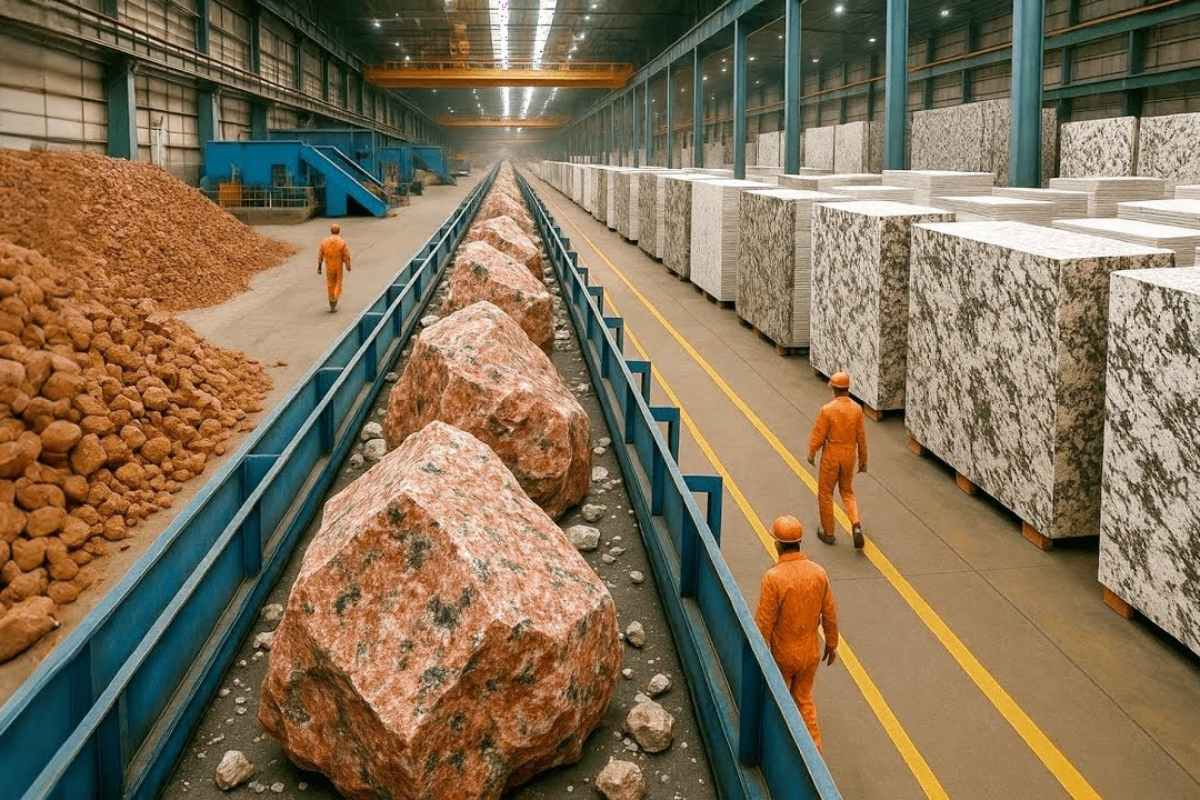
From Solidified Magma to Open-Pit Quarries, Granite Undergoes Controlled Explosions, Diamond Wire Cutting, Multiple Saws, and Automated Polishing Until It Is Approved in Laser Inspections and Packaged for Countertops, Floors, Facades, and International Monuments That Require Extreme Precision, Total Traceability, and Structural Performance in Projects.
Granite is born from magma that cools slowly over millions of years, holding within each block a unique combination of minerals, colors, and veins. In the industrial chain, this seemingly static rock enters a continuous flow of drilling, cutting, transporting, and polishing that transforms rock masses into refined slabs with standardized patterns and controlled finishes.
Throughout the process, raw granite and high-precision technology meet in a highly controlled environment where explosives are calibrated, diamond saws are cooled with recycled water, and laser sensors check every millimeter of the slabs. The result arrives at construction sites in the form of countertops, floors, and facades that combine strength, shine, and the dimensional repeatability required by large-scale projects.
From Magma to Quarries: How Granite Reaches Industrial Cutting

Before becoming a product, granite remains hidden beneath layers of soil, sand, and fragmented rocks.
-
Italian researchers have detected what appears to be a second Sphinx buried under the sands of Egypt, and satellite scans reveal a gigantic underground megastructure hidden beneath the Giza Plateau for over 3,000 years.

-
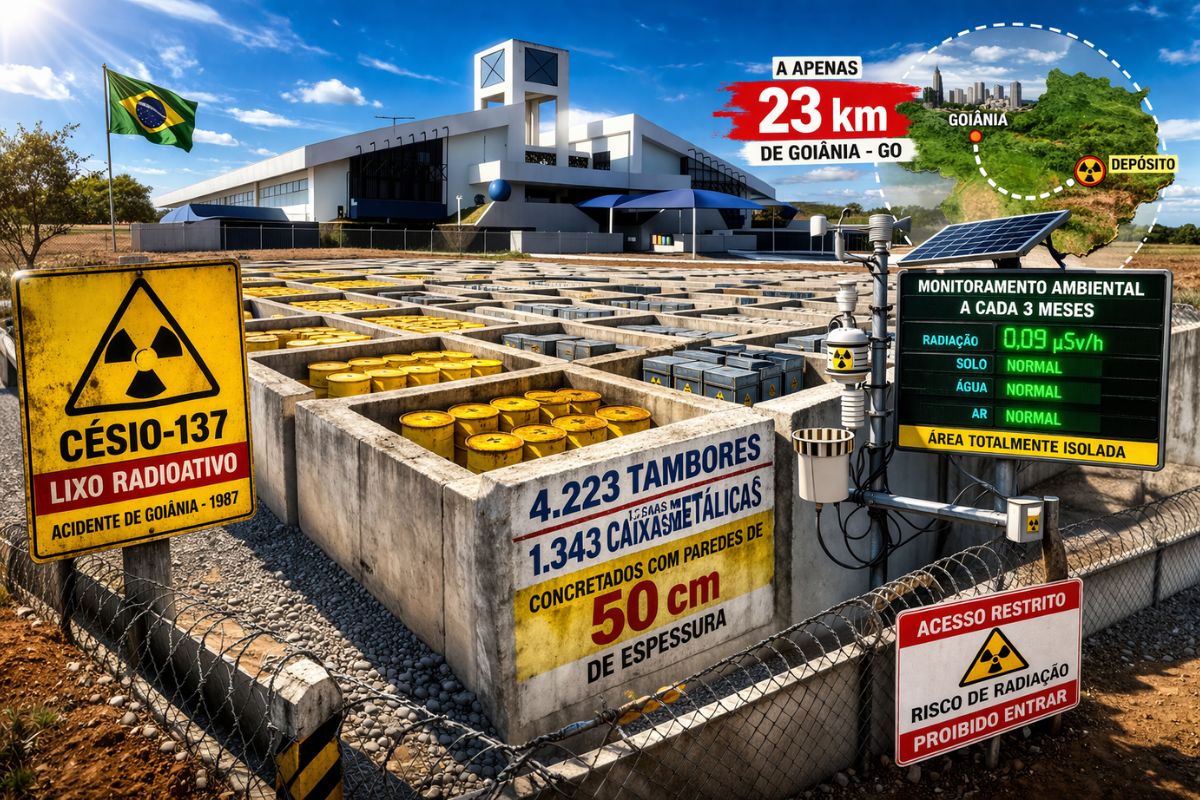
There are 4,223 drums and 1,343 metal boxes concreted with 50-centimeter walls that store the radioactive waste from Cesium-137 in the worst radiological accident in Brazil, just 23 kilometers from Goiânia, with environmental monitoring every three months.
-
Giant Roman treasure found at the bottom of Lake Neuchâtel in Switzerland reveals an advanced trade system, circulation of goods, and armed escort in the Roman Empire about two thousand years ago.

-
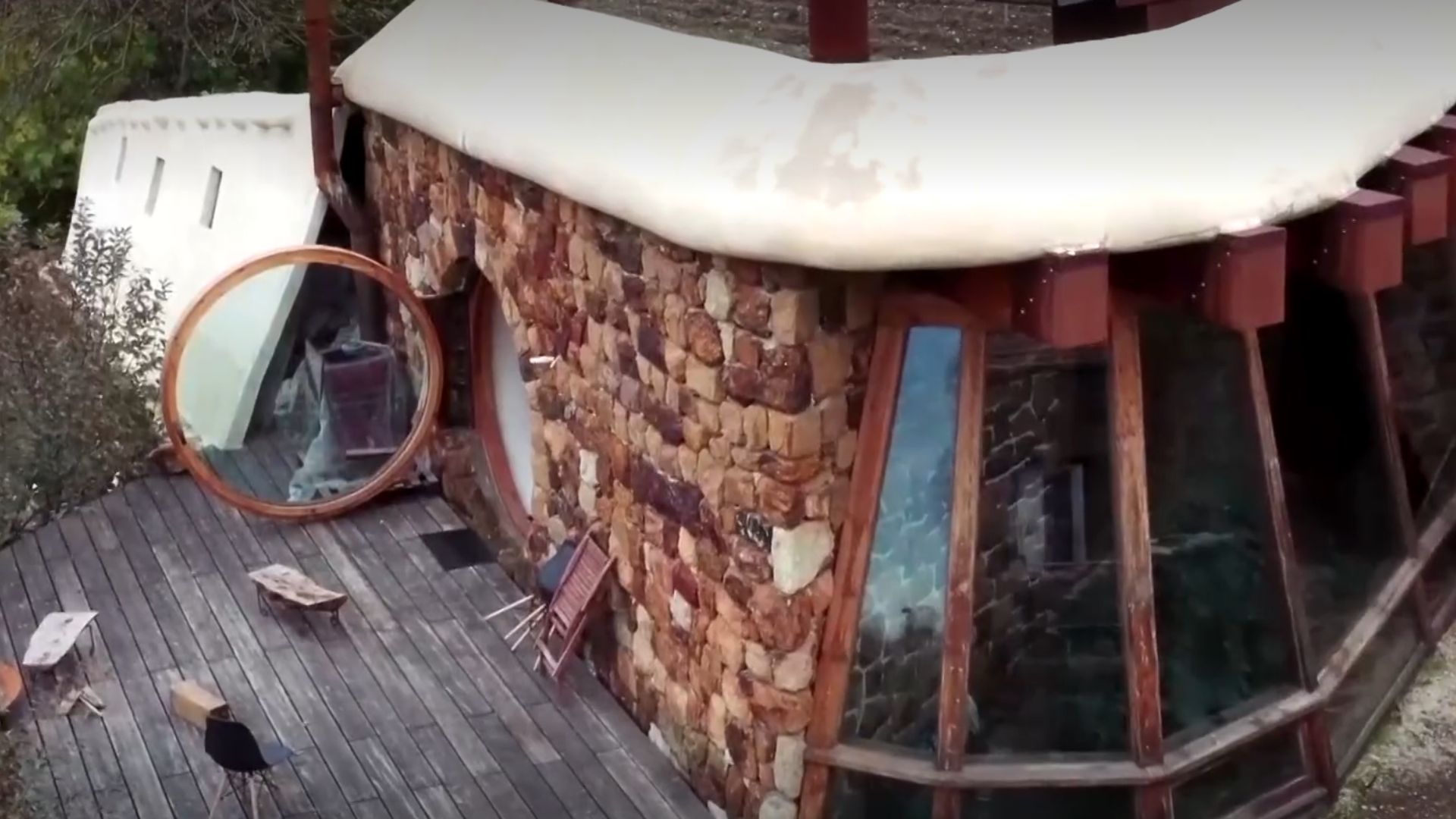
He buried 1,200 old tires in the walls to build his own self-sufficient house in the mountains with glass bottles, rainwater, and an integrated greenhouse.

In open-pit quarries, teams remove this cover until exposing the continuous masses of granite that are of interest for industrial production.
From there, an intricate pattern of drilling and explosives comes into play, designed to separate large blocks without fracturing the rock’s core.
The holes follow a carefully calculated grid pattern.
Each cavity receives a measured amount of explosive, sufficient to break the granite and create blocks weighing tens of tons but without generating internal cracks that would compromise later utilization.
After the controlled detonations, excavators and trucks remove the loose material, revealing the first intact blocks of granite ready for cutting.
Drilling, Diamond Wire, and Giant Saws at the Quarry Face

With the rock face exposed, granite extraction now relies on saws and diamond wire.
The quarry face is marked with parallel lines that define the width and height of each block.
The cutting can be done with diamond wire, where a steel cable coated with segments of synthetic diamond rapidly moves through the granite, or with giant blade saws that slowly advance into the rock.
In both methods, water is a fundamental technical input.
A continuous flow cools the cutting surfaces, removes abrasive sludge, and reduces the suspension of fine silica particles, which pose a respiratory risk to workers.
When the cutting lines reach the projected depth, metal wedges or hydraulic jacks are used to detach the block of granite, which slides to the floor of the quarry, weighing up to tens of tons.
Transport of Granite Blocks to the Factory

Separated from the rock wall, the granite blocks move to internal storage areas.
Low-bed trucks and reinforced structures support the combined weight of rock and equipment, advancing up steep ramps of the quarry to flatter yards.
Cranes on tracks lift the blocks, position the pieces for storage, and prepare for loading towards specialized sawmills.
Upon arrival at the factory, raw granite is deposited on cutting platforms anchored in concrete foundations.
Each block is rigidly secured with hydraulic clamps and steel structures, eliminating vibrations that could create micro-cracks during cutting.
From this point, the process leaves the quarry environment and enters a continuous industrial line, with multiple saws, sensors, and automated lines.
Sawing with Multiple Blades and Formation of Slabs
The heart of transforming granite into slabs lies in the multiple-blade saw. A single machine combines dozens of parallel blades coated with segments of industrial diamond, descending slowly through the block.
The advance speed is only a few millimeters per minute, precisely to protect the crystalline structure of the granite and avoid internal fractures.
During cutting, sensors monitor vibration and resistance in real-time, adjusting the pressure applied to the granite according to the density and mineral variation of each block.
High-pressure jets of water cool the blades, remove stone sludge, and reduce wear on the diamond segments.
At the end of a cycle, which can last many hours, the original block converts into a series of uniform slabs with controlled thickness and weights of hundreds of kilos per piece.
Dimensional Adjustment, Final Cuts, and Preparation of Granite for Use
After the main sawing, the granite slabs still undergo adjustment cuts.
Large-diameter diamond circular saws define the final width, length, and thickness according to application type, whether for countertops, floors, stairs, or facade panels.
The spacing between the blades and the cutting depth are controlled by hydraulic systems and laser readings, maintaining tight tolerances across the entire surface.
At this stage, the goal is to transform the granite into standardized modules capable of fitting in series constructions and large projects.
The dimensional control ensures less visible joints, fewer reworks in construction, and better structural performance, as loads are uniformly distributed among slabs with equivalent thickness and geometry.
Automated Polishing: When Granite Achieves a Mirrored Surface Shine
Exiting the sawing stage, the surfaces of granite remain rough and dull.
In automated polishing lines, each slab comes into contact with a sequence of abrasive heads that gradually replace coarse grains with progressively finer ones until reaching the characteristic mirrored finish of high-end countertops and floors.
The applied pressure, rotation of the heads, and line advancement are controlled by sensors that prevent excessive material removal.
Throughout the process, water once again takes center stage, cooling abrasives, carrying sludge, and reducing friction.
At the end, granite reveals its quartz, mica, and feldspar veins with depth and metallic shine, transforming the raw block into a visually valued product.
Sealants, Protection, and Performance of Granite in Use
With polishing completed, granite surfaces receive a clear sealant.
These products penetrate the microscopic pores of the rock and form a barrier against water, oils, and weak acids present in the everyday use of kitchens, bathrooms, halls, and outdoor areas.
The goal is to prolong shine, reduce stains, and preserve the appearance of granite over the years.
Curing takes place in a temperature and humidity-controlled environment, ensuring proper adhesion. Then, teams visually inspect each slab under intense lighting, looking for scratches, stains, or unwanted color variations.
Only those granite slabs that maintain aesthetic standards and surface integrity proceed to the next stage, where precision shifts from being just visual to being measured in micrometers.
Laser Inspection, Traceability, and Packaging of Granite
In the final inspection, laser scans create three-dimensional maps of each granite slab. Multiple beams record millions of points, allowing for the assessment of flatness, thickness, and parallelism of the faces with great precision.
Micro-cracks, air pockets, and almost invisible deformities can be detected and classified.
The approved slabs are moved with vacuum suction cups, supported on reinforced pallets, and separated by foam or technical rubber.
The entire assembly is tied with metal structures and wrapped in protective film.
The labels contain information about the type of granite, quarry origin, batch, and dimensions, ensuring traceability to the construction site.
From there, trucks and containers take over the transport to projects ranging from corporate towers to high-end residences.
From Subsoil to Construction: Why Granite Remains a Long-Lived Material
At the end of this journey, granite ceases to be just a rock formed within the Earth to become an industrial component with a defined technical standard.
The combination of compressive strength, durability, shine, and dimensional control ensures that the material remains present in high-traffic floors, countertops subjected to intense use, and facades exposed to climatic variations.
In each cycle of extraction, cutting, polishing, and inspection, granite confirms its role as one of the most symbolic materials of enduring architecture, occupying the space that ranges from historic temples to large-scale contemporary works.
Technology has merely refined a process that, at its core, continues to fulfill the essential operation of revealing and protecting what geology took millions of years to build.
In your opinion, in what type of project does granite show all its aesthetic and structural potential today?










-

-

-

-

-

-

18 pessoas reagiram a isso.