





 Portuguese
  English
  Spanish
  3 min of reading
  0 comments


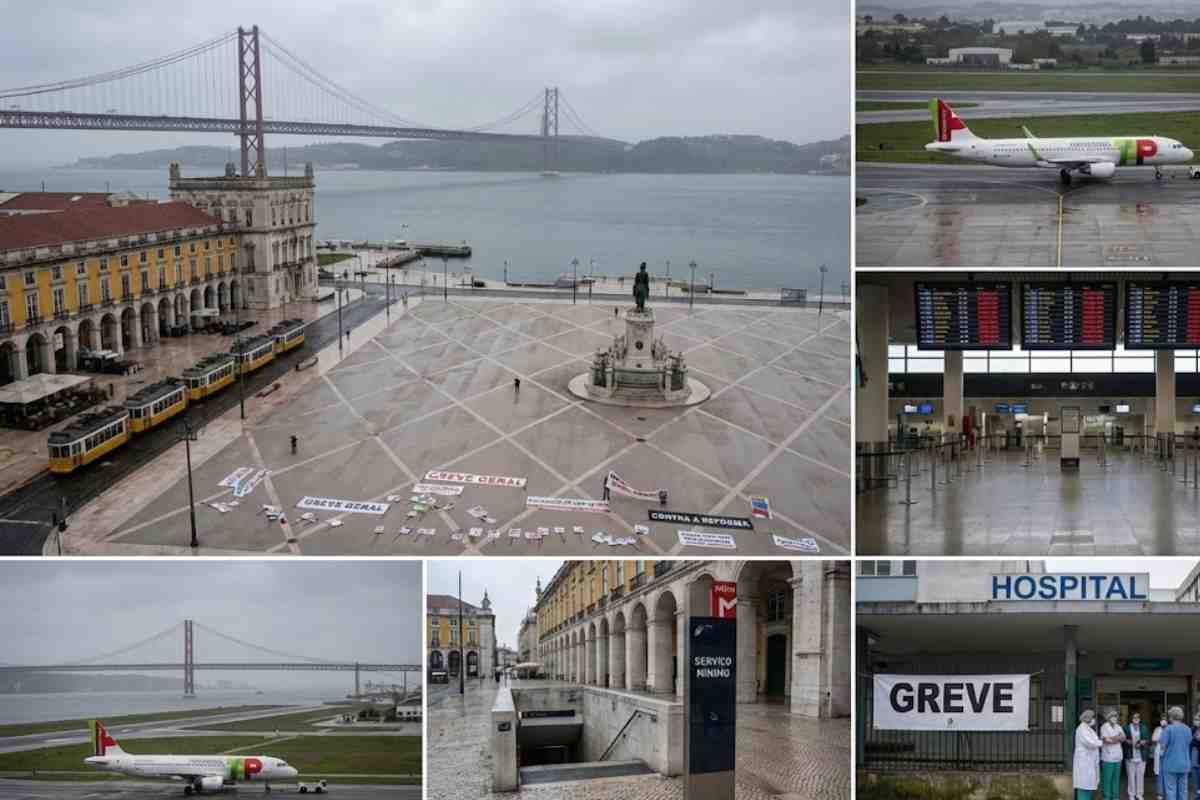
General Strike Hits Portugal This Thursday (11) and Interrupts Air and Rail Connections. Lisbon Central Station Is Deserted, While TAP Air Portugal Suspends Almost Two-Thirds of Its 250 Flights. Unions Say That Garbage Collection Stops, Schools and Courts Are Halted, and Hospitals Reduce Non-Urgent Care in Several Cities.
The General Strike in Portugal, held this Thursday (11), significantly halted air and rail connections and affected the functioning of public services, in protest against proposed labor reforms by the government.
In Lisbon, the main train station was deserted, with most trips canceled, and the national airline, TAP Air Portugal, suspended almost two-thirds of its 250 usual flights, enhancing the feeling of an empty city on mobilization day.
Lisbon Empty and Transportation at the Limit
The General Strike had a direct impact on travel. The capital’s main train station recorded cancellations for most trips, and TAP Air Portugal cut almost two-thirds of its network of 250 flights, significantly reducing passenger flow.
-
50 viaducts, 4 tunnels, 28 bridges, and 40 kilometers of bike paths: BR-262 in Espírito Santo will receive 8.6 billion reais for the largest engineering project in the state’s history, inspired by the Immigrant Highway in São Paulo.

-
Brazil produces too much clean energy and doesn’t know what to do with it: over 20% of solar and wind capacity was wasted in 2025 while investors flee and 509 renewable generation projects were abandoned in the last year.

-
Piauí will produce a new fuel that replaces diesel without needing to change anything in the truck’s engine and reduces pollutant gas emissions by half: truck drivers from all over the Northeast are already celebrating the news that will arrive later this decade.

-
A new Brazilian shopping center worth R$ 400 million will be built in an area equivalent to more than 4 football fields, featuring 90 stores, 5 cinemas, a supermarket, a college, and parking for 1,700 cars, potentially generating 3,000 jobs.


The result was a capital with decreased circulation and broken connections.
Public Services Interrupted and Reduced Attendance
According to the unions, garbage collection was interrupted during the General Strike, and healthcare units focused on non-urgent cases suspended activities.
Schools and courts were also affected by the mobilization, with reduced operations and services, reflecting the extent of the protest in the public sector.
What Motivated the General Strike
The stoppage was organized by unions as a reaction to a bill proposed by the right-wing minority government.
According to the unions, the text seeks to simplify dismissal procedures, extend the duration of temporary contracts, and increase the minimum services required during a strike.
In practice, the dispute centers on hiring rules, dismissals, and the scope of the right to strike.
The Government’s Speech and the Package of Measures
Prime Minister Luís Montenegro argues that the labor reforms include over 100 measures and aim to “stimulate economic growth and promote better wages.”
Although Portugal is experiencing economic growth of around 2% and has a historically low unemployment rate, near 6%, the Prime Minister argues that the country should take advantage of the favorable scenario to implement changes.
Union Criticism and The Portrait of Precarious Work
The unions CGTP and UGT strongly criticized the government’s plans. In the context presented by the unions, unemployment reached its highest level since June 2013, when Portugal required assistance from the International Monetary Fund and the European Union to overcome the debt crisis.
Tiago Oliveira, Secretary General of CGTP, stated that of an active population of approximately five million, about 1.3 million are in precarious situations, a point used as a central argument in the General Strike.
Popular Support and Political Scenario in Parliament
Public opinion appears as a decisive component: 61% of respondents expressed support for the General Strike, according to a survey published in the Portuguese press.
In the Legislative Assembly, although Montenegro’s conservative party does not have a majority, the government is expected to approve the bill with support from liberals and the far-right, which has become the second-largest political force in the country.
This arrangement amplifies the tension between the government’s urgency and union resistance.









-

-

-

-

17 pessoas reagiram a isso.