





 Portuguese
  English
  Spanish
  5 min of reading
  0 comments


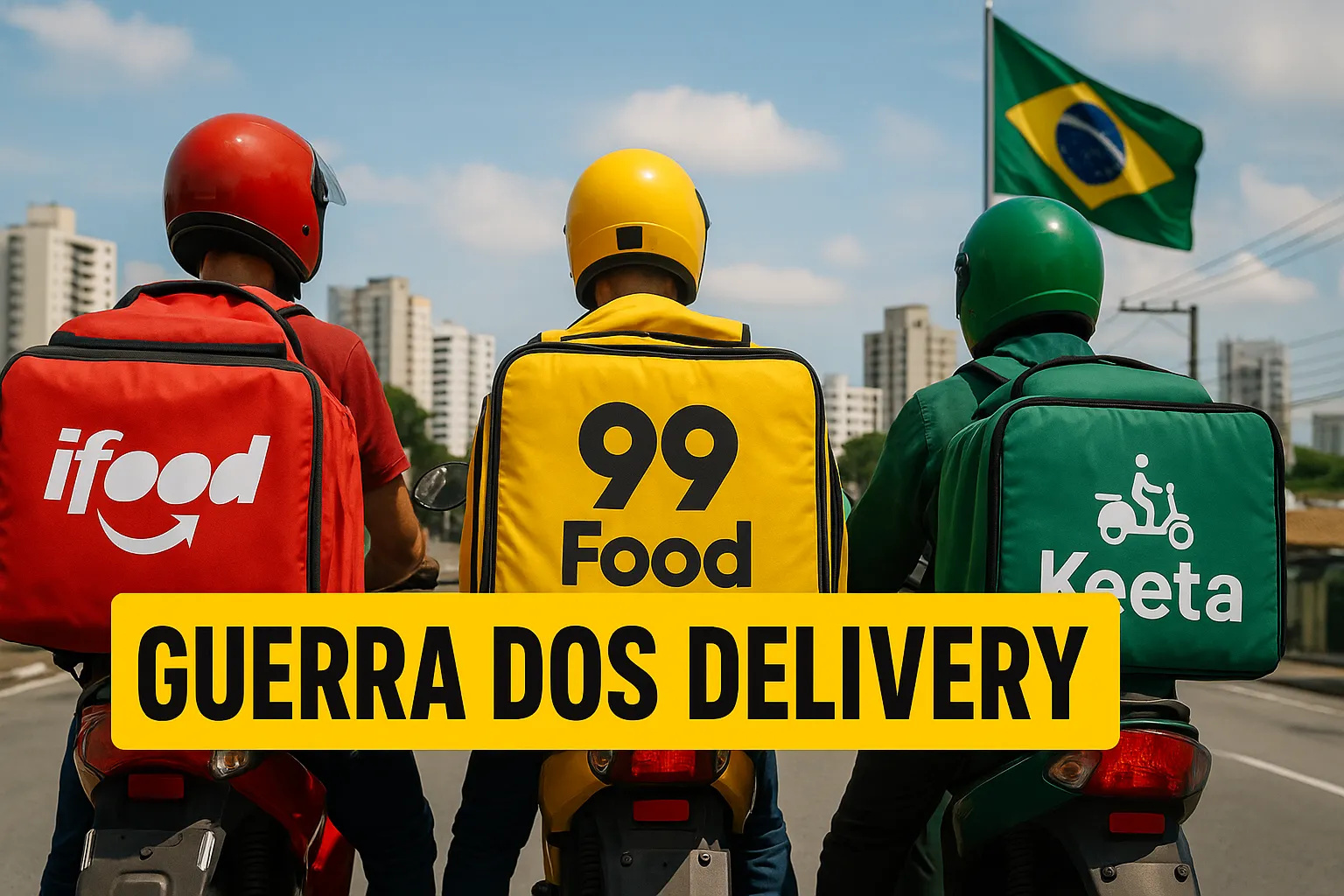
Aggressive Entry of 99 Food and Keeta Rekindles Competition in Brazilian Delivery, Pressures iFood Fees, Expands Coupons, Accelerates Billion-Dollar Investments and Promises Direct Impacts for Consumers, Restaurants and Deliverers Across the Country
The Brazilian delivery market is going through a phase of intense rivalry in 2024 and 2025, with iFood’s consolidated leadership, aggressive return of 99 Food, repositioning of Rappi, and the arrival of Chinese company Keeta, a scenario that increases competition, pressures margins, and generates direct impact for consumers, restaurants, and deliverers.
Consolidated Leadership of iFood in Brazilian Delivery
iFood remains the absolute leader in the delivery market in Brazil, concentrating the largest share of market and bringing together millions of consumers, hundreds of thousands of restaurants, and a wide base of deliverers in a single digital ecosystem.
The strength of the platform lies in the network effect, connecting supply and demand at scale, reducing delivery time, and creating a convenience that is difficult for competitors to replicate, especially in large urban centers.
-
Oil surged to $115 a barrel due to the war in the Middle East, and diesel in Brazil has already risen to R$ 7.45 per liter, while the United States…

-
Brazilian city bets on the business environment to generate jobs and attract investments in the energy sector — secretary reveals strategy at Macaé Energy 2026.

-
50 viaducts, 4 tunnels, 28 bridges, and 40 kilometers of bike paths: BR-262 in Espírito Santo will receive 8.6 billion reais for the largest engineering project in the state’s history, inspired by the Immigrant Highway in São Paulo.

-
Brazil produces too much clean energy and doesn’t know what to do with it: over 20% of solar and wind capacity was wasted in 2025 while investors flee and 509 renewable generation projects were abandoned in the last year.




Expansion Beyond Ready Food
In recent years, iFood has expanded its operations to pharmacies, supermarkets, and other segments, reinforcing the proposal of a superapp focused on convenience, with multiple services accessible in a single application.
This diversification has increased user retention on the platform and strengthened the habit of automatically opening the red app when thinking of delivery, consolidating dominance.
Origin and Accelerated Growth Since 2011
Founded in São Paulo in 2011, initially under the name Disk Cook, iFood started with about 12,000 monthly orders, operating through printed guides and phone before the popularization of smartphones.
In 2012, it launched a website and mobile app and, within a few years, reached 1 million orders per month, driven by investments and a deliberate strategy of accelerated growth.
Burn Rate and Scale Strategy
The growth of iFood was sustained by years of operation with reduced margins or losses, prioritizing scale, user base, and logistical reach, a common model in global digital platforms.
This strategy allowed the company to quickly occupy the market and hinder the entry of new competitors with less financial capacity.
Reduction of Competition After the Pandemic
Before the pandemic, the Brazilian market had greater balance between iFood, Uber Eats, and Rappi, as well as aggressive promotions and more consumer choice.
The gradual exit of competitors after 2020 reduced competitive pressure, allowing iFood to raise fees and adjust commercial rules, which generated frequent criticism from partner restaurants.
High Fees and Restaurant Criticisms
Restaurants report fees that can exceed 20% of the order value, especially in plans that use iFood’s own logistics, in addition to additional costs for highlighting and internal advertising.
For many establishments, the model is considered burdensome, but still viewed as indispensable due to the visibility and volume of orders generated by the platform.
Exit of Uber Eats in 2022
In 2022, Uber Eats officially ceased operations in Brazil, citing a focus on more profitable markets, despite maintaining a strong presence in countries like the United States, Mexico, and Japan.
The exit reduced direct competition and reinforced iFood’s dominant position in the ready meal segment, especially in capitals and metropolitan regions.
Repositioning of Rappi in the Market
Rappi, which once had greater relevance in food delivery, has shifted its focus to other types of deliveries and logistical services, decreasing direct competition with the industry leader.
The strategy included strengthening logistics solutions for third parties, allowing restaurants and platforms to use its delivery structure.
Aggressive Return of 99 Food to Brazil
99 Food returned to the Brazilian market in 2024, starting a pilot operation in Goiânia and rapidly expanding to São Paulo, Campinas, Rio de Janeiro, and other capitals and regions.
The company leverages the existing base of the 99 mobility app, reducing friction for users, who do not need to download a new app or re-register payment details.
Price and Incentives-Based Strategy
The 99 Food offensive includes aggressive pricing, frequent coupons, free delivery, and discounts of up to 50% on the first order, seeking to break the established consumer habit.
The strategy aims to accelerate adoption, even with an initial loss operation, a common practice in markets dominated by large platforms.
Benefits for Deliverers
To attract deliverers, 99 Food announced bonuses and a guarantee of minimum daily earnings based on meeting ride targets, including restaurant orders.
The policy seeks to ensure the availability of delivery personnel and reduce waiting times, one of the main challenges for new entrants in the sector.
Differentiated Conditions for Restaurants
The platform also announced reduced fees or temporary exemptions for partner restaurants, in some cases for up to two years, as a way to attract establishments unhappy with other apps.
Even with debates about the details of these conditions, merchants point to significantly lower costs compared to those practiced by the market leader.
Announced Billion-Dollar Investments
99 Food announced investments of up to R$ 2 billion by 2026, with a significant portion aimed at Greater São Paulo, seeking to build scale quickly and consolidate national presence.
The investment underscores the company’s willingness to sustain initial losses to gain market share in a highly competitive sector.
Arrival of Chinese Meituan in Brazil
Another relevant move was the arrival of Meituan, the largest delivery company in the world, which began operations in Brazil under the Keeta brand, announcing an investment of US$ 5 billion over five years.
In China, Meituan processes about 100 million daily orders and records annual revenue of approximately US$ 30 billion, figures far higher than those in the Brazilian market.
Model Beyond Food Delivery
Unlike local competitors, Meituan operates as a super ecosystem, offering everything from food to flight tickets, event tickets, hotel reservations, and electronics.
The strategy in Brazil begins focused on delivery but with expectations for expansion into other services as its logistical structure consolidates.
Logistics as Main Differential
The main asset of Meituan is its high-speed logistics, based on technology, data, and local partnerships, a model described as turbocharged delivery in the video from the channel Gêmeos Investem.
The company’s initial movements in the country prioritized meetings with logistics operators, signaling strategic focus on this critical point.
Other Players and Relevant Niches
Beyond the major marketplaces, Zé Delivery has established itself as the second largest delivery service in the country by focusing exclusively on the delivery of cold beverages, tapping into a specific niche.
The strategy allowed for rapid growth without directly competing with meal delivery, reducing costs and increasing logistical efficiency.
Impacts for Consumers and Market
For consumers, the intensification of competition results in more coupons, lower prices, and greater variety of options, at least in the short term, with a temporary reduction in platform margins.
Experts point out that, in the long term, the market tends toward concentration again, as companies evaluate financial sustainability and return on the investments made.
Transition and Uncertainty Scenario
The current delivery war in Brazil marks a phase of transition, with billion-dollar disputes, strategic repositioning, and a redefinition of the balance between platforms, restaurants, and users.
The outcome will depend on each company’s ability to sustain initial losses, build efficient logistics, and capture consumption habits in an already highly consolidated market.









-

2 pessoas reagiram a isso.