





 English
  Francês
  Alemão
  Italiano
  Japonês
  Norueguês
  Portuguese
  Spanish
  4 min of reading
  0 comments


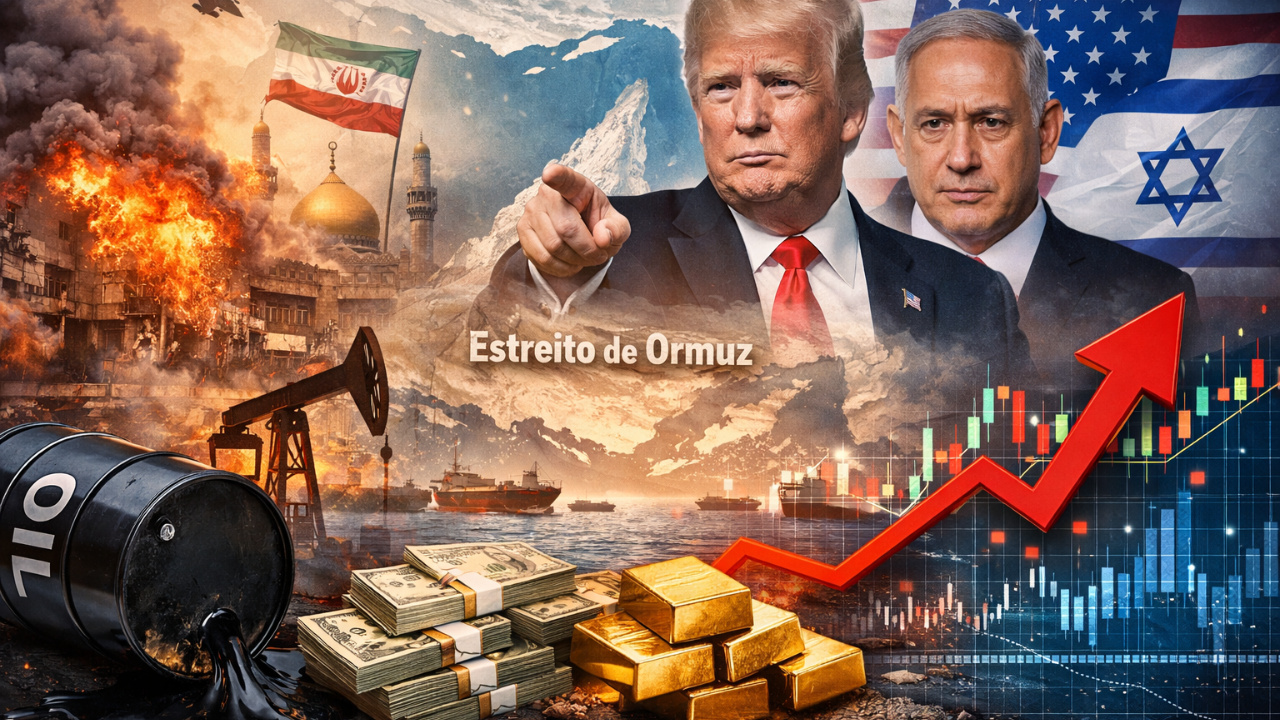
The US-Iran War Reignites Fears in the Middle East, Impacts Oil Prices and Triggers Strong Volatility in Financial Markets.
The new US-Iran War, triggered by joint attacks from the United States and Israel against Iran this weekend, has left over 200 dead in Iranian cities and is already causing strong concern in global financial markets.
The conflict, led by American President Donald Trump and Israeli Prime Minister Benjamin Netanyahu, is occurring in the Middle East and reignites fears of disruptions in energy supply.
As a consequence, investors are responding cautiously, raising oil prices and seeking safer assets. The central reason is the risk of military escalation and its direct impacts on the global economy.
-
Middle East War Hits Fertilizers and Transportation and May Strain Brazilian Wallets
-
Russia Considers Suspending Gas to Europe After Surge in Energy Prices
-
How A War Thousands of Miles From Brazil Started Disrupting Global Shipping Routes, Raising Container Costs, and Putting Up to 40% of Brazilian Beef Exports at Risk
-
Agricultural Parliamentary Front Presses For Safeguards In The Mercosur Agreement


Shortly after the attacks, analysts began projecting volatility in stock markets, exchange rates, and international interest rates.
Additionally, concerns are growing regarding inflationary pressures, especially in countries dependent on energy imports.
Oil Prices Are Expected to Rise with the Advance of the US-Iran War
The main barometer of the conflict is oil prices.
Historically, crises in the Middle East elevate commodity prices, as the region accounts for a large portion of global production.
According to Gustavo Cruz, strategist at RB Investimentos, the initial reaction is likely to be intense.
“The market is going to adopt panic mode. I believe the trend is for oil to rise significantly, along with gold, silver, the dollar, and the future interest rate curve,” he states.
He notes that in times of uncertainty, investors migrate to safer assets, such as the dollar and gold.
This movement is known as “flight to quality,” when there is a search for protection in the face of elevated risks.
On the other hand, some see a less dramatic impact.
Economist Simão Silber, a professor at the University of São Paulo (USP), points out that the increase may be limited.
“Of course, it will affect the price and management of oil worldwide, but the effect is likely to be smaller due to the increase in Russian production and US control over Venezuelan production,” he explains.
The Strait of Hormuz Could Determine the Course of Financial Markets
Despite the recent rise in oil prices — which has accumulated almost 20% appreciation since the beginning of the year — consultant André Perfeito assesses that it is not yet possible to declare immediate panic.
According to him, the central point is the Strait of Hormuz, a strategic passage in the Persian Gulf responsible for the flow of nearly one-third of the world’s oil.
If the route is blocked, the scenario could change rapidly.
“I don’t know if there will be panic. The question is whether Iran will close the Strait of Hormuz.
Then, there will be a greater stress on oil,” explains Perfeito. “The impact on the price of a barrel of oil could be significant, and this brings implications for the level of global activity,” he adds.
Therefore, as long as the conflict remains restricted to targeted attacks, the market tends to react cautiously.
However, any sign of logistical interruption could amplify turbulence in financial markets.
Brazilian Trade Balance May Benefit
Although the international scenario is one of uncertainty, Brazil may occupy a relatively comfortable position.
This is because the country is a net exporter of oil and derivatives, which strengthens the Brazilian trade balance during periods of rising oil prices.
According to André Perfeito, the sector’s surplus approaches R$ 30 billion, representing about 43% of the trade balance during the analyzed period.
In other words, the increase in prices may amplify external revenues.
“Brazil, in this scenario, can benefit significantly, as the country is simply in surplus in the oil and derivatives balance.
In other words, to put it in a finance-friendly way, we are ‘hedged’. If the price of oil skyrockets, the price of imported gasoline rises, but the oil that the country exports rises too,” Perfeito states.
He goes further and suggests that the real may even appreciate against the dollar if the currency flow favors the country.
“Probably, Brazil will win by default, after decades of effort from Brazil itself,” he bets.
The Conflict Could Last Weeks and Maintain Volatility
The duration of the US-Iran War remains uncertain.
However, the advancement of the succession process of Ayatollah Ali Khamenei adds a delicate political component to the Iranian internal scenario.
For Perfeito, there are no clear indications that the United States seeks an immediate regime change.
“The objective on the part of the US is unclear; after all, there will not be an easy regime collapse since the Iranian Revolutionary Guard is an institution embedded in that country’s society.
Thus, it seems that Trump only wants ‘chaos’ to try to achieve objectives more focused on the domestic dynamics of the US,” he stated.
Therefore, as long as uncertainties persist, financial markets are expected to operate under tension.
Oil prices will continue to be the main indicator to monitor, especially in light of any movement in the Strait of Hormuz.
For Brazil, the challenge will be to balance internal inflationary effects with the potential strengthening of the Brazilian trade balance.
In a turbulent global scenario, the country may find a rare opportunity for economic advantage — as long as the crisis does not escalate to even greater proportions.
See more at: Markets Are Likely to Become More Tense After US Attacks on Iran – Rosana Hessel’s Blog










Seja o primeiro a reagir!