





 Portuguese
  English
  Spanish
  6 min of reading
  0 comments


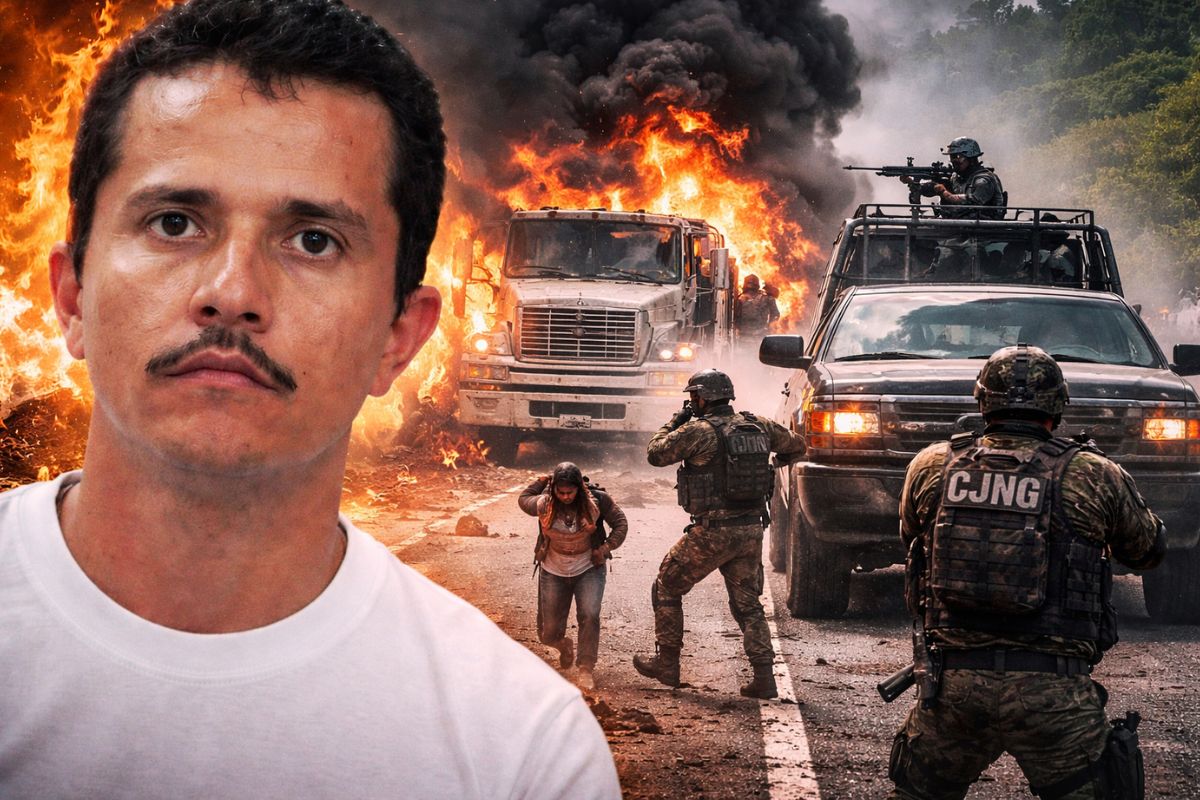
After The Elimination Of El Mencho, The Retaliation Attributed To The CJNG Combines Attacks, Blockades And Fires On Highways, Exposes Accumulated Failures Of Mexican Security And Reignites The Risk Of Criminal Fragmentation, Dispute Over Territories And A New Escalation Of Violence Against Civilians And Public Agents In A Scenario Of High Uncertainty
The death of El Mencho, a leader associated with the CJNG, is presented as a tactical victory of great impact for security and intelligence forces. But the immediate effect described on the streets points to another reality, with blocked highways, burned vehicles, and coordinated attacks, signaling a rapid reaction capacity even after the loss of central command.
In the short term, what appears is not pacification, but rather a demonstration of strength to intimidate the state and the population. Instead of ending the cycle of violence, the elimination of a boss can accelerate internal disputes, create space for rivals, and increase pressure on regions already weakened by the armed presence of organized crime.
What The Retaliation Reveals About The Capacity Of The CJNG

The sequence of actions attributed to the CJNG suggests planning, communication, and territorial presence, not just emotional reaction. Blockades on highways, fires, and attacks at sensitive points usually require logistics, armed men, local coordination, and knowledge of the terrain. This helps explain why the response was so quick after the elimination of El Mencho.
-
Friends have been building a small “town” for 30 years to grow old together, with compact houses, a common area, nature surrounding it, and a collective life project designed for friendship, coexistence, and simplicity.

-
This small town in Germany created its own currency 24 years ago, today it circulates millions per year, is accepted in over 300 stores, and the German government allowed all of this to happen under one condition.

-
Curitiba is shrinking and is expected to lose 97,000 residents by 2050, while inland cities in Paraná such as Sarandi, Araucária, and Toledo are experiencing accelerated growth that is changing the entire state’s map.

-
Tourists were poisoned on Everest in a million-dollar fraud scheme involving helicopters that diverted over $19 million and shocked international authorities.


Also noteworthy is the political target of the retaliation. By affecting circulation, transportation, and the sense of normalcy, the group tries to convey a direct message: even without El Mencho, it can still impose a cost on the state. This type of action seeks to produce public fear, institutional wear, and pressure on authorities, as well as reinforce the cartel’s authority in front of allies and rivals.
Operationally, the impact goes beyond material damage. Each forced blockade mobilizes police, military forces, firefighters, and emergency teams at the same time, fragmenting the state response. When the group chooses to attack mobility and urban routine, it forces the government to react in many locations simultaneously, which increases the perception of collapse.
There is also a significant symbolic component. In contexts of war between factions and the state, the ability to act immediately after a significant loss serves as a currency of power. The retaliation attempts to show that the structure survives the loss of leadership, and that the regional chain of command remains functional.
How The CJNG Reached This Level Of Militarization

The growth of groups like the CJNG has been accelerated by decades of transformation in Mexican drug trafficking. According to the presented basis, cartels that previously operated mainly transit routes underwent a progressive militarization, with recruitment of former police, former military personnel, and individuals trained in combat tactics, ambush, and territorial control.
This process did not happen at once. It was fueled by competition among cartels, expansion of illicit markets, and circulation of heavy weaponry. The result was the formation of groups with paramilitary capacity, armed convoys, homemade armored vehicles, and specialized units, such as the so-called elite group mentioned in the provided material.
Another central factor is the flow of arms and ammunition. The described scenario indicates two main fronts, particularly highlighting smuggling from the United States and internal diversions in the region. In practice, this reduces the cost of equipping fighters and allows the organization to maintain constant pressure across various Mexican states.
El Mencho’s leadership, in the presented context, is believed to have been decisive for this expansion. The combination of experience in drug trafficking, a background in local security forces, and knowledge of institutional functioning gave the cartel a advantage in infiltrating, corrupting, co-opting, and anticipating state movements. This mix of criminal intelligence and operational discipline helps explain its extensiveness.
The Strategic Error That Returns To The Center Of The Debate
The offensive against drug trafficking leaders often generates quick results in political and law enforcement terms. The elimination of a high-profile leader produces headlines, demonstrates state action, and can weaken centralized decisions. The problem, as the Mexican experience itself indicates in the provided material, is that tactical victory does not mean strategic stability.
When the criminal structure is deeply rooted, the removal from the top can fragment command and multiply violence hotspots. Instead of an organized block, smaller cells emerge fighting for territory, routes, and income. This type of fragmentation tends to increase extortion, kidnapping, local attacks, and neighborhood wars, directly affecting civilians.
The discussion also involves public policies. The presented content describes a back-and-forth between military hardening and less confrontational approaches, without the country managing to consolidate a lasting model for reducing violence. This helps understand why Mexico reaches yet another critical point with institutions under pressure and responses still politically disputed.
Ultimately, the question that arises is simple and uncomfortable. Who controls the territory the day after a successful operation? If the state eliminates leadership but fails to occupy routes, cities, and areas of influence with intelligence, a permanent presence, and coordination among government levels, the dispute merely shifts phases.
What Changes Without El Mencho Inside And Outside The Cartel
Without El Mencho, the CJNG enters a risk zone that could produce two simultaneous movements. The first is the attempt at internal preservation, with regional leaders seeking to demonstrate loyalty and command capability. The second is the silent struggle for succession, where violence serves as a political positioning tool within the organization itself.
This internal dispute often has immediate external effects. Rival factions and competing cartels read the moment as an opportunity to advance on strategic areas, ports, corridors, and local markets. Thus, El Mencho’s death could open a cycle where the CJNG fights to avoid shrinking while rivals test its borders.
The national impact goes beyond the cartel’s geography. Attacks on highways and actions against civilians raise economic costs, interrupt the flow of goods, affect services, and pressure state and federal governments. Meanwhile, the perception grows that public safety may enter a state of continuous response, with no time for institutional rebuilding.
In the described scenario, the most likely trend is not immediate demobilization but rather violent reorganization. The elimination of El Mencho may weaken a specific leadership, but it does not automatically dissolve networks of financing, recruitment, armament, and territorial control. This is the central point of the current risk in Mexico.
What The State Needs To Prove Now
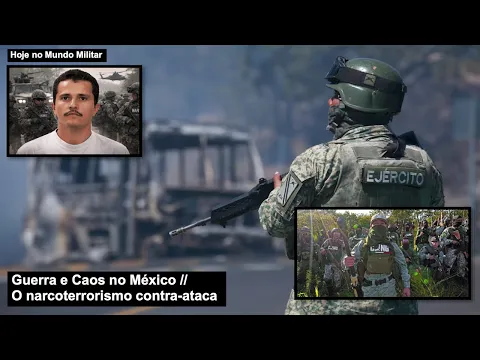

After a high-impact action, the government needs to show something that goes beyond the operation itself. The real proof lies in its ability to reduce attacks in the following weeks, protect civilians, keep highways open, and prevent criminal succession from turning into open warfare across multiple states.
This requires coordination among intelligence, police, military forces, financial investigations, and local justice. Without this coordination, pinpoint operations may continue producing symbolic victories and practical defeats. In El Mencho’s case, the challenge is to demonstrate that the state response does not end with the elimination of leadership but translates into effective recovery of territorial control.
It will also be crucial to monitor signs of partial security collapse, such as an increase in blockades, attacks on agents, extortion, and economic paralysis in specific areas. If these indicators rise, the episode will cease to be merely a retaliation and will mark a new cycle of violence with national impact.
The political dimension cannot be overlooked. The debate over strategy, legality, and use of force returns to the center precisely when the population demands immediate protection. Without clarity of command and operational priority, the dispute between narratives can consume the time that should be used to contain violence.
The elimination of El Mencho, in the presented scenario, changes the game board but does not end the war. It can be an important tactical victory and, at the same time, the trigger for a more unpredictable phase, with retaliation, internal succession, and a struggle for territory happening in parallel.
I want to hear your thoughts on a specific point, without an automatic response. In your view, should Mexico prioritize operations to decapitate leaders like El Mencho or focus efforts on reclaiming territory and suffocating cartel finances before further actions of this magnitude? Which path seems more likely to lead to real reductions in street violence?










-

Uma pessoa reagiu a isso.