





 Portuguese
  English
  Spanish
  7 min of reading
  0 comments


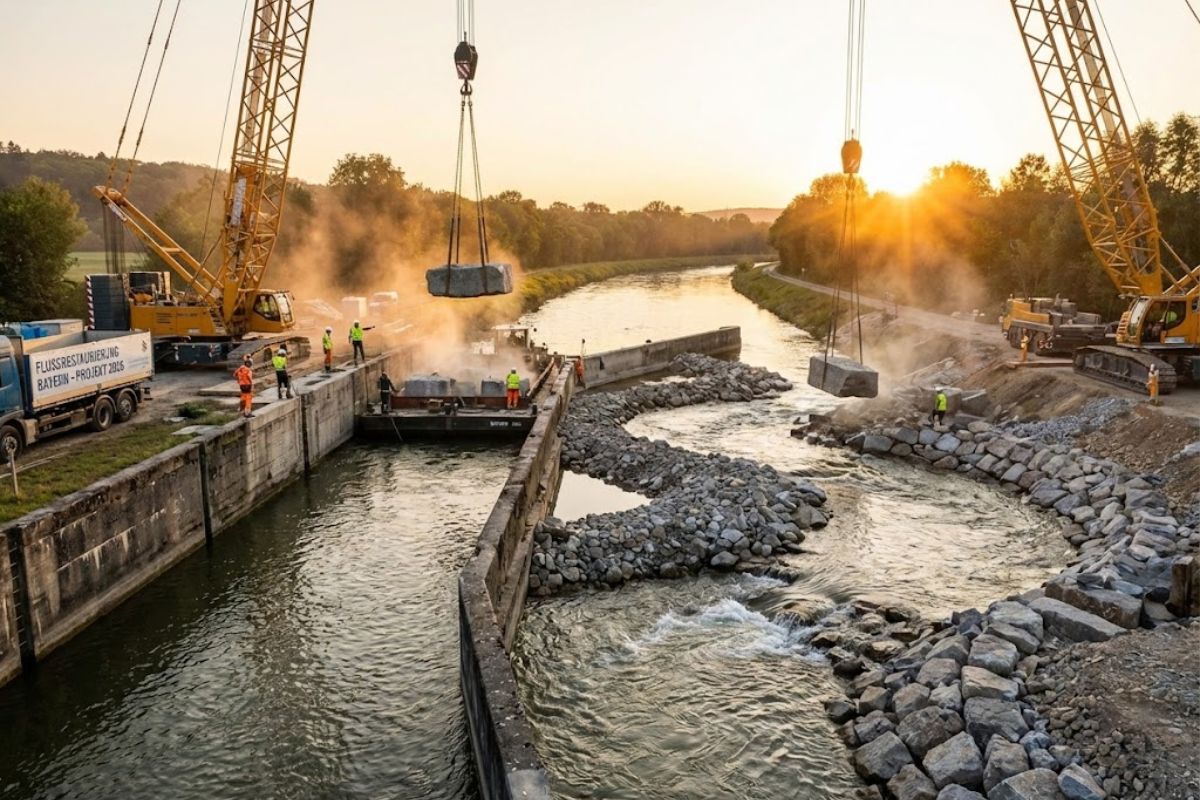
In Bavaria, Germany, Cranes Reposition Blocks and Gravel in the Isar and the Danube to Reopen Straightened Beds from the 19th Century, Create Space for Banks, Reduce Speed, Improve Flood Control, and Create Fish Passages, in a Renaturalization Inspired by the Isar Plan in Munich, Since 2000 with Works Until 2011.
The rivers of Bavaria, in southern Germany, have become a site of heavy engineering: cranes dump thousands of stone blocks and natural gravel to reconstruct sections of beds altered by industrial straightening in the 19th century, focusing on courses like the Isar and the Danube.
The operation aims to slow the water, recreate rapids and branches, return habitat to fish, and test whether the combination of heavy machinery and natural materials can restore degraded river ecosystems on a large scale, while also reinforcing flood control and transforming previously rigid banks into more permeable areas used by the population.
Where It Happened and Why Bavaria Became a Laboratory for River Restoration

The initiative takes place in Bavaria, a state in southern Germany, particularly focusing on urban and peri-urban sections.
-
The coldest seawater ever recorded in Earth’s history was hidden under extreme ice 717 million years ago and reached an impressive -15°C.

-
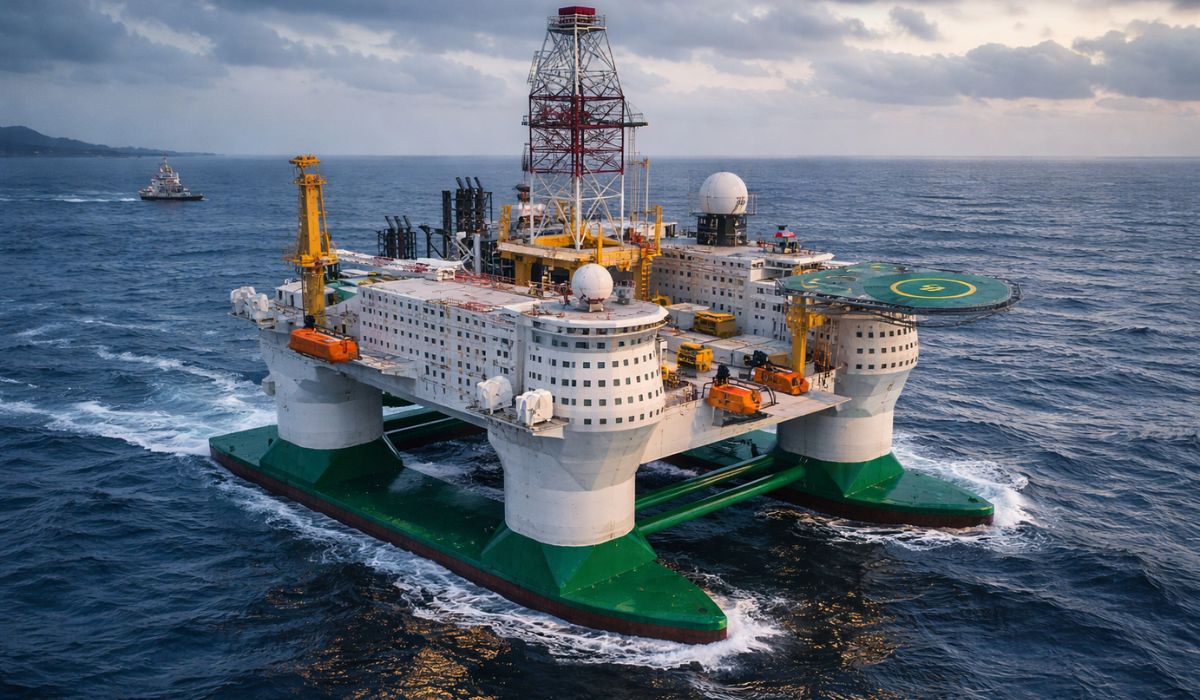
China has launched the world’s first floating artificial island, a scientific structure designed to face open seas, test equipment weighing hundreds of tons, and reach depths of 10,000 meters.
-
China accelerates global science and may surpass the United States in 2 years with increased public investment, continuous growth, and direct impact on the global technological competition.

-
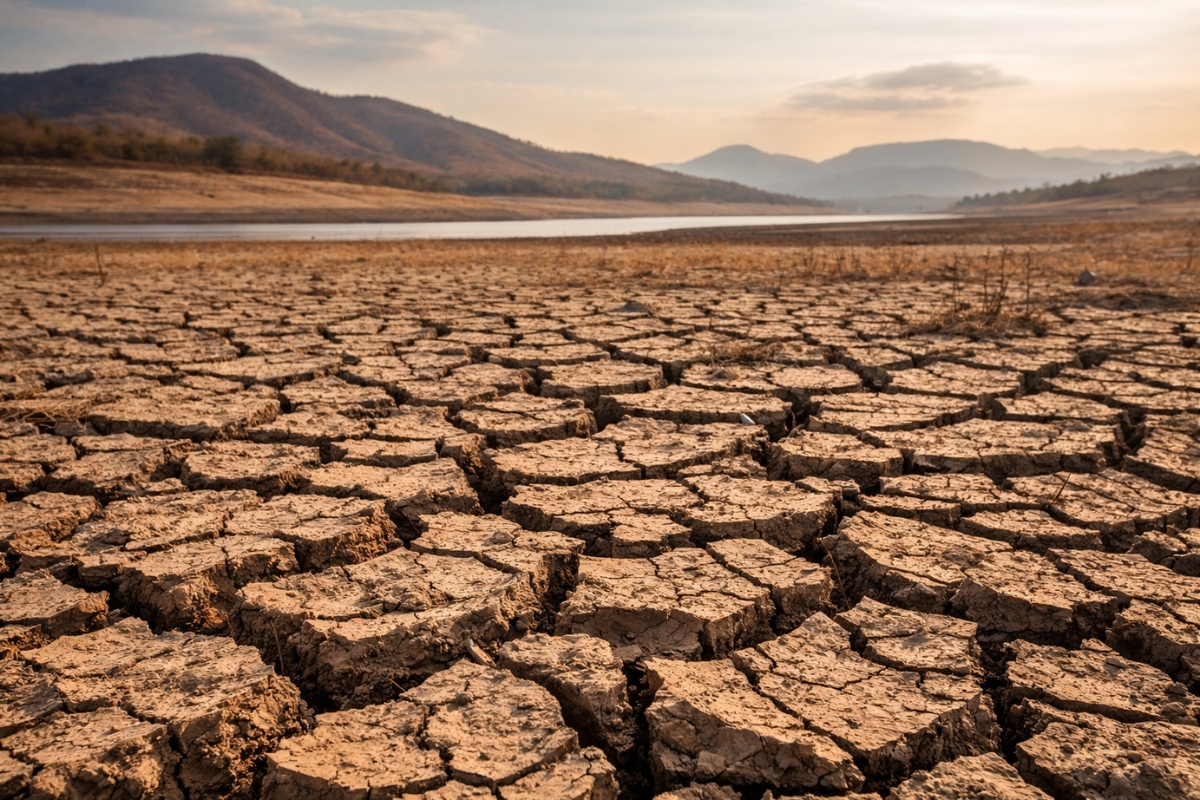
Scientific studies indicate that drought may be strengthening a much greater silent threat: more resistant superbugs.

The most emblematic example cited is the Isar Plan in Munich, a regional reference for renaturalization applied to a high-density urban scenario.
It is in this type of environment that the intervention gains weight: the rivers are not treated merely as drainage channels, but as ecological and safety infrastructure.
By acting in Bavaria, the project aims at two axes simultaneously.
The first is ecological: reopen niches, recover natural dynamics, and allow the return of species.
The second is hydrological: reduce water speed, increase lateral space, and give the system the capacity to absorb peak flows, reducing the destructive energy formed when a river is “stretched” and hardened.
The Straightening of the 19th Century: When It Occurred and How It Changed Rivers

The industrial straightening, according to gathered data, began systematically in the mid-19th century and gained momentum after major floods, notably the flood of 1813 in Munich, and with the industrial boom of the 1870s.
The logic of that time was straightforward: hydraulic engineers viewed the rivers as “inefficient” systems and sought to speed up drainage to prevent overflow in urban areas and facilitate transport.
The “how” of this transformation appears on three fronts.
Channelization, converting winding beds into straighter and deeper channels.
Bank stabilization, replacing natural edges with rigid structures, such as walls and fixed blocks, to protect infrastructure and stabilize the channel section.
Economic exploitation, exemplified by the Isar which became, around 1870, the largest barge port in Europe, transporting wood and stones for the construction industry.
The immediate result was operational efficiency, but it had long-term effects on the dynamics and life in the rivers.
What Cranes Do Today: Thousands of Stones to Redo Beds and Create Rapids

The central method described is the physical reconstruction of the bed with natural materials, executed with heavy engineering.
Cranes deposit thousands of blocks of stone and gravel in the beds of rivers like the Isar and the Danube.
Instead of a smooth and accelerated channel, the goal is to place obstacles and textures that break the energy of the flow and return diversity of microenvironments.
The expected package of effects is specific: recreation of rapids, formation of natural branches, emergence of ecological niches, and reactivation of resting areas for fish.
The stone works as a “flow structure,” altering the speed and direction of the water.
Cranes do not merely dump material, but position volumes to withstand the force of currents and allow the water itself to reorganize sediments over time, forming gravel bars and islands.
Why Slowing Water Became a Priority: Floods, Erosion, and Lack of Floodplains
The straightening of the 19th century bet on the idea that fast water meant more safety.
The current assessment reverses this: in straightened and hardened channels, water accelerates, gains destructive force, increases erosion, and can push more violent floods downstream.
The problem worsens when floodplains are eliminated, as the river loses natural escape areas.
The renaturalization in Bavaria attempts to return lateral space to the bed, introduce natural obstacles, and reduce speed, which increases resilience to major floods.
In engineering terms, the goal is to decrease the peak energy of the flow within a wider river corridor, with banks capable of absorbing excesses.
In the rivers, this also means reconnecting processes that were cut off by concrete, such as sediment deposition in less energetic areas.
Habitat and Biodiversity: Fish Passages and Return of Ecological Niches
Socioecological degradation appears as a direct consequence of transforming living rivers into rigid and fast channels.
Without refuges and reproduction areas, fish and plants lose their survival conditions.
Moreover, old constructions created migratory barriers, with steps and artificial drops that interrupt movements.
The described intervention includes the creation of fish passages and the replacement of vertical barriers with ramps and structures with stone, allowing for ecological continuity.
The redesign of the bed seeks to reintroduce “complexity,” with areas of strong current and areas of calm, which increases the availability of shelter and food.
This is a point where Isar and Danube become showcases: recovering ecological corridors in large rivers requires that flow once again offers choices, not just an accelerated jet.
Water Table and Riverbed: Why Elevating the Bed Is Part of the Plan
Another noted detail is the progressive lowering of the bed in rectified rivers.
When the channel is deepened and accelerated, it tends to “dig” the bottom even more over time. This can drain water from the surrounding soil, drying riparian areas and reducing underground reserves.
By dumping stones, gravel, and pebbles, renaturalization seeks to stabilize the bottom, elevate grades in specific segments, and reduce erosion.
In practice, the bed ceases to be a ditch that continuously deepens and begins to have dissipation points that hold sediments and support deposition areas.
In rivers like the Isar, this adjustment is treated as part of the return of dynamics, not as an aesthetic finish.
Materials and Machinery: Stone, Gravel, Logs, Vegetation, and Heavy Engineering
The main material is mineral: rock blocks and gravel to form rapids and ramps.
Gravel and pebbles help reconstruct the bottom and favor biological processes, including egg deposition sites for native species.
There are also the use of logs and roots, referred to as “dead wood,” to create shelters for aquatic fauna, divert currents, and protect banks from erosion.
On the machinery side, cranes and hydraulic excavators operate from barges or the banks, in addition to transport barges to carry tons of stone to hard-to-reach segments.
The planning includes 3D digital modeling and hydraulic simulation to predict how the rivers will react to the new obstacles, reducing the risk of undesirable effects during floods.
The intended result is a bed that appears natural but is technically calculated to withstand flood flows and extreme events.
The Isar Plan in Munich: Timeline and What It Represents in Bavaria
The modern restoration movement gained momentum in the 1980s, but the most cited case, the Isar Plan in Munich, has defined stages: planning from 1995 to 1999, main works from 2000 to 2011.
By 2026, the described scenario is one of continuity, with new phases of expansion and maintenance in different segments.
The Isar appears as a thermometer of paradigm change.
Previously, concreted and straightened banks were treated as an advance in hydraulic control.
Later, renaturalization began to incorporate retention, lateral space, and ecological function.
In Munich, this also has an urban component: previously hardened banks become public spaces with the appearance of a “natural river,” integrating leisure and water security.
What Happens Now in 2026: Self-Modeling, Removal of Obstacles, and Climate Resilience
The plan described for 2026 is not to “freeze” a final form, but to allow the rivers to work.
The stones placed by cranes serve as an initial push.
The expectation is that future floods will reorganize part of the material, creating gravel bars and islands, while the widened channel allows for changes without constant intervention.
There is also a focus on ecological continuity, with the removal of remaining obstacles, such as old small dams, to allow migration of fish such as salmon and trout along the course.
On the climate front, the logic is that of a sponge: widened areas and restored floodplains absorbing peak flows that, in concrete channels, would press urban areas.
In urban areas, renaturalized banks are treated as cooling corridors, helping to reduce urban heat during more frequent heatwaves.
Expansion of the Model: Danube, Smaller Segments, and Water Quality Monitoring
The success of the Isar Plan in Munich is seen as a model for replication. In 2026, the effort expands to segments of the Danube and to smaller rivers still marked by past straightening.
The scale matters: restoring only one segment does not resolve a river network altered for decades, so the real test is replicability.
Another cited front is real-time monitoring and purification systems, aiming to ensure that the river is not only visually natural but that water quality allows for safe use, including swimming in urban areas.
This type of requirement adds a technical layer: it is not enough to place stone and widen banks; parameters must be monitored and interventions adjusted over time.
Do you believe that projects with cranes and thousands of stones can restore life to the rivers without creating new flood risks in cities?







-

-

-

-

-

5 pessoas reagiram a isso.