





 Portuguese
  English
  Spanish
  5 min of reading
  0 comments


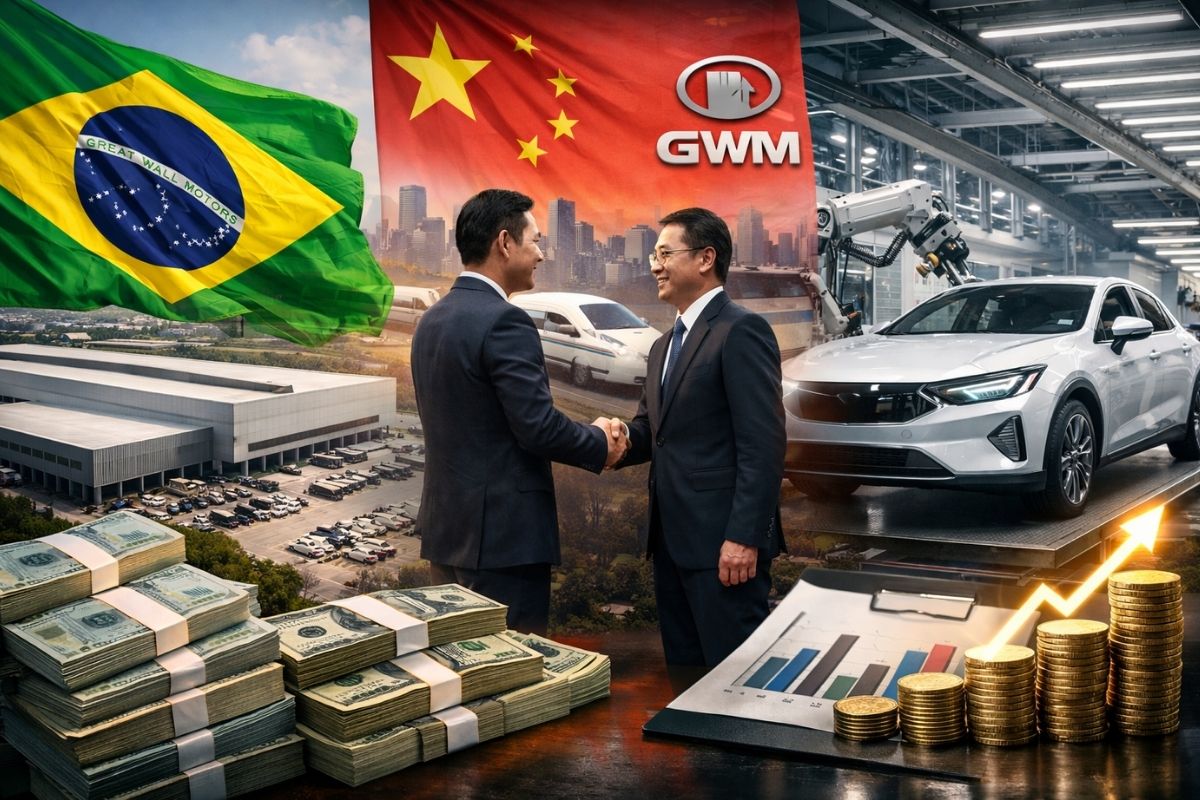
With GWM Negotiating Outside São Paulo, Espírito Santo Enters the Map: Agreement Signed in China Predicts Electric Car Factory in Aracruz, at ParkLog. Casagrande Sees More Sophisticated Economy. The Automaker Talks About R$ 10 Billion in Ten Years and Produces 50,000 Vehicles in Iracemápolis Today.
GWM took a new step in its industrial expansion strategy in Brazil by signing, in China, a commitment that outlines the installation of a second car factory in the country, this time in Espírito Santo.
The forecast is that the unit will be installed in Aracruz, in the northern part of Espírito Santo, within the development area of ParkLog, a movement that expands the automaker’s presence beyond the São Paulo axis and ignites a new competition among states for major investments.
The Signature in China and the Design of the Project in Espírito Santo
The commitment was officially signed on Wednesday (14), in China, by the Vice Governor of Espírito Santo, Ricardo Ferraço (MDB), and representatives of Great Wall Motors, GWM.
-
A new Brazilian shopping center worth R$ 400 million will be built in an area equivalent to more than 4 football fields, featuring 90 stores, 5 cinemas, a supermarket, a college, and parking for 1,700 cars, potentially generating 3,000 jobs.

-
Larger than entire cities in Brazil: BYD is building a 4.6 km² complex in Bahia with a capacity for 600,000 vehicles per year, but the discovery of 163 workers in conditions analogous to slavery has shaken the entire project.

-
With an investment of R$ 612 million, a capacity to process 1.2 million liters of milk per day, Piracanjuba inaugurates a mega cheese factory that increases national production, reduces dependence on imports, and repositions Brazil on the global dairy map.

-
Brazilian city gains industrial hub for 85 companies that is equivalent to 55 football fields.


The gesture formalizes the intention to bring a new industrial front to Espírito Santo territory and positions Aracruz as the designated address to host the factory focused on electric cars.
The public confirmation of the plan was made by Governor Renato Casagrande (PSB) at an event held in a hotel in Vitória.
According to the governor, the arrival of an automaker adds layers of complexity to the local economy, with the potential to attract businesses connected to the automotive chain.
The state government’s reading is that a factory does not come alone: it usually brings services, suppliers, and new industrial activities.
Aracruz and ParkLog: Northern Espírito Santo on the Industrial Map
The forecast indicates Aracruz, in northern Espírito Santo, as the chosen municipality for the new unit, with installation planned in the development area of ParkLog.
The highlight of ParkLog as a development area indicates the search for a space prepared to receive industrial and logistical operations, which is usually decisive when an automaker establishes a plant and needs efficiency to receive inputs and distribute vehicles.
Even with the location’s signaling, there is still no disclosure of practical details about the future factory.
The company was contacted to provide information on production capacity and number of jobs in Espírito Santo, but stated that there is currently no official information on these points.
Industrial Dispute Among States: Why the Movement Matters

The decision to plan a second factory outside São Paulo directly affects the logic of attracting automakers in the country.
When a company expands its presence to another state, a competition for infrastructure, industrial areas, and attraction packages opens up, because an automotive plant usually radiates effects beyond the factory gates.
In GWM’s case, the movement is even more sensitive because the Brazilian operation already has a consolidated industrial address in the São Paulo interior.
By projecting Aracruz as a new base, the automaker signals that it wants to diversify its production geography and that the game of attracting investments is not restricted to a single hub.
GWM’s Investment Plan in Brazil and What Is Still Open
The investment plan reported by GWM last year was about R$ 10 billion over ten years in Brazil.
Within this horizon, the second phase, scheduled between 2027 and 2032, focuses on more than R$ 6 billion in investments.
These numbers help gauge the automaker’s appetite in the country, but do not clarify, by themselves, how much of the package will be directed to Espírito Santo, nor how the company plans to divide projects, technology, and production volume among the different units.
It also remains open how the Espírito Santo plant will connect to the electric vehicle strategy mentioned in the planning of the new site.
What Already Exists in Brazil: Iracemápolis as GWM’s Industrial Base in the Americas
Today, GWM operates a factory in Iracemápolis, in the interior of São Paulo, inaugurated in August 2025.
The São Paulo unit has about 600 workers and a production capacity of 50,000 vehicles per year. This data is central because it establishes the industrial scale already set up by the company in the country.
The Iracemápolis factory also has a strategic characteristic: it is described as the only GWM unit in the Americas and the Southern Hemisphere.
In practice, this reinforces Brazil’s weight as the automaker’s regional platform and explains why a second plant, now projected for Espírito Santo, is seen as a structured expansion rather than a one-off movement.
Models Produced and Portfolio Strategy
In the São Paulo unit, current production consists of three models, each with a distinct market profile.
The hybrid SUV Haval H6, the medium pickup Poer P30, and the seven-seater SUV Haval H9 are manufactured. The combination of hybrid SUV, medium pickup, and seven-seater SUV reveals a bet on high-volume segments with strong commercial appeal.
This portfolio helps understand the backdrop of the announcement involving Aracruz.
If the new factory is designed as an electric vehicle unit, the tendency is for GWM to start organizing Brazilian production in layers, with complementary functions among plants, but without this being officially detailed so far.
Next Steps: Big Promise, Details Still Pending
With the signing in China and confirmation from the government of Espírito Santo, the project enters a phase where expectation and uncertainty coexist side by side.
On one hand, there is the projection of the site in Aracruz, at ParkLog, and the indication of the economic impact defended in Vitória.
On the other hand, there are missing points that usually define the real size of an undertaking: annual capacity, implementation schedule, direct and indirect jobs, and how the Espírito Santo plant fits into the announced investment plan.
What is already clear is the political and industrial message: GWM wants to grow in Brazil and is willing to expand the map of its own operation, putting states on a route of competition for a new generation of factories associated with electric vehicles.
Which state do you think is most prepared to win this competition for global automakers and receive a new GWM factory?








Seja o primeiro a reagir!