





 Portuguese
  English
  Spanish
  6 min of reading
  9 comments


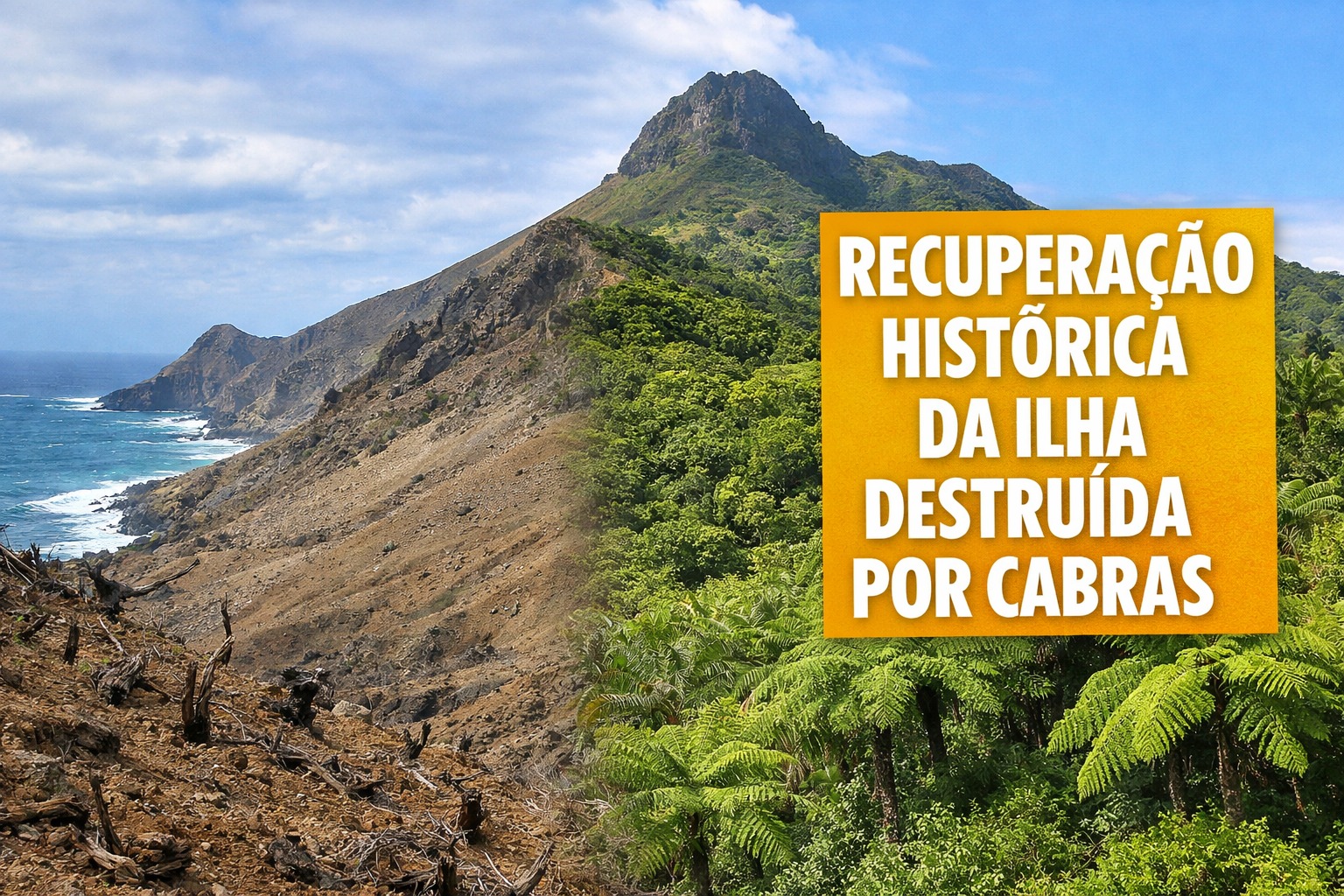


The Island of Trindade Presents Unprecedented Forest Expansion After Removal of Goats, Reversing Centuries of Environmental Degradation Documented by Scientific Study Based on Three Decades of Continuous Environmental Monitoring
The Island of Trindade, a Brazilian territory in the South Atlantic, shows significant environmental recovery after centuries of degradation caused by introduced goats, with a 1,468% increase in forest area over three decades, according to a recent scientific study.
The Environmental Recovery Observed in Recent Decades
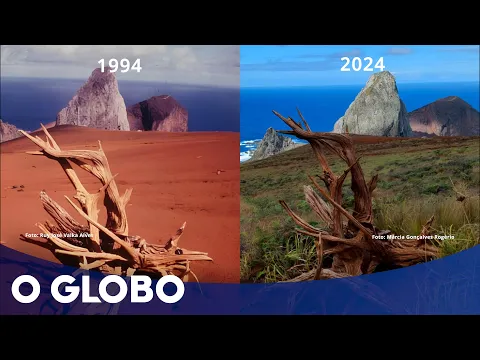
Researchers identified a significant expansion of the island’s vegetation cover, a direct result of the elimination of goats and natural regeneration processes over the past 30 years.
The forest area increased by 1,468%, reaching 65 hectares, while the undergrowth expanded by 325 hectares, an increase equivalent to 319% during the analyzed period.
-
Motorola launched the Signature with a gold seal from DxOMark, tying with the iPhone 17 Pro in camera performance, Snapdragon 8 Gen 5 that surpassed 3 million in benchmarks, and a zoom that impresses even at night.

-
Satellites reveal beneath the Sahara a giant river buried for thousands of kilometers: study shows that the largest hot desert on the planet was once traversed by a river system comparable to the largest on Earth.

-
Scientists have captured something never seen in space: newly born stars are creating gigantic rings of light a thousand times larger than the distance between the Earth and the Sun, and this changes everything we knew about stellar birth.

-
Geologists find traces of a continent that disappeared 155 million years ago after separating from Australia and reveal that it did not sink, but broke into fragments scattered across Southeast Asia.

According to botanist Márcia Gonçalves Rogério, forest growth exceeded 1,000%, accompanied by a broad expansion of grassland and ground cover.
Currently, vegetation covers about 15% of the island’s former green area, having been reduced to just 5% at its most critical moments.

The Scientific Study and Its Authors
The data is part of a study published in the Journal of Vegetation Science, focusing on the vegetation dynamics of the Island of Trindade in the South Atlantic.
The article was authored by Márcia Gonçalves Rogério, Felipe Zuñe, Ruy José Válka Alves, and Nílber Gonçalves da Silva, researchers affiliated with the National Museum.
The research analyzed historical images, records from scientific expeditions, and remote sensing data to reconstruct the environmental scenario of the island over the last three decades.
The work details how ecological factors and the removal of goats directly influenced the process of regeneration of native vegetation.
Strategic Location and Characteristics of the Island
The Island of Trindade forms an archipelago with Martim Vaz, located 48 kilometers away, at the easternmost point of the Brazilian continental territory.
With only 9.2 km², an area equivalent to more than 80 times the Maracanã Stadium, the island has rugged terrain and volcanic origin.
The archipelago occupies a strategic position in the South Atlantic, granting Brazil the right to explore up to 200 nautical miles (approximately 322 km) around the area.
The permanent presence of a Navy garrison and scientists reinforces the geopolitical and scientific importance of the territory.
The Introduction of Goats and the Beginning of Degradation
Environmental devastation began around 1700, after the visit of British astronomer Edmond Halley to the island.
Halley left goats on the island with the intention of providing food for sailors passing through that isolated region of the South Atlantic.
Reports from early expeditions describe lush forests dominated by redwood trees of the species Colubrina glandulosa.
Over time, the goats reproduced uncontrollably and began to intensely consume the available vegetation.
Environmental Impacts of the Presence of Animals
The forest, which occupied about 85% of the island, was reduced to less than 5% due to the actions of goats, pigs, and sheep.
The loss of vegetation cover exposed the soil, accelerating erosion processes and compromising the environmental stability of the territory.
The steep terrain made natural regeneration difficult, worsening the effects of degradation over more than two centuries.
The fragility of the ecosystem became evident in light of its inability to recover while the animals remained on the island.

The Elimination of Goats and the Environmental Turnaround
By the end of the 1990s, the goat herd was estimated to have reached about 800 animals, according to estimates from Professor Nílber Gonçalves da Silva.
The Navy began the elimination of the animals at the end of the decade, facing difficulties due to the steep and inaccessible areas.
The action was supported by scientific expertise from the National Museum and environmental agencies, resulting in the total eradication of goats in 2005.
The removal of the animals marked the beginning of a continuous process of natural regeneration of the island’s vegetation.
Natural Regeneration and New Vegetation Formations
After the elimination of the goats, vegetation began to reestablish itself without any direct human intervention.
Notable are the giant ferns Cyathea copelandii, regarded as a botanical relic exclusive to the Island of Trindade.
The forest began to expand mainly in the higher areas, near Pico do Desejado, which is 600 meters high.
Environmental factors, such as increased precipitation during the wetter periods, contributed to accelerating the recovery of green cover.
Scientific Monitoring of Recovery
Researchers collected data from previous expeditions, with vegetation marking points and detailed historical records.
The use of images and remote sensing allowed for monitoring the evolution of vegetation cover over the past 30 years.
The analysis revealed a tenfold increase in green cover since the removal of goats from the island.
In addition to the forest, there was significant expansion of grasslands and a reduction in bare soil areas.
Ecological Limitations and Current Challenges
The Colubrina glandulosa, a species that originally dominated the island, was completely wiped out over the historical process.
In 1959, only one moribund specimen was found among dead trunks, marking the end of the species’ natural presence on the island.
Subsequent reintroduction attempts used seedlings from the mainland, resulting in a few individuals currently present.
Despite this, the forest that forms today is distinct from the original and predominantly composed of giant ferns and native species.
Invasive Species and Environmental Management
Invasive species, such as almond trees, are also present on the island, primarily concentrated near the accommodations.
The Navy, ICMBio, and Project Reter are conducting actions for the gradual removal of these invasive plant species.
According to researchers, removal needs to be careful to prevent erosion, since the volcanic soil is highly fragmented.
The almond trees help temporarily in soil stabilization and provide food for endemic crabs in the region.
Current Biodiversity and Endemic Species
Surveys conducted by Professor Nílber Gonçalves da Silva indicate a significant increase in the number of recorded species.
In 2006, there were about 130 cataloged species, a number that surpassed 200 after a new survey in 2010.
Although many species are non-native, most of the natives are endemic, existing exclusively on the Island of Trindade.
This fact underscores the ecological relevance of the archipelago in the context of Brazilian biodiversity.
History, Occupations, and Curious Facts
The island was discovered in 1501 by navigator João da Nova, in the service of King D. Manuel I of Portugal.
Over the centuries, Trindade suffered attempts of occupation by English, Portuguese, and Brazilian forces, along with episodes of failed colonization.
The place also functioned as a prison between 1924 and 1926 and housed Azorean couples in a failed experiment.
Among legends, the story of a supposed pirate treasure buried in a flooded tunnel dug by the waves stands out.
Mysteries, Accidents, and Geological Formation
Trindade has recorded numerous fatal accidents, especially caused by wave surges that surprise beachgoers and military personnel.
By 2018, 17 people had died on the island, victims of waves, falls, heart attacks, and one recorded murder.
The island houses what remains of Brazil’s last volcano, formed by eruptions that occurred 3 million years ago.
On Morro do Paredão, it is still possible to observe half of the preserved volcanic crater, while the other half has been destroyed by the sea.
With information from O Globo.







Quero ter pelo menos um casal dessas cabras onde procuro alguém pode informar
The proverb of “British are the roots of all evil” has been confirmed, next to the Israelis. Not enough destroying other countries using Jews or convicts, British are also destroying forest with goats.
Que mal, cuando ahí sobre población las eliminan y porque no hacen lo mismo con los humanos que destruye n todo contaminan desforestan, a ellos no les hacen nada!!!!.
Começando por você.