





 Portuguese
  English
  Spanish
  5 min of reading
  0 comments


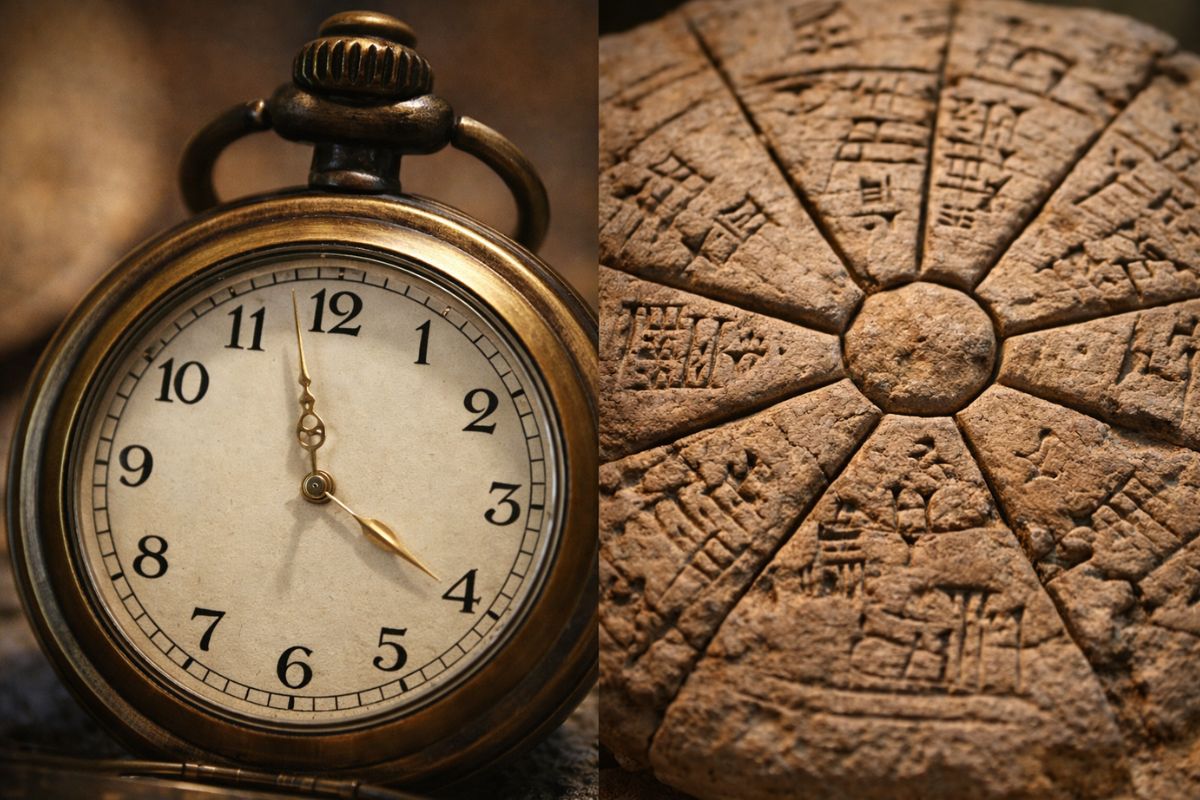
The clock marks 60 minutes per hour because the Sumerians of Mesopotamia discovered 5,000 years ago that the number 60 is exceptionally divisible, facilitating calculations in agriculture, trade, and astronomy, and even the French Revolution could not replace this system when it attempted to in 1793.
Looking at the clock seems like such a banal gesture that no one stops to question why it works that way. But behind the 60 minutes that make up each hour on your clock lies one of the most enduring legacies of human history, a mathematical decision made about 5,000 years ago in ancient Mesopotamia that directly influences how the entire world organizes its time to this day. The way we measure hours did not arise by chance or arbitrary convention. It emerged because the Sumerians found in the number 60 an efficiency that no other system could surpass.
The sexagesimal system, based on the number 60, was developed by the Sumerians and refined by the Babylonians. Unlike the decimal system we use to count money and measure distances, the clock follows a different logic because 60 offers an advantage that 100 simply does not have: it can be divided exactly by 2, 3, 4, 5, 6, 10, 12, 15, 20, and 30. This exceptional number of divisors made day-to-day calculations much more practical in a time without calculators, and that is why your clock does not mark 100 minutes per hour.
Why the Sumerians chose the number 60 that is still on your clock
The choice was neither philosophical nor religious. According to the BBC, it was purely practical: the number 60 facilitates common fractions like half, a third, and a quarter, essential operations for dividing harvests, calculating lunar cycles, and organizing trade exchanges.
-
A 90-meter secret corridor remained hidden for 2,000 years under gladiator sand in Croatia and now reveals how the Roman Empire organized death away from the public eye.

-
Capable of flying above Mach 3.3 at nearly 29,000 meters altitude and crossing up to 4,800 km without a pilot, the secret drone D-21 was created to invade forbidden territories faster than any fighter jet and disappear before being detected.

-
A gigantic project in the Netherlands is using the sediment from a degraded lake to create artificial islands, improve water quality, and restore natural shorelines.

-
After seeing a 100% automated factory in Shanghai, the president of Honda exclaimed, “we don’t stand a chance”; China accelerates electric cars, cuts costs, and exposes the brand’s crisis worldwide.

In a civilization where everything was divided manually, having a numerical system that produced whole number results in most divisions saved time and reduced errors. The clock you check today inherits this efficiency.
The advantage of 60 over 100 becomes evident when trying to divide the two. The number 100 can only be divided exactly by 2, 4, 5, 10, 20, 25, and 50. Try dividing 100 by 3 and the result is a repeating decimal. Divide 60 by 3 and you get exactly 20. Divide by 6 and you get 10.
This precision in divisions was fundamental for a civilization that needed to measure time based on astronomical cycles and organize agricultural life accurately. The clock with 60 minutes is a direct inheritance of this efficient mathematics.
How the Babylonians used their own bodies to count to 60
One of the most ingenious practices of the Babylonians involved using their hands as a calculating tool. Using the thumb to count the phalanges of the other four fingers of one hand, it was possible to reach the number 12.
Each finger has three phalanges, and four fingers times three phalanges gives exactly 12. With the other hand, the Babylonian marked how many times this cycle of 12 was completed, reaching 60 with five repetitions.
This method required no external tools and worked anywhere, from the market to the agricultural field. The practicality was such that the system consolidated not only for counting objects but also for measuring time, angles, and astronomical distances.
The modern clock carries the mark of a system that was born at the fingertips of Mesopotamian merchants and farmers 5,000 years ago. The connection between the human body and the numerical system was so natural that it required no explanation.
How the 60-minute clock system spread throughout the ancient world


The consolidation of the sexagesimal system did not happen overnight. Scholars like Claudius Ptolemy, in the 2nd century, used the model of 60 to divide the circle into 360 degrees, directly influencing how we measure time and space to this day.
With the advancement of astronomy in Ancient Greece and Alexandria, the system became a scientific standard. Astronomers needed a measurement system that matched the precision of celestial cycles, and the sexagesimal clock delivered exactly that.
The standardization was inherited by successive civilizations, from the Roman Empire to the medieval Islamic world and the Renaissance Europe. Each culture that adopted the system reinforced its permanence, creating an inertia that made any change practically impossible.
Calendars, maps, navigation instruments, and, of course, the mechanical clock invented in medieval Europe were all built on the foundation of 60 minutes that the Sumerians established millennia before.
The failed attempt to change the clock from 60 to 100 minutes
During the French Revolution, the obsession with rationality led to a bold attempt to replace the system that governed the clock. In 1793, revolutionaries created a decimal model with 10 hours per day, 100 minutes per hour, and 100 seconds per minute.
In theory, the system was logically coherent with the metric system that France was implementing for weights and measures. In practice, it was a disaster.
The population massively resisted the change of the clock. The cultural habit of measuring time in 60-minute hours was so ingrained that people simply refused to adopt the new model.
Work routines, religious ceremonies, meal times, and all social organization were structured around 24 hours of 60 minutes. In just two years, the decimal time system was abandoned. The clock with 60 minutes triumphed over the French Revolution.
Why no one has managed to change the 60-minute clock in 5,000 years
The permanence of the sexagesimal system on the clock is not explained by a lack of alternatives. It is explained by the combination of mathematical efficiency, adaptation to natural cycles, and a cultural inertia of 5,000 years that makes any replacement more costly than the benefits it would bring.
Currently, discussions arise about eliminating time zones to simplify global communication, but even these proposals do not touch the foundation of 60 minutes.
The human rhythm is deeply linked to the natural cycle of day and night, and any radical change in how the clock measures time would face biological resistance in addition to cultural. The fact that we still use a system created in ancient Mesopotamia demonstrates that some solutions are so efficient that they transcend entire civilizations without needing updates.
The number 60 is not just a historical curiosity engraved on your clock. It is proof that mathematics, when well applied, can last longer than empires.
Have you ever wondered why the clock marks 60 and not 100? What surprised you more: the method of counting with the phalanges of the fingers or the failure of the French Revolution to change the system? Share in the comments. This kind of curiosity about everyday life completely changes the way you look at a gesture as simple as checking the time.







Seja o primeiro a reagir!