





 Portuguese
  English
  Spanish
  5 min of reading
  0 comments


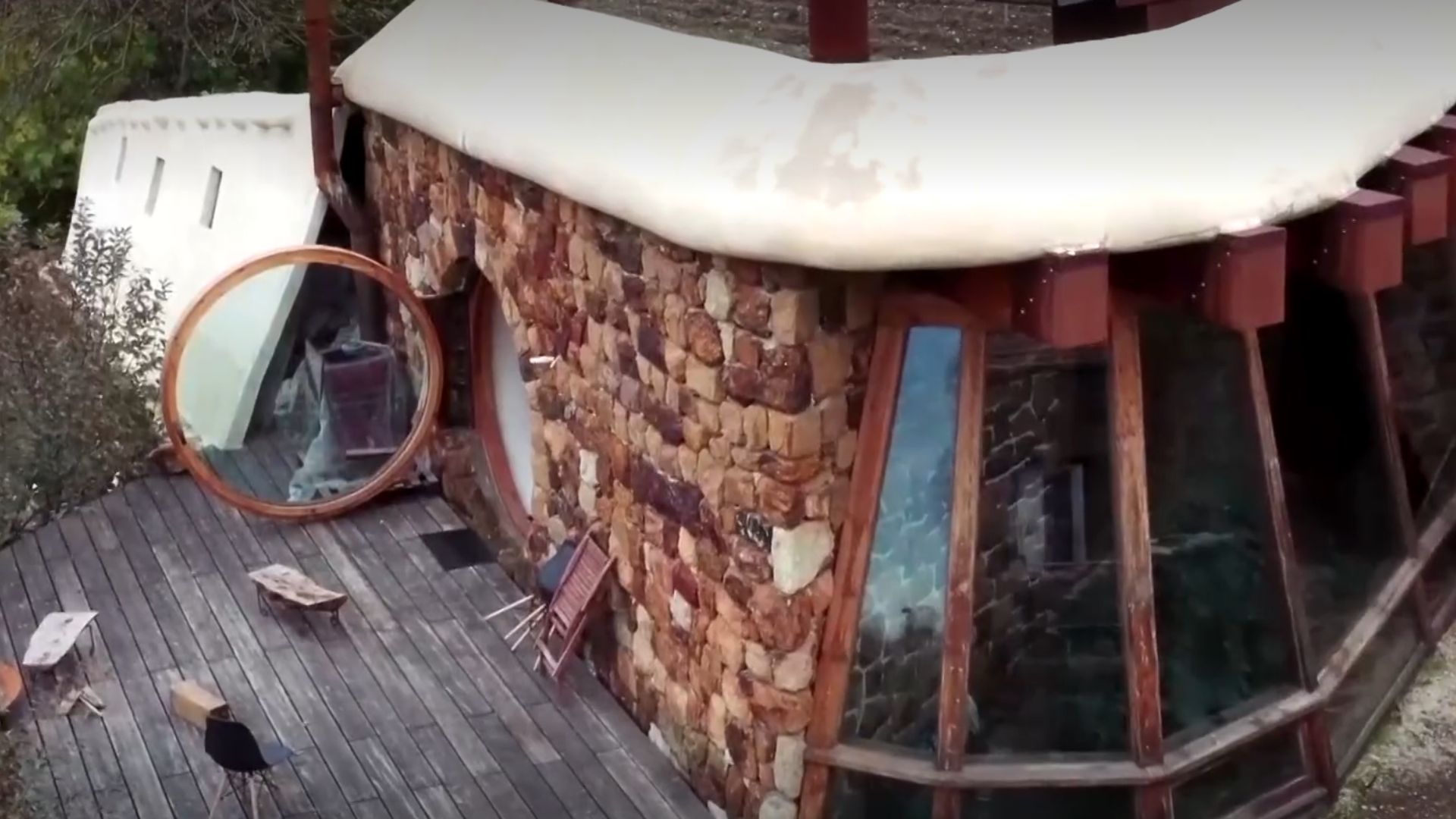
Project in Lebanon brings together tires, glass bottles, rainwater harvesting, solar energy, and an integrated greenhouse in a house designed to operate off the conventional grid, combining ancestral techniques, repurposed materials, and low-impact environmental solutions in a semi-buried residence.
In the village of Baskinta, in the mountainous region of Lebanon, architect Nizar Haddad developed the Lifehaus, a residence designed to operate off conventional water and energy grids and to reduce the environmental impact of construction.
The project incorporates about 1,200 repurposed tires in the walls, glass bottles integrated into the structure, rainwater harvesting, water reuse, and an integrated greenhouse in the property.
The proposal emerged less as a visual experiment and more as a practical response to a scenario of fragile infrastructure.
-
The aircraft carrier HMS Prince of Wales is heading to the Arctic with F-35 fighters, helicopters, and warships in an operation that repositions the United Kingdom at the forefront of NATO in 2026.

-
He found the largest gold shipwreck in the United States with tons of the precious metal at a depth of 2,400 meters in the Atlantic and recovered a treasure that no one thought possible to reach, but 500 gold coins disappeared without explanation.

-
The United States has a serious problem with its F-35s: China is already producing fighters at a pace that exceeds American capacity and could manufacture up to 300 aircraft per year before the end of the decade, shifting the global military balance.

-
A retired IT professional built a 22-meter boat in his backyard in Oklahoma with a school bus engine, light pole masts, and handmade watertight doors to become the redneck version of Jacques Cousteau.

In a report published by Reuters in December 2022, Haddad presented the house as a materialization of his vision for environmental architecture, in a country that has faced successive energy and supply crises.
Instead of relying on the traditional grid, the idea was to build a dwelling capable of operating with its own resources and demonstrating that low-impact solutions can come to fruition.
Self-sufficient house in Lebanon combines sustainable architecture and recycled materials
The Lifehaus has 160 square meters, or 1,722 square feet, according to Architectural Digest and the case study by Fossil Free Zones.
The space includes a living room, mezzanine, terrace, greenhouse, and technical area, in a semi-buried layout that follows the topography and enhances thermal performance by bringing the building closer to the ground and the surrounding stone mass.
One of the most unusual solutions lies precisely in the walls.

Architectural Digest reported that the lime-coated panels were filled with 1,200 car tires taken from a local landfill, repurposing that reduces the need for new materials and adds thermal mass to the structure.
The publication also described the tires as part of a durable system, capable of helping regulate temperature and the structure’s resilience.
In addition to the tires, the property incorporates reused glass bottles in some sections of the walls.
Instead of serving merely as finishing, they allow natural light to enter certain points inside without relying solely on conventional windows, creating a functional effect of diffuse lighting.
The house also combines stone, clay bricks, sheep wool for insulation, reeds, and other local or recycled materials, in a logic that revives ancient construction knowledge and adapts it to current demands for comfort and efficiency.
Tires in the walls and glass bottles help with thermal comfort
The daily operation was planned to require as little external infrastructure as possible.
The main source of electricity comes from solar panels, while the Fossil Free Zones study also mentions a vertical wind turbine, the movement of water within the house, a generating electric bicycle, and the use of biogas obtained from black water for cooking.
The same material notes the presence of efficient equipment, such as LED lighting and solar electric stove, which reduces energy demand even before generation.
This combination helps explain why Haddad, in an interview with Architectural Digest, stated that he managed to reduce the project’s energy dependence by cutting heating and cooling consumption.
According to him, the reduction of thermal load allowed the installation of nine solar panels instead of twelve, as well as a smaller inverter.
The logic, therefore, is not just to produce clean energy, but to lower the structural consumption of the house to make autonomy more viable.
Solar energy, biogas, and rainwater sustain the operation of Lifehaus

The water management follows the same closed-loop principle.
Architectural Digest reported that the residence collects rainwater and integrates it into an internal reuse system, while Fossil Free Zones details that gray water is used for irrigation of crops.
In the case of black water, the study indicates that it goes through a septic tank for biogas production and, after treatment, can also be used for irrigation.
This process is not limited to storage.
The study points to the presence of filtration by reeds, a biological resource that helps reintegrate treated water into the agricultural cycle of the property.
In practice, the project attempts to keep within its own grounds stages that, in conventional models, rely on separate public systems for water supply, sewage, energy, and organic waste disposal.
The greenhouse attached to the property plays a central role in this arrangement.
Images and descriptions from Fossil Free Zones indicate a glass-enclosed environment with vegetation, integrated into the thermal performance of the house, and Architectural Digest details that the heated air there helps with internal heating during winter.
In summer, the circulation through ducts and passages under the structure helps cool the air before it enters the rooms, reducing the need for conventional air conditioning.
Integrated greenhouse increases food production and helps regulate temperature
The insulated earth walls and natural ventilation complete this passive thermal comfort system.
The case study states that the mass of the walls stores heat in summer and returns thermal stability throughout the year, while the combination of greenhouse, insulation, and ventilation eliminates the need for heating or cooling with external resources.
In other words, the house does not rely solely on more efficient equipment but on bioclimatic design to function better from its very form.
The project was also conceived as a replicable prototype.
The Lifehaus describes the experience as an initiative aimed at developing low-cost, self-sufficient, and energy-neutral housing, with the potential for application on different scales.
In Architectural Digest, Haddad stated that the five principles adopted — local or reused materials, bioclimatic design, water management, renewable energy, and waste management — can be adapted to other climates and locations, as long as they respect the conditions of each region.
The construction also mobilized shared knowledge among professionals and residents.
Fossil Free Zones reports that the project brought together community members with diverse scientific and technical backgrounds, and Architectural Digest highlighted the exchange of experience with specialists accustomed to traditional methods, such as the production of earth bricks.
For Haddad, this recovery does not mean copying the past, but reclaiming techniques that have lost ground and combining them with contemporary engineering.
Nizar Haddad’s project seeks to inspire low-impact housing
In this sense, the house in Baskinta has become more than an unusual dwelling carved into the mountain.
By transforming difficult-to-dispose waste, such as tires and glass, into structural and functional parts of a residence that captures water, produces energy, reuses effluents, and integrates cultivation into the domestic space, the Lifehaus has come to operate as a concrete demonstration of architecture aimed at reducing external dependence, using local resources, and attempting to lower environmental costs throughout the entire lifecycle of the building.







Seja o primeiro a reagir!