





 English
  Francês
  Alemão
  Italiano
  Japonês
  Norueguês
  Portuguese
  Spanish
  5 min of reading
  0 comments


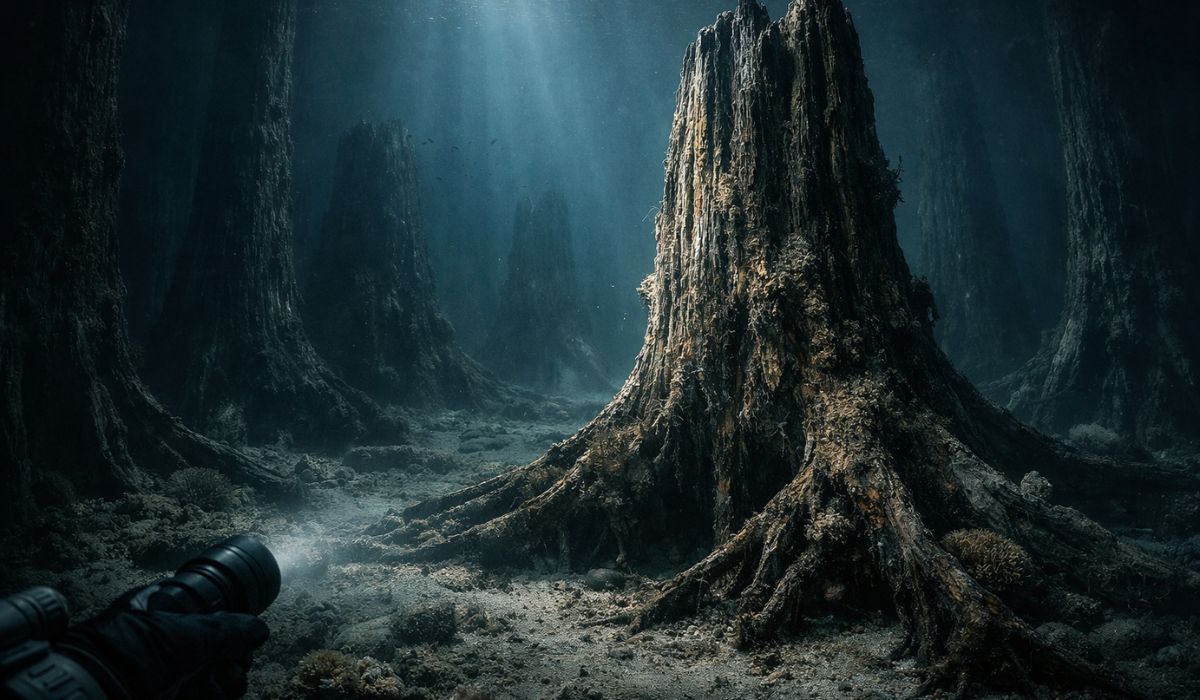
An ancient submerged forest in the Gulf of Mexico gathers wood preserved since the ice age and organisms studied by scientists, in a discovery that connects past climate change, marine biodiversity, and biomedical research.
An ancient cypress forest preserved underwater in the northern Gulf of Mexico, about 18 meters deep and near the coast of Alabama, in the United States, has returned to the center of scientific research for two main reasons.
The first involves clues about the landscape and climate of the last ice age.
The second is linked to the study of microorganisms, enzymes, and compounds with potential biomedical and biotechnological applications.
-
350-year mystery may have been solved: remains of a soldier who inspired the hero of The Three Musketeers found beneath a church in the Netherlands.

-
NASA photographed a nearly perfect square with 3 km sides on Mars, 13 times larger than the Great Pyramid of Giza, but the official explanation is natural erosion; still, no one has explained why the four sides have almost identical lengths.

-
Starlink breaks the barrier of 10,000 satellites in orbit and takes its expansion to an unprecedented level, with a direct impact on global internet, technological competition, and the race for space.

-
Japan finds an alternative to oil amid rising prices by transforming ocean balance into electricity with a new technology that maintains efficiency even when the sea changes.


Although the discovery is often associated with the mark of 60,000 years, the studies published so far indicate a broader age range, between 42,000 and 74,000 years.
Still, researchers and agencies related to ocean exploration use the approximate number to describe the antiquity of the submerged site.
The preservation was favored by burial in oxygen-poor sediments, a condition that reduced the decomposition of the wood.
Submerged forest in the Gulf of Mexico helps explain climatic past
The site contains remains of an ancient bald cypress forest, a species typical of flooded areas in the southern United States.
During a period when sea levels were lower and the coastline occupied a different position, those trees grew on solid ground, in a swamp environment.
Later, changes in sea level and burial by sediments kept the wood isolated for millennia.
When analyzing the samples, researchers found material in an unusually well-preserved state.
Paleoclimatologist Kristine DeLong from Louisiana State University reported that the wood still smelled like freshly cut cypress, a fact often cited to illustrate the degree of preservation of the site.
In a marine environment, the usual expectation would be for more accelerated degradation by bacteria and wood-boring organisms.
This collection of logs is used to reconstruct the environmental history of the region.
The growth rings and sedimentary context can indicate what the climate was like in the Gulf during the last glaciation, when the area now submerged was part of a continental landscape.
The research also helps map episodes of sea-level rise and changes in the coastline of the southeastern United States.

How the area was exposed after storms on the seabed
The ancient forest did not “come back to life” in a literal sense.
What happened was the re-exposure of part of this material after storms removed sediments from the seabed.
One of the most cited episodes by researchers is the passage of Hurricane Ivan in 2004, which cleared the way for previously buried logs and stumps to reappear.
After that, divers and scientists began documenting the extent and relevance of the site.
Since then, the site has been investigated by academic teams and projects supported by NOAA, the United States agency for oceans and atmosphere.
The interest is not limited to geology or paleoclimatology.
With the wood once again exposed, the environment began to host a marine community with fish, invertebrates, and microscopic organisms associated with ancient organic matter.
Microorganisms and shipworms enter the focus of biomedical research
One of the most cited lines of research involves the so-called shipworms, mollusks that bore into and consume submerged wood.
Despite the name, they are not worms, but bivalves adapted to this type of substrate.
According to researchers, the interest in these animals is mainly in the symbiotic bacteria that live associated with them.
According to NOAA, previous work with bacteria found in shipworms had already led to the investigation of at least one antibiotic for the treatment of parasitic infections.
From this, the project in Alabama began to examine whether the microbiome established in the ancient wood could reveal new molecules, with potential pharmaceutical or industrial value.
In the field, researchers collected logs, removed hundreds of animals, produced microbial cultures, and separated samples for genetic and chemical analyses.
This point helps distinguish what has already been confirmed from what is still under study.
There are records of a search for compounds with antimicrobial, analgesic, anticancer potential and for enzymes capable of degrading wood.

At the same time, the public data consulted do not confirm that scientists have already isolated novel drugs ready or validated from this forest.
What exists, so far, is a biological prospecting front in search of candidate molecules.
Biomedical potential of the ancient forest is still under study
Research in extreme or underexplored environments has gained ground because many microorganisms produce chemical substances to compete, defend themselves, or adapt.
These molecules can serve as a basis for studies on new drugs or industrial processes.
In the case of the submerged forest, scientists believe that the prolonged isolation and unique composition of the habitat may increase the chance of finding unusual organisms and compounds.
Moreover, the ancient wood serves as a support for its own ecological chain.
NOAA describes the site as a habitat capable of sustaining fish, invertebrates, and microorganisms in communities that, in some aspects, resemble reefs.
In this context, biological diversity is of interest not only for the description of the ecosystem but also for its potential use in areas such as drug development, enzyme production, and biotechnological utilization of plant biomass decomposition.

Still, the distance between the discovery of a promising compound and its transformation into a drug is great.
Even when a molecule shows antibiotic activity or action against tumor cells in preliminary tests, it still needs to go through validation, safety, efficacy, and pharmaceutical development stages.
Therefore, the most accurate formulation at this moment is that of research with potential, and not that of an already consolidated source of new drugs.





Seja o primeiro a reagir!