





 English
  Francês
  Alemão
  Italiano
  Japonês
  Norueguês
  Portuguese
  Spanish
  4 min of reading


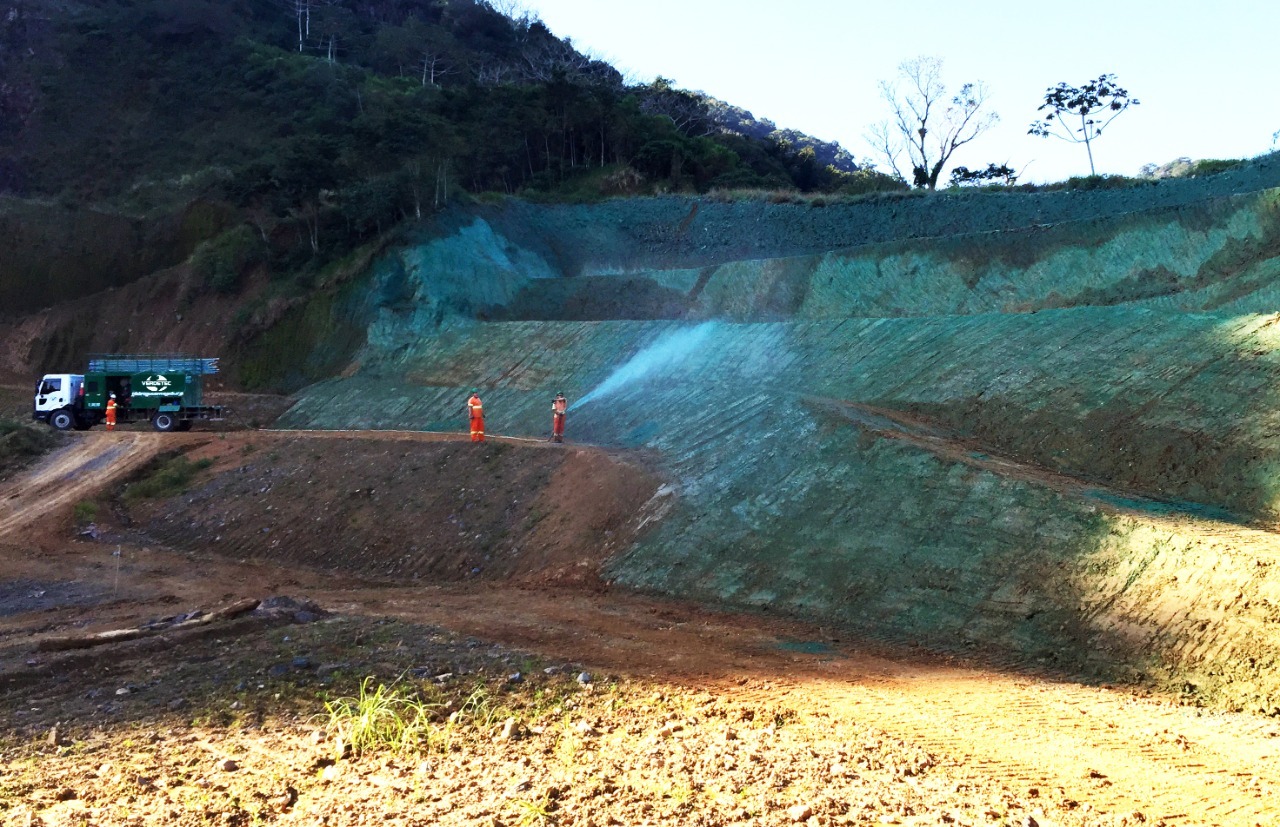
Use of Blasting Technology on Slope Lands or Erosion Soils Prevents Landslides; It Also Contributes to the Environment by Reducing CO2 Emissions Up to Ten Times Compared to Traditional Logistics
São Paulo, April 2022 – Hydroseeding is undoubtedly the best option for covering bare soils through the use of fast-growing plant species. This is because the technology used doesn’t lay sod on slopes or works; it “paints” the soil using a blasting and mixing equipment.
What has defined hydroseeding as the “darling” of agriculture and companies in road, urban, railway, and mining infrastructure is precisely its faster and more practical application on projects, eliminating soil erosion risks while covering vegetation to retain slopes and difficult terrains.
It is estimated that each piece of equipment can plant up to 30,000 m2 of vegetation per day, requiring less than 45 days for lawns, ground covers, or slopes to be covered by robust vegetation.
-
While Russia dominates the global wheat market, Brazil emerges as an unexpected competitor in the Cerrado, offering grain available in July and August when stocks in the Northern Hemisphere are at their lowest point of the year.

-
China returned almost 20 Brazilian ships with soybeans, but now everything could change: the country that buys 80% of the grain is considering relaxing regulations after impurities held up shipments of thousands of tons and caused million-dollar losses.

-
Chinese giant worth nearly R$ 4 billion that manufactures cables for electric cars, solar energy, and robotics wants to open a factory in SC.

-
Many employers do not know, but the law guarantees domestic workers a 25% increase in salary during trips, 50% for overtime, 20% for night shifts, and 17 additional benefits that can lead to labor lawsuits if not paid.


This revegetation model consists of applying a mix of selected seeds of herbaceous species with an emphasis on grasses, legumes, chemical fertilizers, organic fertilizers, wood fiber mulch, and adhesive polymers.
According to Bruno Watanabe, CEO of Grupo VG – an accelerator holding of greentechs, considered one of the largest operational hydroseeding groups in the country -, by dispensing with soil preparation or application of blankets, the process directly contributes to the environment. “With the aim of reducing CO2 emissions from freight and transportation, we perform intelligent logistics through seed planting in fiber mulch instead of sod or seedlings. Another sustainable part is that the seedlings do not require potable water, as they are planted during the rainy season,” he explains.
Types of Hydroseeding
VG Hydroseeding has been adapting to the needs of its clients in various regions of the country. Although it offers several application solutions, there are two types that are most sought after by companies in road, urban, railway, and mining infrastructure.
- Liquid Sod – ideal for soils with low susceptibility to erosion and a maximum slope of 45°. Liquid sod is a hydroseeding process made by blasting a high-viscosity solution containing seeds, fertilizers, wood fiber mulch with fixatives, and additives.
- Liquid Biomantle – ideal for damaged soils, with susceptibility to erosion and slopes above 45°. It is an innovative erosion control and vegetation covering process for critical areas. It consists of using the hydroseeding process to apply to the soil a high-performance material made up of wood fiber mulch, hydro-absorbent polymers, and high-performance mineral-based fixatives. This material, along with fertilizers and seeds, when applied, forms a mat of intertwined fibers with high cohesion to the soil. This mat adheres completely to the soil, forming a protective layer and an excellent growth medium for seeded vegetation.
Biodiversity and Pollen Banks
Floral vegetation is part of the regeneration and balance of the entire ecosystem. The development of genetically modified organisms in large-scale agriculture accelerated the growth of monocultures, as seen in corn and soybean productions. This subject is controversial as it puts pollinators at risk – and that is why it has been debated.
A solution found to address the challenge is the development of “pollen banks,” planting flowering vegetation around highways and solar farms, for instance, that benefit the “feeding” and preservation of pollinators: usually insects such as bees, flies, butterflies, moths, wasps, beetles, and ants, beings essential for the future of upcoming generations.
Technology vs Safety
One of the most relevant differences of hydroseeding is safety by reducing the rate of work accidents on construction sites, as it eliminates the need for work at height and reduces exposure of workers in risk areas such as roadside margins or locations where earth movement occurs.
It is worth noting that this reduction of professionals in loco thanks to hydroseeding solves the challenge of idle professionals, as, in routine situations, field engineers remain on-site waiting and depending on approvals from the occupational safety area.
About Grupo VG – It is the holding company responsible for managing and accelerating the greentechs Vertical Garden, ONE, G-BRANDS, Watanabe, and Hydroseeding VG. With more than 4,500 executed projects in full-service landscaping, it has branches in South America, North America, and Europe. Its methodology is to offer solutions in full-service landscaping, sustainability, and environment, counting on a multidisciplinary project team formed by architects, engineers, biologists, landscapers, agronomists, decorators, communicators, advertisers, among others. It is the only company with an active ecosystem to consolidate the landscaping sector in Brazil.
Source: Orto Comunicação







Seja o primeiro a reagir!