





 Portuguese
  English
  Spanish
  4 min of reading
  150 comments


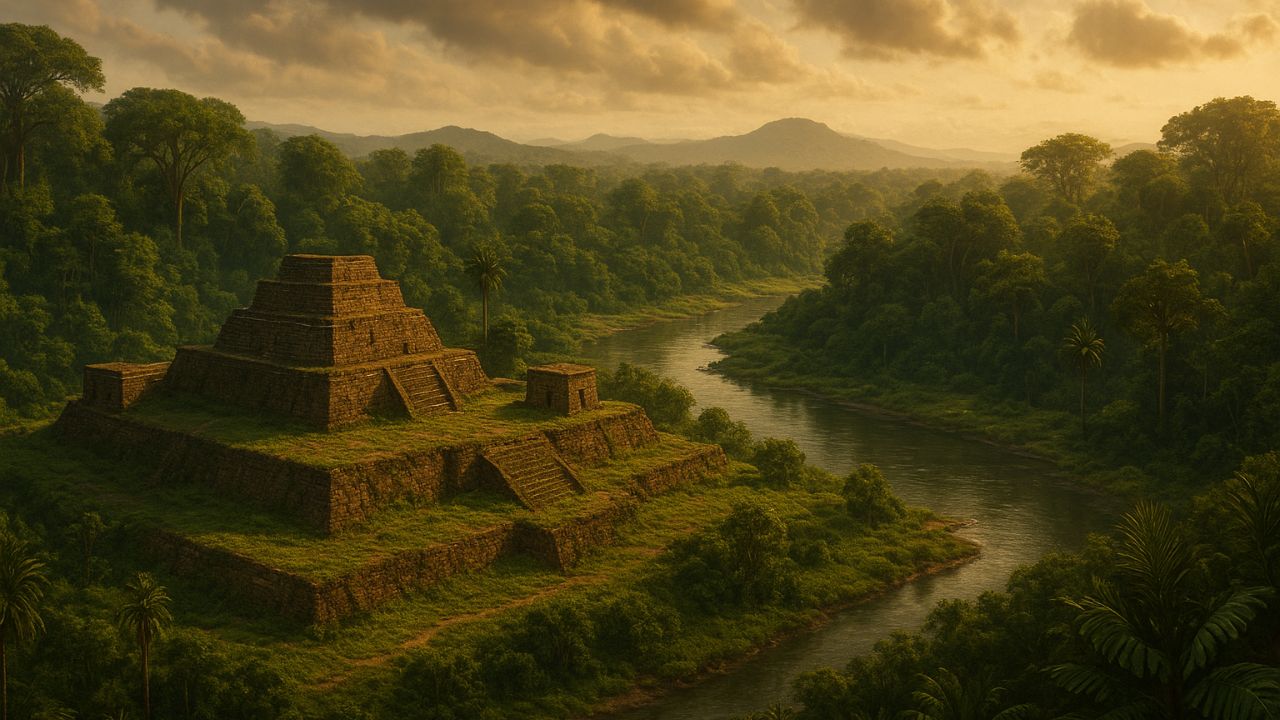


Long Before the Arrival of the Portuguese, Brazil Before 1500 Was Home to Complex Civilizations That Built Cities and Created the Amazon Rainforest.
The history taught in schools often starts in 1500, with the “discovery” by the Portuguese. However, Brazil before 1500 was already a densely populated territory, home to millions of people. As detailed by recent research highlighted by Canal Nostalgia, what existed here were not just small isolated groups, but organized civilizations that developed social and environmental engineering on a large scale.
The “green hell,” as the Amazon was nicknamed, was, in fact, an urban and agricultural center. Historical accounts, such as that of the Spanish friar Gaspar de Carvajal in 1542, who spoke of “cities that seemed endless,” were dismissed for centuries as fantasy. Now, modern archaeology, using technologies like LIDAR, is confirming: the Amazon was home to perhaps ten million people, more than the population of Portugal at the same time.
The Myth of the Empty Amazon vs. Historical Reality
The first European account of the Amazon River, written by Carvajal, describes a startling reality. He mentions fleets of “200 canoes“, each with 20 to 40 warriors, and settlements so dense that, in his words, “if a needle were dropped from the air, it would certainly hit the head of an indigenous person and not the ground.” Canal Nostalgia revives this account to illustrate the shock between what was seen and what was reported later.
-
Friends have been building a small “town” for 30 years to grow old together, with compact houses, a common area, nature surrounding it, and a collective life project designed for friendship, coexistence, and simplicity.

-
This small town in Germany created its own currency 24 years ago, today it circulates millions per year, is accepted in over 300 stores, and the German government allowed all of this to happen under one condition.

-
Curitiba is shrinking and is expected to lose 97,000 residents by 2050, while inland cities in Paraná such as Sarandi, Araucária, and Toledo are experiencing accelerated growth that is changing the entire state’s map.

-
Tourists were poisoned on Everest in a million-dollar fraud scheme involving helicopters that diverted over $19 million and shocked international authorities.


Why, then, did 19th-century scientists find an “empty” forest? The answer lies in demographic collapse. Between the 16th and 19th centuries, diseases brought by Europeans (influenza, smallpox, measles), against which indigenous peoples had no immunity, and conflicts wiped out entire populations. Survivors retreated into the interior of the forest. When naturalists returned centuries later, the vegetation had reclaimed the abandoned cities, and they erroneously concluded that the forest had always been “wild” and that Carvajal had fantasized.
Lost Cities: Archaeology Confirms the Past


The difficulty of excavating in the Amazon, due to its vastness and rapid decomposition processes in a humid environment, meant that these cities remained hidden for centuries. However, recent technologies have changed the game. Canal Nostalgia explains that LIDAR (Light Detection And Ranging), a laser sensor mounted on aircraft, can “see” through the tree canopy and accurately map the terrain, revealing ditches, roads, and foundations.
Thanks to LIDAR and tools like Google Earth, previously invisible structures have been revealed. In Ecuador (Upano Valley) and Bolivia (Casarabe culture), extensive urban centers, with plazas, platforms, and road networks of up to ten kilometers have been found. In Brazil, the famous Acre geoglyphs, perfect geometric shapes carved into the ground, some over 3,000 years old, also attest to this complex occupation, often being discovered, ironically, through deforestation.
Engineering and Urbanism: How Amazonian Civilizations Lived
These were not stone cities like those of the Incas or Aztecs, as the available raw material was earth. But their engineering complexity was equivalent. Marajó Island is an example of sophistication. The local civilizations, from 400 A.D., built “tesos”, gigantic earth platforms to raise their homes, ceremonial centers, and cemeteries above the level of annual floods.
More than that, the Marajoara created a complex hydraulic control system, with dams and channels that held water in the dry season and drained excess during floods. These artificial lakes also served as fish and turtle farms. In the Upper Xingu, another complex society thrived. Archaeological remains reveal a system of circular villages interconnected by straight roads, forming an urban network. The largest of them, Kuhikugu, may have housed about 50,000 people, supported by large cassava fields and orchards, resulting in healthier and better-nourished populations than their European counterparts at the same time.
The Amazon as a Monument: The Forest That Man Created
The greatest revelation about Brazil before 1500 is that the Amazon Rainforest itself is, to a large extent, a human construction. Canal Nostalgia highlights the existence of Terra Preta de Índio, a dark and extremely fertile soil that is not natural to the Amazon basin. It was intentionally created by indigenous peoples through a millennia-old composting process, transforming their organic waste (food scraps, broken pottery, bones) into powerful fertilizer that enabled intensive agriculture.
This fertile land allowed for what we now call “agroforestry.” The indigenous peoples not only harvested but also actively domesticated and managed the forest. A cited study shows that, out of the 16,000 tree species in the Amazon, 227 are “hyper dominant” (comprising half of the forest). Many of them, such as açaí, cocoa, guarana, and Brazil nuts, were domesticated and spread by humans, concentrating exactly where we now find archaeological sites. The forest is, therefore, the greatest monument and the largest legacy of these peoples.
The history of Brazil before 1500 is being rewritten by science. The Eurocentric view of a “discovered” and wild territory ignores millennia of civilizations that not only lived here but that, with their scientific knowledge and sustainable management, actively created the largest tropical rainforest on the planet. Recognizing that the Amazon is a constructed monument is essential to understanding the true and profound foundation of Brazil.
What did you learn in school about the pre-colonial period? Were you aware that there were cities with 50,000 people in the Amazon or that the forest itself was managed by humans? We want to know your opinion on this story that is coming to light. Leave your comment.









Gostei muito desta história, não fazia ideia da dimensão de habitantes da Amazônia até 1500. Infelizmente na escola aprendi mentiras pois assim eu era domesticada, sob o mando patriarcal e ****! Espero que antes de eu morrer ainda conheça mais verdades que os interessados politicamente esconderam.
Fiquei muito interessada em saber mais
Gostaria muito de saber mais, sobre a floresta amazônica…