





 Portuguese
  English
  Spanish
  5 min of reading
  0 comments


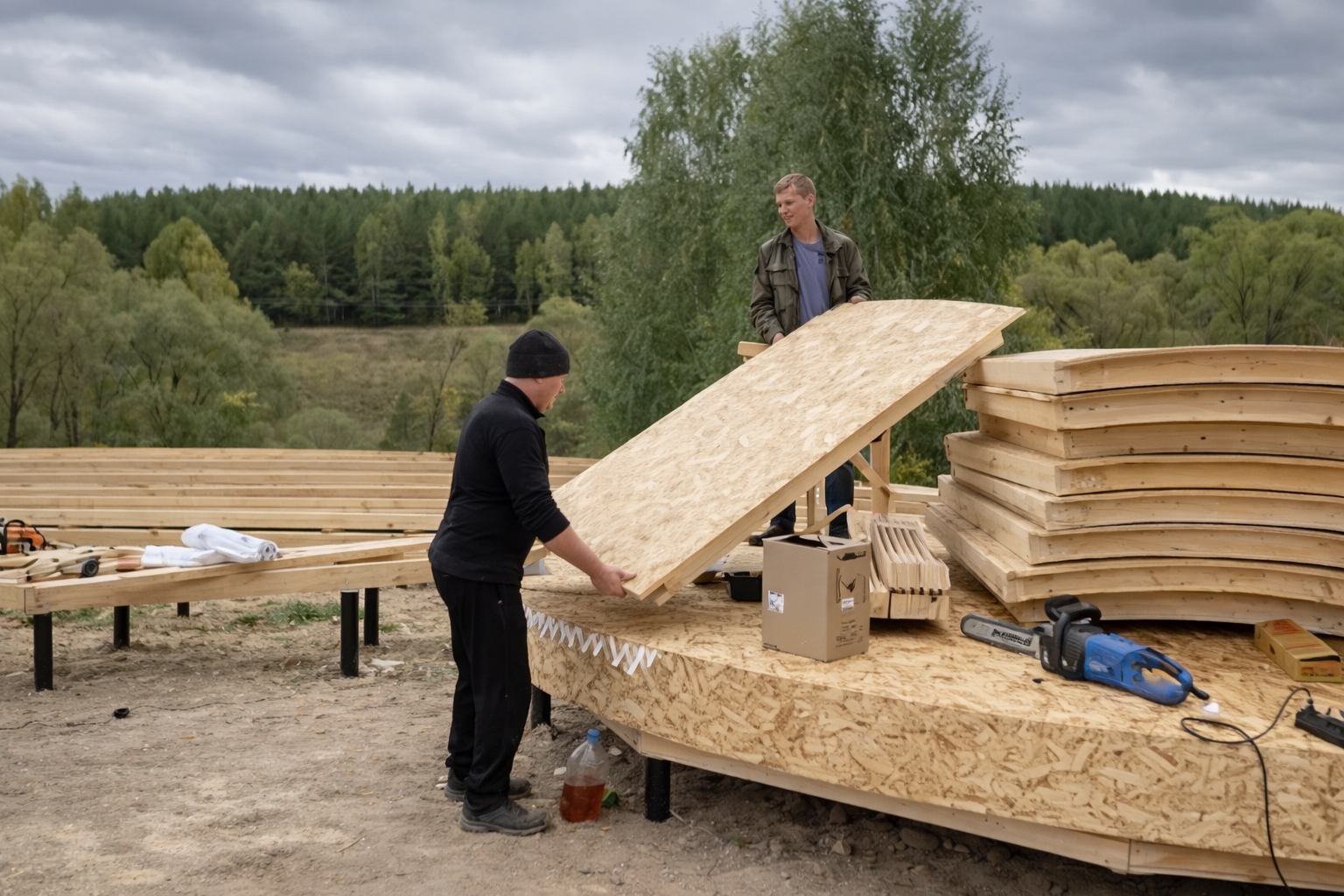
Three Friends Build a House in Just 5 Days with Wood, Organization, Continuous Work, and Show Each Step of the Construction
It all starts with an open space, exposed ground, and a pile of wood waiting to become something greater. No giant machines or large teams. Just two friends, portable tools, and the clear idea of erecting a functional house in the shortest time possible. In a few days, what was just structure turns into a closed volume, with firm walls and a roof installed.
The construction progresses without long pauses. One day leads to the next. First comes the foundation, then the beams, followed by the structural panels, and before you know it, the wooden house has a defined shape. Each step prepares the next, with no wasted movement.
This type of construction draws attention because it shows that with a simple method and organized repetition, it’s possible to go from zero to the final result without complications. It’s the kind of process that many people want to understand, whether to build, adapt, or simply learn how it works in practice.
-
Friends have been building a small “town” for 30 years to grow old together, with compact houses, a common area, nature surrounding it, and a collective life project designed for friendship, coexistence, and simplicity.

-
This small town in Germany created its own currency 24 years ago, today it circulates millions per year, is accepted in over 300 stores, and the German government allowed all of this to happen under one condition.

-
Curitiba is shrinking and is expected to lose 97,000 residents by 2050, while inland cities in Paraná such as Sarandi, Araucária, and Toledo are experiencing accelerated growth that is changing the entire state’s map.

-
Tourists were poisoned on Everest in a million-dollar fraud scheme involving helicopters that diverted over $19 million and shocked international authorities.


The Wooden Structure Gives the First Sign That the House Will Become a Reality

In the beginning, everything revolves around the wooden beams. They are positioned on the elevated foundation and gradually form a regular skeleton. One beam pulls the next, always maintaining the same spacing, creating an easy-to-repeat pattern. The impact is immediate. It’s already possible to see where the walls, corners, and openings will be.
The work is direct. One holds the piece, the other secures it. Screws go in with a portable electric tool, without fuss. The wood receives fine adjustments right there in the fit until everything is aligned. There are no leftover pieces scattered or mess on the ground.
With this, the structure gains firmness quickly. What once seemed fragile begins to support weight. The house stops being an idea and becomes something that stands on its own.
Anyone who has worked with wood knows that repetition helps a lot. The gesture is repeated, the rhythm fits, and the work flows. This is exactly what is evident in this phase.
Structural Panels Close the Walls and Change the Pace of the Work
When the structural panels come in, the construction takes on a new look. The walls start closing quickly. One panel covers a large area at once, reducing intermediate steps. In a short time, the internal space is already delineated.
The panels are raised manually and leaned directly against the beam structure. The edges meet easily. Then comes the securing, with screws distributed around, always following the wood’s contour.
The practical effect is clear. The house gains presence. There is now internal shade, lateral protection, and a well-defined volume on the ground. It is no longer just a frame.
The wood shows marks of handling, dust on the ground, and stacked panels nearby, ready for use. Everything is close, nothing is too far away. This saves time and effort.

Inside, the Cavities Begin to Be Filled
With the walls erected, the work moves inside. Between the beams appear empty cavities, which start receiving light panels of material. They fit snugly, occupying all the available space.
The fitting is manual. The panel is pressed against the edges of the wood until leveled. No extra fastening is seen, just precise adjustments. Each filled opening changes the internal appearance of the house.
The result is a more uniform interior, with no open spaces between the beams. The structure is ready for the next closure, keeping everything organized.
In some spots, the work takes place at height, especially on the sloped part. Balance is constant, the movement repeats, and the rhythm doesn’t break.
The Roof Closes the Volume and Marks the Final Turn
The assembly of the roof uses the same principle as the rest of the construction. Sloped beams form the simple design of the roof. On top of them, compressed wood panels are added, one by one.
The panels are aligned along the edges and secured directly to the beams. The electric tool works non-stop. Screws go in sequence, creating visible lines of fastening.
When the roofing is finished, everything changes. The interior becomes shaded, protected, and clearly defined. The wooden house is now closed on top and outside.
There are still cut residues on the panels, showing that adjustments happen on-site. Nothing seems hidden or improvised.
Simple Organization Keeps the Progress Moving

Throughout the construction, organization makes a difference. Beams on one side, panels on the other, stacks of boards near the work area. The space remains clear for circulation.
Even without defined names or roles, one can perceive a division of tasks. One positions, the other secures. While one adjusts, the other prepares the next piece.
This avoids unnecessary stops. Each step leads directly to the next. The work progresses because the environment helps.
As the parts are completed, the internal space also becomes cleaner. The house is being defined alongside the organization.
A Simple House That Shows How Construction Can Be Direct


In the end, what emerges is a compact house, closed, with a clear structure and an easy-to-understand method. The most decisive factor lies in the use of standardized wood, well-distributed beams, and structural panels that speed everything up.
This type of construction shows that it’s not necessary to complicate things to raise a functional house. Organization, sequence, and repetition make a real difference.
As civil engineer Roberto Corrêa often says in interviews about wooden construction systems, “when the process is simple and repeatable, errors decrease and the rhythm increases.” This is precisely what this story makes clear.
If you enjoyed following this step-by-step process, leave your comment, tell us what you think about this construction, and share it with anyone else interested in wooden houses and simple construction solutions.










-

-

-

-

-

-

22 pessoas reagiram a isso.