





 Portuguese
  English
  Spanish
  5 min of reading
  1 comment


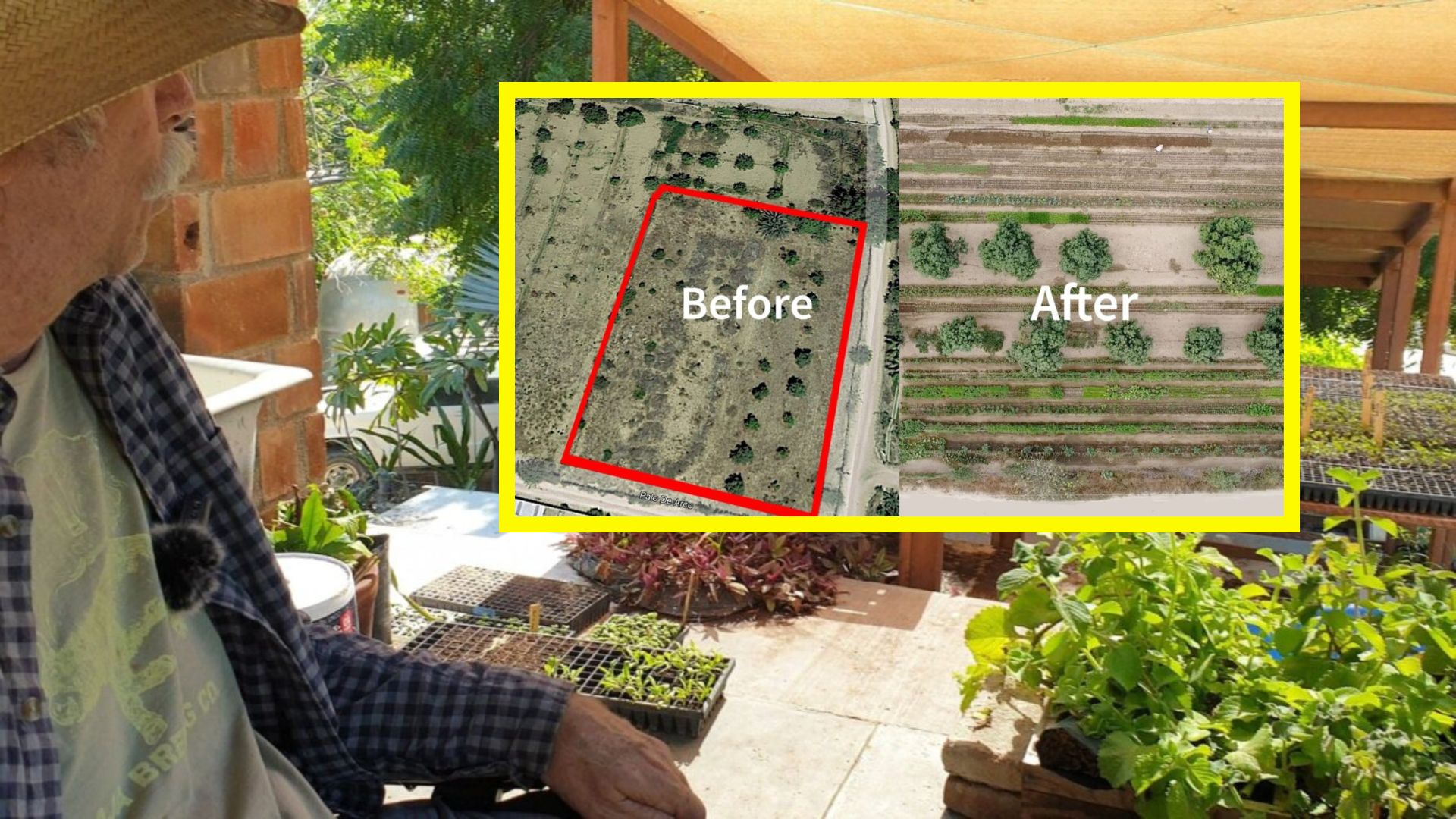


Agricultural Routine In Extreme Climate Inspires Curiosity By Describing Deep Beds, Species Diversity And Use Of Biochar In Sandy Soil.
In an arid stretch of Baja California, Mexico, a farmer cited in recent reports is said to have transformed sand considered sterile into productive land in about three months, with about 60 crops per hectare.
According to these reports, cultivation occurs where annual rainfall ranges between 4 and 6 inches and temperatures can approach 104°F, a scenario where soil management and water retention determine what thrives and what dies.
Organic Farm In The Desert Of Baja California
The publications identify the producer as John Graham, described as a farmer who works without heavy machinery and synthetic pesticides, supported by a small team and field routines based on daily observation and manual labor.
-
Spain surprises the world by erecting 62 artificial dunes, mixing sand with natural remains of posidonia, and causing the structure to lose only 1.4% of its volume in 1 year.

-
With 16 Bulava missiles, improvements in acoustic stealth, and a design focused on silent patrols, Russia’s nuclear submarine was born to ensure Moscow’s invisible retaliation and has become one of the pillars of its maritime strength.

-
‘Populous’ city in Rio among the worst in Brazil in national ranking and exposes silent development crisis.

-
Couple buys house in the South Zone of São Paulo, opens a hidden door in the garage, and finds a secret wine cellar with dozens of old wines forgotten since the 1970s.


Although the story circulates with variations in details across different sites, there is convergence on three central points: the area would be approximately one hectare, the number of cultivated species would be around 60, and the reported timeframe for the soil’s “turnaround” would be about three months.
Instead of presenting the location as an “oasis”, the reports describe a system that attempts to retain moisture and nutrients where they easily escape, using permanent beds, constant addition of organic matter, and techniques to reduce compaction.
Deep Beds And Soil Preparation Without Plowing
The core of the method is the adoption of “deep beds”, also called dug beds, where the soil is worked to about 60 centimeters, in a logic associated with intensive gardening and practices propagated by Alan Chadwick.
In this arrangement, the intention is not to invert soil layers with each crop, but to loosen and structure the profile so that roots can explore more volume, water can infiltrate better, and soil life can remain active under the heat.
Hand tools are part of the process, including shovels, garden forks, and adapted versions of broadforks, tools used to loosen the soil without the same type of disturbance caused by mechanized implements.
Once formed, the beds are no longer stepped on, as described in the texts, which aims to prevent compaction and preserve air spaces that facilitate infiltration, drainage, and root growth for longer periods.
Crop Diversity As A Barrier Against Pests

Another key aspect of the system is species diversity. Instead of extensive monocultures, the beds bring together multiple species.
The diversity of species is presented as a strategy to reduce losses due to pests, as planting avoids large areas with the same crop and combines plants with different cycles and characteristics in the same bed.
In one of the cited examples, the distribution even gathers many varieties along an extensive bed, which, according to the described logic, reduces the chance of an attack spreading uniformly across the entire area.
In daily management, reports indicate that control does not aim for a “pest-free” environment, but rather a balance in which natural predators can act, a concept summarized in the phrase attributed to the method: “zero insects” would mean a “dead garden”.
When there is an infestation hotspot, the reported approach involves targeted measures, with frequent inspections, removal and replacement of severely compromised plants, and localized use of plant-based products and simple solutions, always with an organic nature.
Biochar And Amazonian Black Soil In Desert Fertility
To address the nutritional poverty of the sand, the texts describe a combination of composting with references to the concept of Amazonian black soil, highlighting the use of biochar, a ground charcoal “loaded” with microorganisms.
The recurring explanation is that the organic matter from the compost helps to gradually provide nutrients and improves structure, while biochar, being porous, acts as a reservoir for water and nutrients, remaining in the soil for extended periods.
Another mentioned practice is the use of ashes associated with charcoal as a complementary mineral source and as a dry barrier in specific points, although the texts do not detail quantities, frequency of application, or results measured in the laboratory.

Without public data on chemical analyses of the soil on this specific property, what appears is the operational description of the management, emphasizing repeated inputs of organic matter over time and the maintenance of beds without compaction.
Accessibility And Team Work Routine
The reports state that Graham has been using a wheelchair for decades and that the property has been adapted with ramps and accessible paths, allowing circulation between preparation areas, nurseries, seed banks, and management spaces.
According to the reports, the house functions as the operation base, with spaces for producing seedlings and preparing inputs, which shortens movements and facilitates monitoring beds that require quick decisions during extreme heat periods.
The production, as described, would primarily supply the local market with vegetables, greens, and herbs, and the control of each bed would depend on frequent recording and monitoring to adjust irrigation, shading, and organic matter replenishment.
What The Reports Show And What Is Lacking Documentation
The technical elements mentioned in the articles — deep excavation, permanent beds, addition of compost, and use of biochar — have counterparts described in literature on intensive gardening and studies on biochar, but the narrations lack standardized public documentation.
So far, there has not been a secure identification in academic sources or easily auditable institutional records of a report with comparable metrics on productivity, water consumption, soil analysis, and a detailed timeline that proves the “before and after” in three months.
Still, the case continues to be presented as an example of management in arid environments, where fertility is built with organic matter, soil structure is preserved with non-compacted beds, and pest control relies on diversity and monitoring.







Fantástico !