





 Portuguese
  English
  Spanish
  6 min of reading
  0 comments


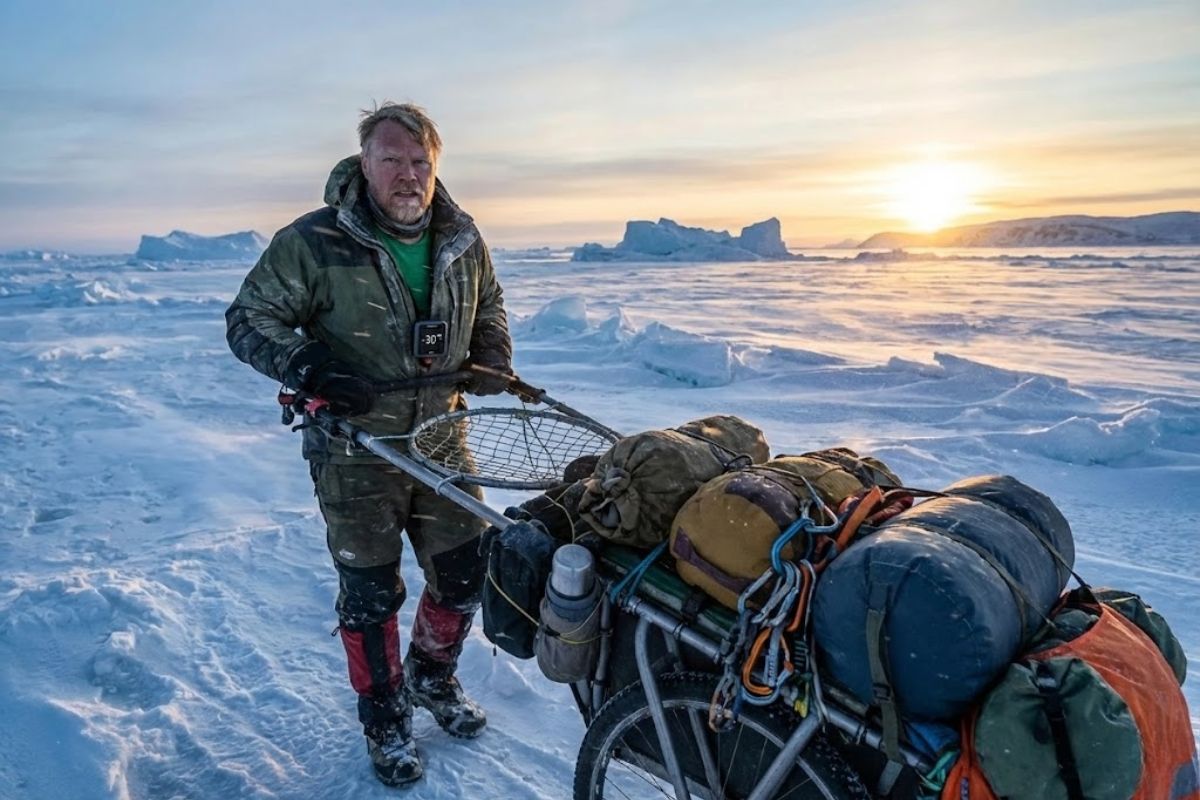
The Man Gave Up Everything on November 1, 1998 and Began the Goliath Expedition: A Walk Around the World, Adding 58,000 Kilometers. Former Paratrooper, Karl Bushby Crossed the Frozen Bering Strait in 2006 and Swam 300 Km in the Caspian Sea in 2024, Forecasting to Return in 2026.
On November 1, 1998, the man gave up everything and set off from Hull, a coastal city in England, with a goal that seems simple on paper and brutal in practice: to walk 58,000 kilometers around the world without using any mode of transportation. Former paratrooper, Karl Bushby believed he would complete the journey in 12 years, but the calendar moved faster than the path.
The story, however, is not measured only in kilometers. It is also measured in dates that marked turning points and extremes: 2006, when Karl crossed the frozen Bering Strait at -30°C; 2024, when he swam 300 kilometers in the Caspian Sea; and the most anticipated forecast by the family, September 2026, when he estimates he will finally return home.
The Decision of 1998: 58,000 Kilometers Without Transportation, At Any Cost

The rule that defines everything is straightforward: no use of any mode of transportation. This means that the journey could not “skip” a leg for convenience.
-
After 14 years of waiting, a rammed earth mansion built in 1702 in the North Zone of São Paulo will become a park with leisure facilities and green areas, with a million-dollar investment.
-
With 2 unfinished nuclear reactors, up to 25 billion in costs, and proven fraud, the Nukegate case has left 800,000 consumers still paying today for energy that will never be produced.

-
The household appliance that consumes the most energy in Brazilian homes is not the air conditioner; it is located in the smallest room of the house, is used daily, and can account for up to 25% of the electricity bill, while an alternative in the same outlet can reduce this cost by up to 75%.

-
Son of a seamstress from the rural area of Ceará who did not speak English wins a scholarship of over 2 million reais at Williams College, one of the top 10 universities in the United States, covering everything including dormitory, meals, and annual trips to Brazil.


The proposal was to connect the world by self-movement, insisting on progress even when the scenario demanded improbable solutions.
That’s how the plan was born and gained a name: Goliath Expedition. From the beginning, the crossing was supported by Karl’s father, Keith, a former soldier.
The project carried ambition and discipline, but time showed a central detail: the reality of a route of this size does not respect timelines.
What Changes When “12 Years” Becomes “Almost Three Decades”
Karl thought it would take 12 years. Today, it has been 27. And this difference changes everything: the way he maintains contacts, deals with bureaucracy, sustains his own motivation, and endures long periods away from home.
Along the way, the man gave up everything and traveled routes that already include South America, Central America, North America, parts of Asia, and now, Europe.
This sequence through continents helps to dimension that it is not a prolonged outing, but a constant construction of routes, decisions, and resistance.
Angela, 75 Years Old: The Mother Who Saw Her Son Only Three Times Since 1998
As Karl continues to move, Angela Bushby remained at the same emotional starting point: the house in the suburbs, the place from which her son left.
She reported that she has seen Karl only three times since 1998. It’s little for a lifetime, and a lot for a story that never disconnected.
Angela summarizes the wait as a permanent mix of pride and worry.
She keeps newspaper clipping albums that document her son’s journey, as if each news item were a “sign of life” organized page by page.
And she imagines their reunion with a fixed scene: “I will be here waiting for him to pass through the gate.” After the hug, she says she will ask the question that has been held for decades: “What time do you call this, Karl?”
The Crossing of 2006: 14 Days on Ice in the Bering Strait at -30°C
In 2006, Karl became the first Briton to cross the frozen Bering Strait, between North America and Russia. It was 14 days walking on ice sheets, facing temperatures of -30°C.
The impact of this stage was not just physical. For the family, it was a period of extreme tension.
Angela recalls that everyone went to Alaska before the crossing because they feared he wouldn’t survive. When a journey reaches this level of risk, the “dream” takes on another texture: that of calculated survival.
When Bureaucracy Becomes an Obstacle: Visas, Borders, and Difficult Choices
Not every challenge appears in the form of a storm, ice, or distance. There is also the weight of documents, permits, and allowed routes.
Karl faced difficulties with visas and, at certain points, this began to directly influence the possible path.
In this context, route decisions ceased to be merely geographical and became strategic. The man gave up everything to walk the world, but he had to deal with a world that has real, bureaucratic barriers that are often non-negotiable.
The Caspian Sea in 2024: 300 Kilometers Swimming to Avoid Iran and Russia
In 2024, Karl swam 300 kilometers in the Caspian Sea.
The reason was clear: to avoid entering Iran or going back through Russia, precisely where he had already faced difficulties related to visas.
This information stands out because it alters the traditional image of “walking around the world.”
Here, the gesture shows the level of commitment to movement without transportation while at the same time the level of adaptation necessary to continue progressing.
It’s not just walking: it’s solving the path when the path closes.
Europe in the Final Stretch: Hungary, Austria, and the Sense of Approaching
Now, Karl is about to leave Hungary and enter Austria. For those following from afar, it may seem like just another border.
For Angela, it is a sign that the return is less abstract than ever.
The expected arrival home is estimated for September 2026.
This is the first time the finishing line seems to fit into a calendar, and this changes the way the family views the wait: still long, but finally measurable.
Dyslexia at 13 Years Old and Bullying: The Origin of a Tenacity That Did Not Fade
Angela recalls that Karl faced bullying at school and was called “stupid” by his classmates. At 13 years old, he was diagnosed with dyslexia, and his mother describes this moment as a turning point: when he understood there was a reason for the difficulties, “there was no way to stop him”, in her view.
This detail helps explain a trait that permeates the entire story. The man gave up everything in 1998, but he did not give up his own determination.
The diagnosis did not define him as a limit, but rather as a trigger for persistence.
Christmas Gifts Accumulated: The Sadness Kept in the Form of Ritual
Throughout all these years, Angela continued to buy Christmas gifts for Karl. She says he will still have some to open when he returns.
When she told this to her son, he replied: “Mom, you must be crazy.”
The gesture may seem simple, but it carries a practical emotional function: marking time, maintaining a bond, placing materiality in the wait.
For those who stay, absence also needs routine so it doesn’t become just emptiness.
From Rare Calls to Messages: The Communication That Changed Over the Years
In the beginning, communication was made through occasional calls. Over time, it shifted to messages.
This change shows how the journey extended and needed to adapt to what was possible to maintain at a distance.
Even with more contact, the mother admits a concern: how will Karl adapt to normal life after so much time in motion?
She herself suspects he won’t stay in one place for very long. Returning home may be as challenging as getting there.
What This Story Reveals About Time, Family, and Human Limits
The numbers are impressive: 58,000 kilometers, 27 years, 14 days on ice, -30°C, 300 kilometers swimming. But the core of the story is not just the extreme feat.
It’s the contrast between movement and permanence: on one side, Karl crossing territories; on the other, Angela waiting at the same gate.
In the end, the man gave up everything to pursue an uncommon goal, and this choice reorganized the life of those who stayed.
The journey turns into biography, turns into memory, turns into newspaper clippings, turns into stored gifts, turns into messages on the cell phone.
And for you: what is more difficult, the man giving up everything to move forward for 27 years or the mother enduring the wait for so long, seeing her son only three times since 1998?







-

Uma pessoa reagiu a isso.