





 Portuguese
  English
  Spanish
  4 min of reading
  0 comments


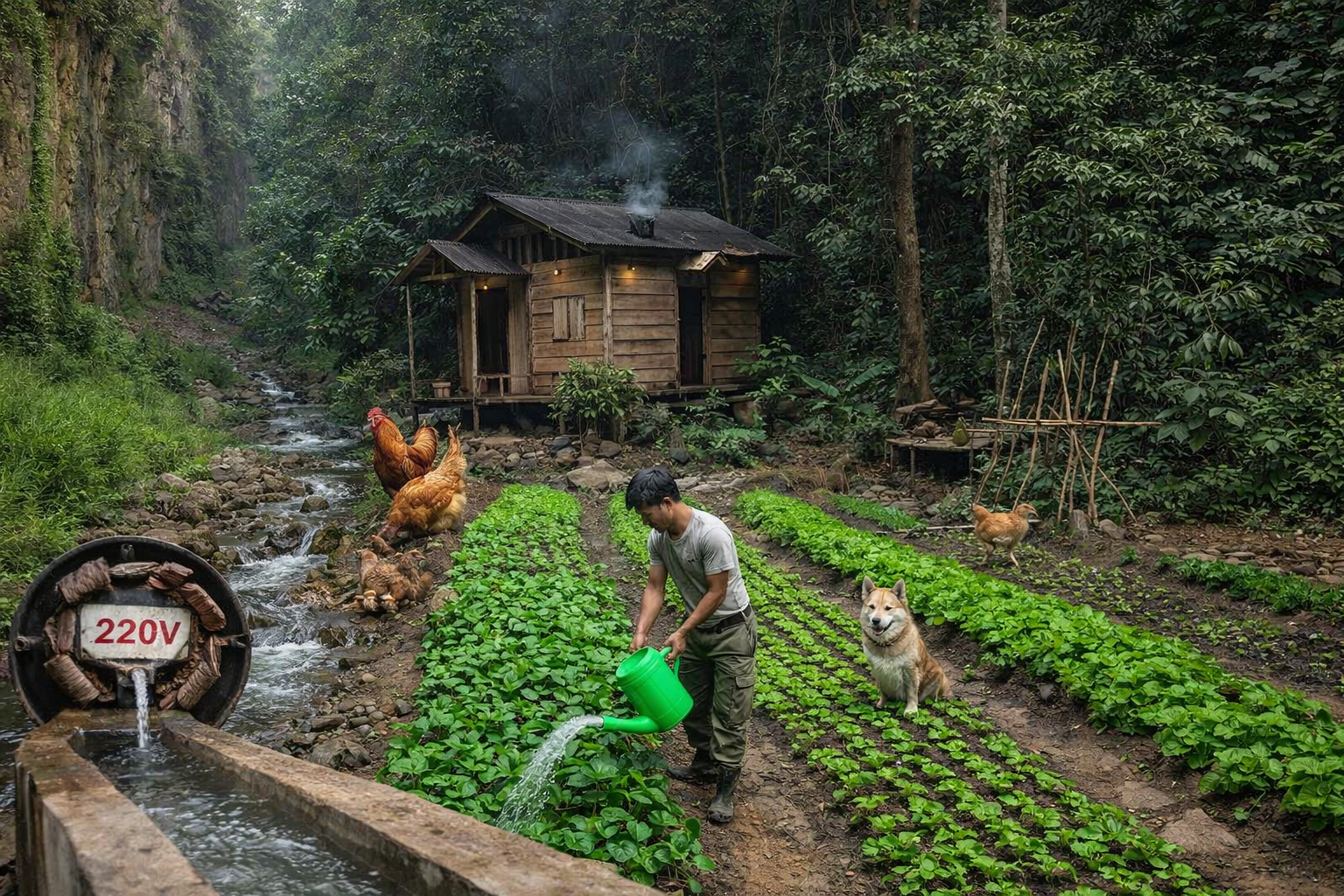
Man Abandons The City And Spends Years Living In Isolation In The Forest Of Vietnam, Where He Builds A Wooden Cabin Alone, Grows Food, And Develops A Self-Sufficient Rural Life.
In an increasingly urban, noisy, and fast-paced world, the decision to abandon everything to live in isolation in the forest seems extreme. However, that is exactly the path Thanh chose when he left the city and settled in a remote and mountainous rural area of northern Vietnam.
Alone, far from urban infrastructure and the electrical grid, he embarked on a journey to build a new life based on self-sufficiency, manual labor, and direct contact with nature. The process, documented in videos, ended up capturing the attention of millions on social media.
A Radical Change To Live Away From Civilization
Thanh lived a normal life until he decided to completely break away from the urban model. With no paved roads, nearby commerce, or basic services, the forest became his new home.
-
He started running at 66 years old, broke records at 82, and is now a subject of study for having a metabolic age comparable to that of a 20-year-old, in a case that is intriguing scientists and inspiring the world.

-
Oldest tree on the planet reappears after 130 years of searches: Wattieza, 385 million years old, was 10 meters tall and had no leaves or seeds; Gilboa fossils in New York solved the mystery in 2007.

-
A 48-square-meter house assembled in hours with 4,000 bricks made of recycled plastic that does not absorb moisture, has natural thermal insulation, and costs less than 90,000 reais in a complete kit.

-
Luciano Hang revealed that Havan’s air fleet has already accumulated more than 20,000 landings, 10,000 flight hours, and 6 million kilometers traveled, and he says that without the planes, the company would never have grown so quickly.

The choice was not motivated by luxury or comfort, but by the desire to build a simple, sustainable, and independent life, using only local resources and traditional techniques. From the beginning, he made it clear that he would do everything alone, without teams or heavy machinery.
Building A Wooden Cabin From Scratch
The first major challenge was to raise a wooden cabin in the middle of the forest. Using logs, planks, and basic tools, Thanh built the structure step by step, starting with the foundation, raising walls, assembling the roof, and finishing the interior.
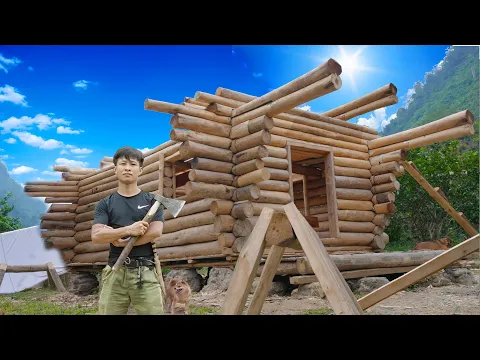

The entire process was done manually, requiring physical strength, patience, and planning. The cabin became the centerpiece of his new life, serving as shelter, resting space, and base for all other activities.
Despite its simplicity, the construction showed care in details and resilience, adapted to the humid climate and temperature variations of the region.
Home Farming As The Basis For Survival
With the housing ready, the focus shifted to food production. Thanh started small cultivation areas around the cabin, planting vegetables, roots, and fruits typical of the region.
Over time, the garden grew and diversified. He began to cultivate, harvest, and sell part of the produce in local markets, generating income to buy tools and basic supplies.
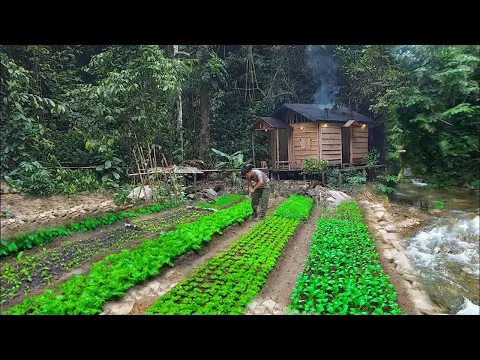
Agricultural work follows natural cycles, respecting the soil and the climate, and has become essential to maintaining life outside the city sustainably.
Life Off The Power Grid And A Self-Sufficient Routine
Living away from civilization also means giving up conventional electrical energy. To address this challenge, Thanh decided to set up a small generator with a turbine powered by hydropower, taking advantage of the flowing water from the forest around the cabin.
The process was laborious. Before installation, he had to clear and prepare the watercourse area, removing stones, branches, and sediments to ensure a continuous and stable flow. Only after this step was it possible to correctly position the turbine and securely fix the equipment.
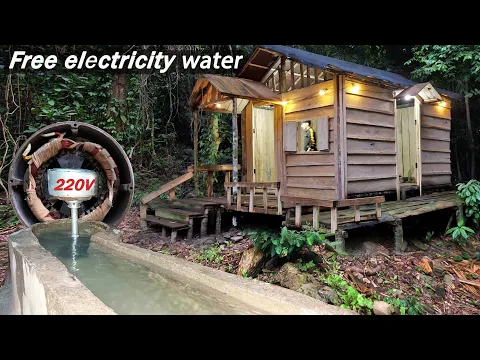
With the generator installed, Thanh carefully organized all the wiring, bringing power to the cabin. After several adjustments and tests, the system finally started working, providing continuous and renewable electricity.
The generated energy began to be used for basic lighting and small daily needs, further reducing dependence on external solutions. The system, simple and efficient, became one of the most impressive elements of the self-sufficient routine built in the forest.
From Isolation To Global Interest On Social Media
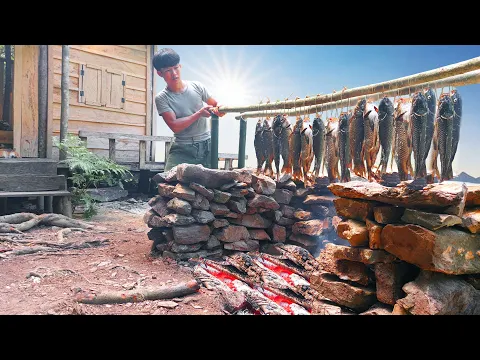
While documenting his daily life in the forest, Thanh did not imagine that his story would reach so many people. The videos show everything from the construction of the cabin to harvesting, food preparation, house maintenance, and challenges faced in isolation.
The combination of simple living, real effort, and absence of exaggerations made the content stand out among highly edited productions. The project came to be seen as a rare portrayal of an alternative life that many say they admire, but few would have the courage to live.
A Choice That Challenges The Modern Urban Model
Thanh’s story is not just about living in the forest. It provokes reflection on consumption, dependence on urban systems, and people’s relationship with time and work.
By trading convenience for autonomy, he shows that it is possible to build a functional life outside the dominant standard, even if it requires significant sacrifices.
A Simple Life That Continues To Be Built
Thanh’s journey is still ongoing. New projects arise, the cabin receives improvements, and the cultivation area continues to expand. Each stage reinforces the idea that life in the forest is not a temporary escape, but a conscious and long-term choice.
More than an experiment, his story has become an example of how planning, persistence, and simplicity can transform isolated land into a functional home — away from cities, but close to the essentials.








-

2 pessoas reagiram a isso.