





 Portuguese
  English
  Spanish
  3 min of reading
  0 comments


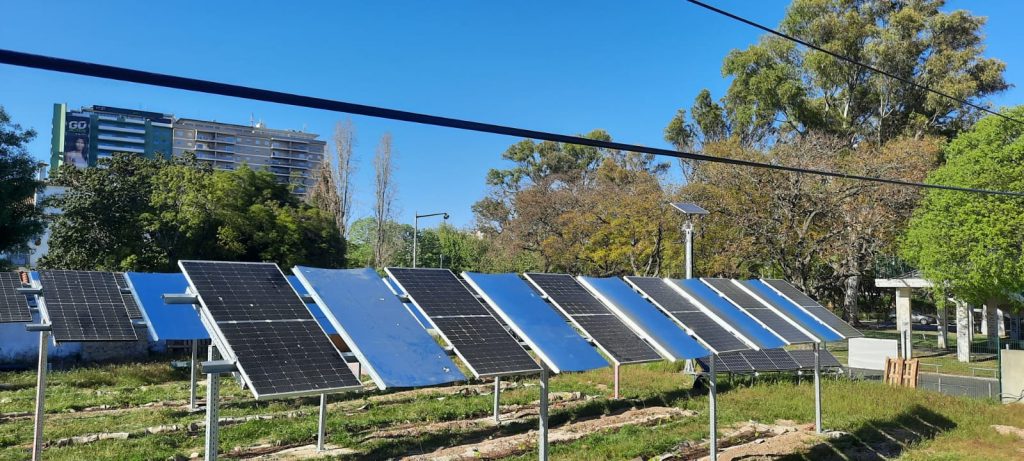
The Faculty of Sciences at the University of Lisbon recently celebrated the second anniversary of the Solar Garden, a pioneering agrovoltaic project that combines urban agriculture and solar energy generation.
Since March 2023, the initiative has clearly demonstrated that it is possible to integrate photovoltaic technology with food cultivation, promoting a sustainable solution adaptable to the urban environment.
In addition to integrating the Solar Campus and the Living Laboratory for Sustainability, the Solar Garden exemplifies how nature and technological innovation can coexist harmoniously.
Thus, the project allows for the simultaneous study of the impact of shading from solar panels on agricultural crops and the effect of plants on the energy efficiency of the solar modules.
-
China has launched the world’s first floating artificial island, a scientific structure designed to face open seas, test equipment weighing hundreds of tons, and reach depths of 10,000 meters.

-
China accelerates global science and may surpass the United States in 2 years with increased public investment, continuous growth, and direct impact on the global technological competition.

-
Scientific studies indicate that drought may be strengthening a much greater silent threat: more resistant superbugs.

-
Man builds functional 5-meter submarine in his garage using gas cylinders, PVC pipes, and a refrigerator motor, and navigates with the vessel on a lake in Colombia.


Technology and Nature: A Relation of Mutual Benefits
According to observations made over the two years of operation, the microclimate generated by the plants contributes to the natural cooling of the panels, which consequently increases their photovoltaic efficiency.
On the other hand, species such as beans and carob perform better under the shade of the modules. Meanwhile, crops like corn thrive better in areas more exposed to direct sunlight.
In this way, the Solar Garden serves as an experimental field to assess which crops adapt better to different shading conditions.
Based on this data, researchers strategically position the plants, optimizing both crop production and energy generation.
Water Efficiency and Urban Adaptation
In addition to integrating with energy production, the project also tests innovative water efficiency solutions.
Due to the shading created by the panels, soil moisture retention increases, which in turn reduces the need for constant irrigation.
Therefore, the agrovoltaic model represents a viable alternative to confront water scarcity in cities and arid regions.
Simultaneously, the Solar Garden offers a platform for studying the adaptation of agriculture to the particularities of the urban environment.
This includes factors such as solar radiation reflection by buildings, soil quality, and levels of air pollution.
In all these aspects, the project seeks practical solutions that can be replicated in other urban areas.
Education, Science, and Permaculture at the Center of the Project
While promoting innovation, the Solar Garden also functions as a living laboratory for learning and scientific research.
Since its creation, the space has involved students, teachers, and researchers from various fields of knowledge.
For this reason, subjects such as Sustainability, Solar Energy, and Permaculture have become integral parts of the practical activities conducted in the garden.
Moreover, the ongoing collaboration with the Horta FCUL team and the Permalab has been essential for the implementation of regenerative agriculture techniques.
Thus, the project combines technology, science, and community action to transform the way sustainability is conceived and practiced in universities.
Community Participation and Social Impact
While promoting scientific knowledge, the Solar Garden also opens its doors to the community.
Each year, over 600 people visit the space, including students, researchers, teachers, and citizens interested in sustainable solutions.
In this way, the project transcends the university walls and positively influences urban culture.
Additionally, the garden integrates the DOMUS project, dedicated to biodiversity monitoring on campus.
As a result, the space becomes a practical example of how to produce energy and food in harmony with the environment.
More than that, the initiative reinforces the role of universities in building a more resilient, conscious, and sustainable society.
Perspectives for the Future
Now that it has completed two years, the Solar Garden consolidates itself as an inspiring example of climate innovation.
The expectation is that the project will continue to grow, generating knowledge, encouraging new partnerships, and training professionals prepared to face the environmental challenges that intensify every day.
Through the combination of science, education, and technology, the Faculty of Sciences at the University of Lisbon demonstrates that it is possible to transform the future with intelligent, accessible, and sustainable solutions.
Therefore, initiatives like this show that the urban ecological transition depends, above all, on integration, collaboration, and continuous action.








-

Uma pessoa reagiu a isso.