





 Portuguese
  English
  Spanish
  5 min of reading
  0 comments


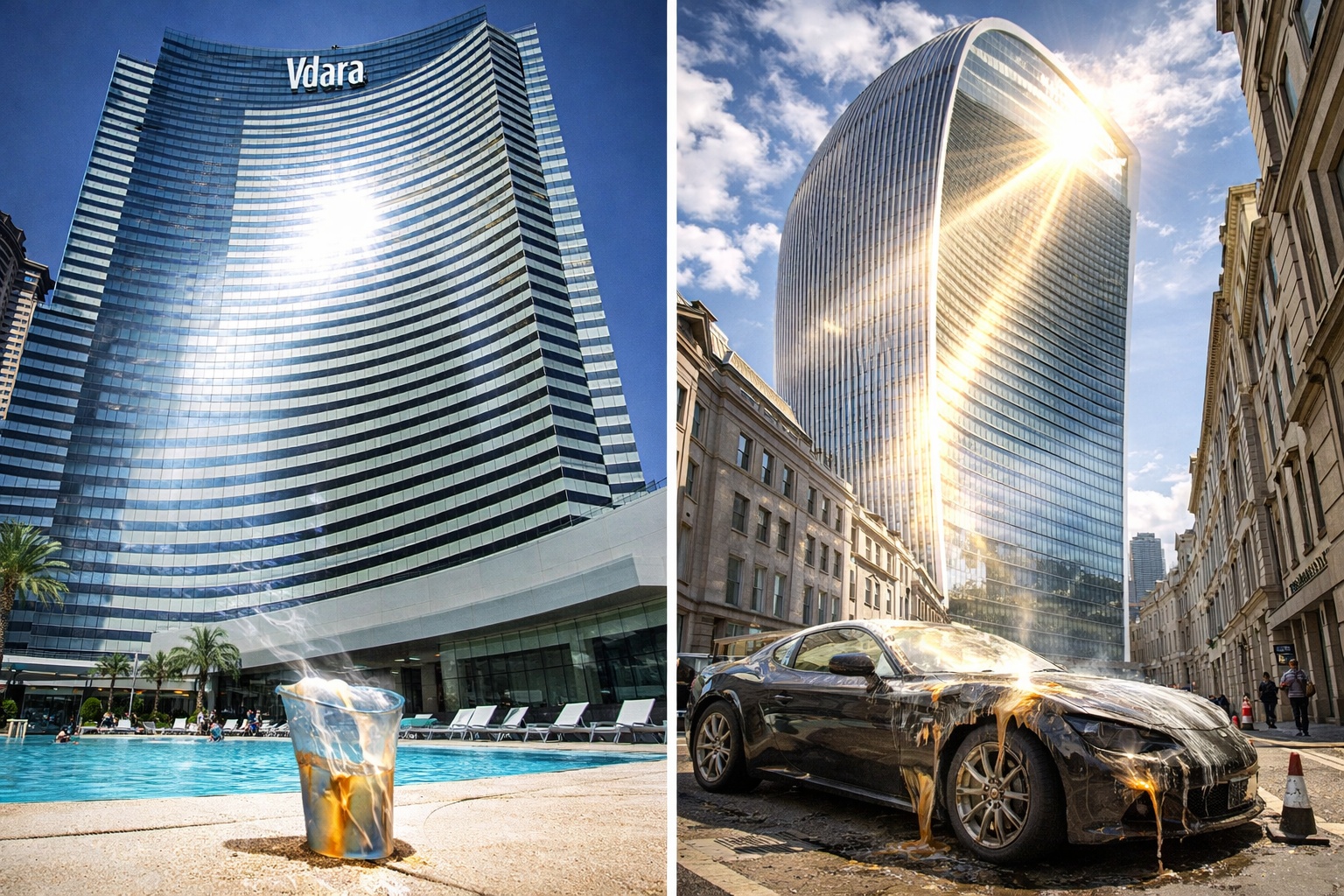
The Architect Rafael Viñoly Designed the Vdara in Las Vegas and the 20 Fenchurch Street in London, Buildings with Concave Facades That Concentrated Solar Light, Melted Cars, and Created the Phenomenon Known as “Death Ray.”
The architect of the building that melted cars in London had already created a hotel in Las Vegas that burned guests with a solar lens effect. On September 16, 2010, attorney Bill Pintas experienced something that seemed impossible on the Las Vegas Strip. He was relaxing by the pool at the Vdara Hotel & Spa when he felt his scalp suddenly and intensely burn. There was no visible flame. There was no chemical accident. There was just sunlight. Seconds later, he realized that his sandals were too hot to wear. A plastic bag left next to the chair had melted holes in it. Hotel staff were not surprised.
They already knew about the phenomenon. They internally referred to it as “death ray.”
What seemed like an isolated incident was actually a classic case of solar concentration caused by a glass concave facade, a physical phenomenon known by optical engineering for decades.
-
Italian giant of 130 tons arrives at the Senna Tower construction site and accelerates foundations: Mite CFA 3436 drills up to 50 m, 750 hp engine, investment of R$ 20 million, unique in Latin America.
-
The adobe house in Monteiro Lobato takes shape with bamboo and clay from the land, a stone foundation, and a roof for the wind; cracks are normal, and finishing with lime turns it into a “common house.”
-
Four friends with over 30 years of friendship built a “mini village” by the banks of a river in Texas to grow old together, with houses of just 32 m² and a shared common space. The Bestie Row project has become a model of alternative living that is starting to spread around the world.
-
The ancient Japanese capital, planned over 1,200 years ago, still withstands earthquakes with colossal wooden temples and palaces, built without concrete or modern steel, by masters who created engineering capable of enduring centuries.


Vdara Hotel in Las Vegas: How Architecture Transformed a Skyscraper into a Parabolic Lens
The Vdara is a 57-story skyscraper opened in 2009 as part of the CityCenter complex on the Las Vegas Strip. The building was designed by Uruguayan architect Rafael Viñoly and has a crescent shape—a half-moon of glass and steel with a highly reflective facade facing south.


To achieve LEED Gold sustainability certification, highly reflective glass was used, designed to return solar radiation and reduce the use of air conditioning.
The problem lay in the geometry. The south facade was concave. Concave surfaces reflect parallel rays— like sunlight—toward a focal point. This is the same principle used in:
- Parabolic mirrors
- Concentrated solar power plants
- Optical telescopes
- Parabolic antennas
In the case of the Vdara, between 10:30 AM and 12 PM during the hottest months, the sun’s position aligned with the curvature of the facade, creating a zone of concentrated heat in the pool area.
Engineers measured temperatures 20°C to 25°C above the ambient. Staff reported melted plastic regularly on the pool deck.
The hotel saved energy. The pool cooked the guests.
Parabolic Solar Concentration: The Physical Phenomenon That Caused the “Death Ray”
The technical name for the phenomenon is urban parabolic solar concentration. When sunlight strikes a curved reflective surface, the light energy is redirected to a single point or focal line. The thermal intensity increases exponentially because the energy that was previously distributed becomes concentrated.
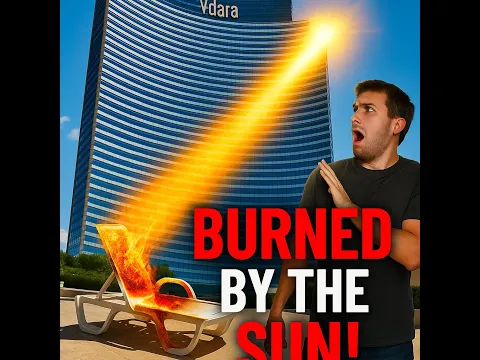
In solar power plants, this principle is intentionally used to generate steam and move turbines. In urban environments, when not properly modeled, it can generate:
- Extreme temperature rise
- Damage to vehicles
- Deformation of plastic materials
- Superficial burns
- Thermal cracking of surfaces
The problem was not unknown to science. What failed was the detailed analysis of thermal impact on the surroundings.
20 Fenchurch Street: The Building That Melted Cars in London
Three years after the Las Vegas incident, Rafael Viñoly delivered another controversial building: the 20 Fenchurch Street in London.
Known as “Walkie-Talkie” for its bulbous top, the 38-story building again featured a concave and reflective south facade.

In September 2013, before the official inauguration, a Jaguar parked on the street next to it had parts of its bodywork deformed by the concentrated heat reflected by the building.
Temperatures recorded at the focal point reached 91°C, with later peaks of 117°C. The British press nicknamed the building “Fryscraper.”
A reporter fried an egg on the sidewalk to demonstrate the thermal effect. The reflected beam was up to six times more intense than direct solar radiation. Check out the case of the controversial 20 Fenchurch Street in London below:
Solar Modeling Errors and Cost-Cutting Decisions
The original design of 20 Fenchurch Street included horizontal louvers that would reduce solar concentration. They were removed during negotiations to cut costs.
Computational modeling indicated an increase of about 36°C at the focal point. The reality showed more than double.
In 2015, the building received the Carbuncle Cup, an award given to the worst new building in the UK.
Similar Cases in Contemporary Architecture
The problem was not exclusive to Viñoly. The Walt Disney Concert Hall, designed by Frank Gehry, had to have its facade sanded after concentrating sunlight on neighboring buildings and raising internal temperatures by up to 9°C.
The phenomenon has also been recorded in:
- Residences with curved windows
- Polished metal facades
- Crystal doorknobs causing house fires
The combination of reflective glass, curved facades, and insufficient modeling is the common factor.
The Solutions Implemented in the Buildings
At Vdara, umbrellas and additional film were installed to mitigate the thermal focus. At 20 Fenchurch Street, the permanent solution involved installing aluminum horizontal fins along the south facade.
The fins broke the reflective curvature and eliminated the focal point. The cost of the correction far exceeded the individual reported damages.
After these incidents, protocols for analyzing solar reflectivity became stricter. Today, skyscraper projects with glass facades require:
- Annual solar trajectory computational simulation
- Urban thermal impact analysis
- Seasonal reflectance studies
- Assessment of potential focal points
The cases of Vdara and Walkie-Talkie are frequently cited in technical literature on building engineering.
Legacy of Rafael Viñoly
Rafael Viñoly passed away in March 2023. His portfolio includes globally significant works, but the two buildings with solar concentration will remain as emblematic examples of thermal assessment failures in contemporary architecture.
The central lesson is not about aesthetics. It is about basic physics applied to structures hundreds of meters tall. The most expensive part was not the damaged Jaguar.
It was refurbishing the entire facade to prevent the building from continuing to act as a giant lens over the city.






-

-

-

-

-

11 pessoas reagiram a isso.