





 Portuguese
  English
  Spanish
  5 min of reading
  0 comments


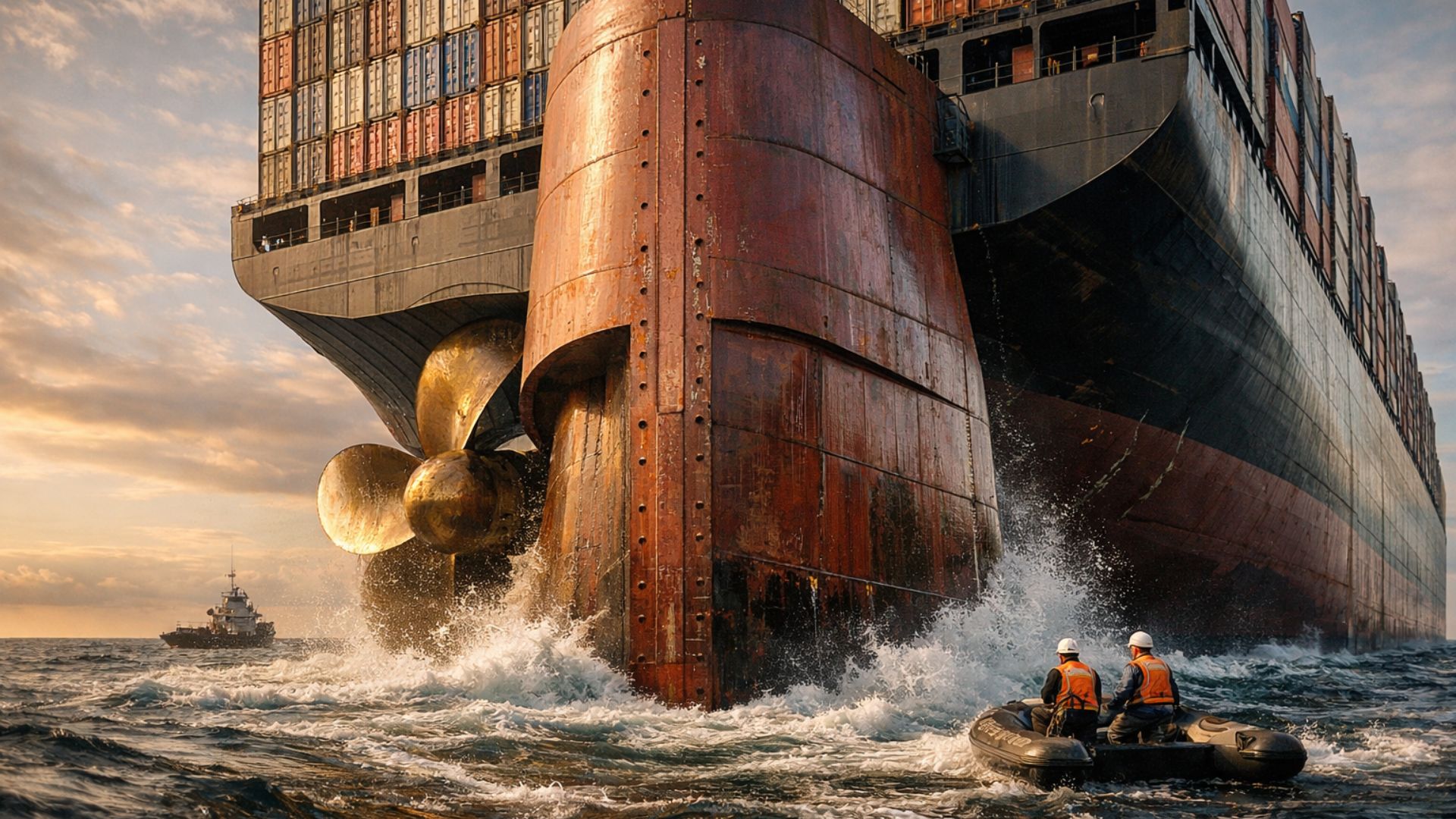
Submerged and little visible component concentrates critical functions of direction, stability, and energy efficiency in giant container ships, with engineering that evolved along with the increase in scale of global navigation and began to directly influence fuel consumption, performance, and logistical costs.
A 100 square meter rudder helps to steer container ships of 21,000 TEU because, in practice, the scale of these vessels requires a surface capable of diverting much larger volumes of water without interrupting propulsion.
In an official statement, Becker Marine Systems reported that the Shanghai Waigaoqiao Shipbuilding yard in China ordered six units of the Becker Twist Rudder with this area for ships of this class, a dimension that illustrates how a little visible component gained strategic weight in the operation of the largest cargo ships in the world.
The relevance is not limited to maneuvers in ports or narrow channels.
-
China is using colored laser lights on highways to prevent drivers from falling asleep at the wheel, and the technology acts as a silent alarm that is already reducing fatal accidents due to fatigue.

-
American couple renovates over 100-year-old castle in Texas and transforms historic building with Italian marble, mahogany panels, and eight fireplaces into a retreat that blends memory, grandeur, and comfort.

-
Japan is transforming used disposable chopsticks into an ambitious and surprising project that could forever change the way restaurants and offices handle one of the most common waste products of urban life.

-
Father wins a brand new car in a raffle he organized himself at church.

Maritime transport accounts for over 80% of the volume of global merchandise trade, according to UNCTAD, which transforms any advancement in hydrodynamic control into a potential impact on fuel consumption, travel regularity, and logistical costs in global supply chains.
Function of the rudder in navigation and hydrodynamic control
According to Wärtsilä, the rudder is the device used to steer and maneuver the vessel.

The company describes the system as a hydrofoil typically mounted at the stern, behind the propeller, to generate transverse force and yaw moment by diverting the flow of water, changing the direction of the hull without shutting down the main thrust.
The same source states that the efficiency of the rudder increases when it operates in the propeller’s flow and when its area is enlarged.
This point helps explain why the growth of container ships required an equivalent response in steering engineering.
As ships began to carry more cargo, the system responsible for correcting the course and stabilizing the vessel also needed to gain size, structural rigidity, and hydrodynamic refinement to maintain response precision at high speeds and in open water.
Why 100 m² rudders became standard in mega cargo ships
The order announced by Becker in 2016 made this leap more tangible.
In the statement, directors Dirk Lehmann and Henning Kuhlmann stated that the Chinese shipyard had requested 100 m² rudders for six 21,000 TEU container ships.
The same document noted that the largest container ships at that time continued to operate with full spade type rudders, a configuration without external lower support that favors steering response and integration with the flow produced by the propeller.
The escalation did not stop with this generation.

In another note, released on September 5, 2024, Becker announced an order for ten 24,000 TEU ships under construction at the Jiangsu New Yangzi Shipbuilding yard for CMA CGM.
On the same page, the manufacturer added that it would also supply five full spade rudders of 125 m² for VLCCs under construction at Qingdao Beihai for Euronav, the largest ever delivered by the company to date.
This history shows that the enlargement of the rudder is not limited to following the increase of the hull by geometric proportion.
The challenge is to control more mass, more inertia, and a more intense flow field, maintaining predictable response and avoiding additional energy losses in an environment where small percentage differences can represent significant costs in long-haul crossings.
Rudder engineering and impact on fuel consumption
In the case of the Becker Twist Rudder, the manufacturer claims that the twisted profile was developed to better utilize the rotational flow generated by the propeller.
According to the official product description, this design prevents the formation of low-pressure areas on the surface of the rudder, reduces the risk of cavitation and erosion, allows for larger angles at higher speeds, and also cuts drag, a combination that improves the vessel’s propulsive efficiency.
In operational terms, this means that the rudder is no longer treated merely as a steering component.
It has become part of the ship’s performance package, alongside other energy-saving devices installed in the stern area to reorganize the flow before and after the propeller.
In practice, the goal is to convert more of the shaft power into effective thrust, reducing hydrodynamic waste and, consequently, emissions associated with fuel consumption.

Wärtsilä itself has already treated the rudder as a component with a direct impact on propulsion.
In a technical document from the company, the concept of Efficiency Rudder is presented as a solution capable of increasing propulsive efficiency compared to a conventional rudder, with real-scale tests indicating power savings between 5% and 8% in single-screw ships and a reduction of 20% to 40% in pressure pulses on the hull.
Although it is another market architecture, the data shows that the geometry of the rudder interferes not only in the maneuvering curve but also in vibration, noise, and energy performance.
Reinforced structure and challenges in large ships
In ships of this size, the metal surface is just part of the equation.
Becker claims that, with the King Support feature, its full spade rudder design can be applied to vessels of practically any size.
The company describes this concept as an extension of the internal structure into the rudder blade, a solution that allows it to handle high loads and provide profiles more suitable to the demands of large ships.
This structural adaptation matters because the rudder works under continuous stress, in direct interaction with the propeller and with the flow exiting the hull.
In a large-capacity container ship, the system needs to combine mechanical strength, stability of response, and minimal hydrodynamic penalty.
Any imbalance between these factors can affect everything from course accuracy to fuel consumption throughout the journey.


Discreet piece that supports global navigation
Even hidden from view in most images of mega cargo ships, the rudder has gained status as a central component in an industry that tries to increase scale while simultaneously reducing operational losses.
Becker reports that its products have already been installed on more than 9,000 ships worldwide, across different segments, a fact that helps to size the weight of this area within contemporary naval innovation.
On a fully loaded container ship, the stack of boxes on deck draws more attention than any submerged system.
Still, it is behind the propeller that one of the most important decisions of the journey continues to be executed, with a piece that corrects the trajectory, manages intense hydrodynamic forces, and influences the efficiency of routes that connect production, ports, and consumption on a global scale.




Seja o primeiro a reagir!