





 Portuguese
  English
  Spanish
  5 min of reading
  0 comments


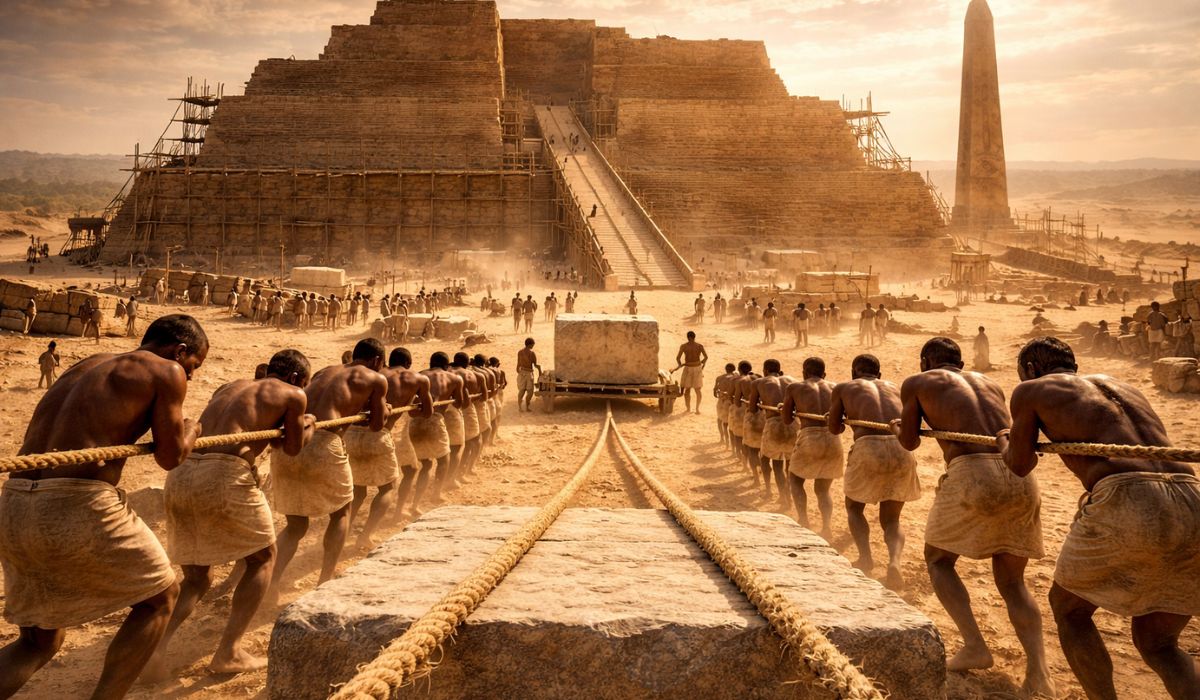
Pyramids, temples, and obelisks continue to mobilize research by bringing together engineering, state organization, and large-scale construction techniques, in one of the most durable and studied chapters of ancient history, with impact on archaeology, architecture, and science.
The construction of pyramids, temples, and obelisks in ancient Egypt remains at the center of academic debates and public interest for combining monumental scale, precision, and permanence without the use of engines, industrial steel, or modern equipment.
According to archaeological research, these works resulted from the combination of state organization, specialized labor, practical engineering knowledge, and techniques applied to cut, transport, and position stone on a large scale.
Work organization in ancient Egypt
At the center of this process was a centralized state, capable of collecting food, coordinating workers, and sustaining projects for years.
-
The induction stove you know may be numbered: a new invisible technology hides the stove under the stone countertop, heats only the pot, and promises to cook up to 50% faster while using less energy.

-
Garlic with pure honey undergoes a natural fermentation that transforms the two ingredients into a versatile condiment for marinades, sauces, and roasted vegetables, and it can also be used as a natural treatment in your garden.

-
A woman in the United States hired six immigrants for a $10,000 job on her house, and when the work was almost done, she allegedly called ICE to avoid paying and to have the workers deported.

-
iPhone in 2026: the technological innovations that go beyond cameras and processors


This model allowed for planning from stone extraction to the arrival of materials at the construction site, as well as feeding the teams, maintaining tools, and defining the stages of the work.
The evidence gathered in Giza dispels the idea of an improvised operation.
Excavations in the area associated with the builders of the pyramids indicate the existence of settlements, workspaces, and support structures compatible with a permanent and organized operation.

At the same time, sites like Deir el-Medina, from another period of Egyptian history, help to understand how pharaonic power structured communities of artisans and workers linked to large state enterprises.
This picture also weakens the old idea that the pyramids were primarily built by slaves.
According to the prevailing interpretation among archaeologists, there were specialized workers and contingents recruited by the state under a system of seasonal compulsory labor, especially when the flooding of the Nile interrupted part of the agricultural activities.
The model indicates a state mechanism for mobilizing labor, without dismissing the harshness of these working conditions.
How stone blocks were transported
The movement of stones depended less on isolated strength and more on techniques to reduce friction, organize traction, and take advantage of the terrain.
One of the most accepted hypotheses, based on iconographic evidence and physical studies, is the use of sledges on wet sand.
With the right amount of water, the soil became more compact and stable, which reduced the resistance to the load’s advance and decreased the effort needed to pull it.
This principle helps explain why the technology employed was simple but functional.
Ropes, sledges, wood, and sand formed an efficient system when applied methodically.
Instead of replacing physics with complex machines, the Egyptians relied on resources available in the environment, such as friction, incline, leverage, weight distribution, and coordinated collective work.
In Hatnub, in the eastern desert, archaeologists found traces of a ramp system with side staircases and holes for wooden posts.
According to the researchers responsible for the study, the ropes attached to these posts helped control the ascent and allowed moving alabaster blocks over steep sections.
The finding does not close the debate on all the techniques used in the pyramids, but it is treated as concrete evidence that such solutions existed in pharaonic Egypt.
Ramps and levers in the construction of the pyramids
The most accepted explanation for the elevation of materials remains the use of ramps in different shapes, possibly adapted to the phase of the work, the height already achieved, and the available space.
In practice, the inclined plane allowed for replacing the need to lift a block vertically with the effort of dragging it over a longer and less steep path.
There is still no absolute consensus on a single ramp model for all pyramids and monuments.
Some researchers admit the combination of front, side, or wrapping ramps, with adjustments throughout the construction.

Even without a single definition, the general principle remains accepted: the Egyptians mastered techniques to lift heavy loads without resorting to modern cranes.
Wooden levers also appear in this set of solutions.
They could be used for fine adjustments, repositioning blocks, and the final settling of pieces, especially in the upper layers or in points where the ramp alone did not solve the fit precisely.
In this context, the monumentality of these works is attributed by specialists to an engineering based on the repetition of methods, planning, and intensive use of human labor.
Mathematics and astronomy in monumental works
Egyptian monumental construction required more than strength and discipline.
It required calculation.
The so-called Rhind Mathematical Papyrus, preserved in the British Museum, is pointed out by researchers as evidence that the Egyptians mastered mathematical procedures applied to concrete problems, such as measurements, proportions, and operations necessary for administration and construction.
It is not about abstract mathematics in the modern sense, but about a technical knowledge aimed at planning volumes, surfaces, and inclinations.
In the orientation of the monuments, practical astronomy also played a relevant role.
The Great Pyramid of Giza is known for its precise alignment with the cardinal points, reinforcing the hypothesis of systematic observations of the sky and consistent methods of marking direction.
Researchers still discuss which stars or exact procedures were used, but the degree of precision of this alignment is widely recorded in specialized literature.
This technical mastery contradicts the idea that ancient engineering was based solely on trial and error.
The evidence indicates the existence of knowledge transmission, standardization of practices, and the ability to repeat results in successive works.


What the unfinished obelisk reveals
Obelisks also help to understand this accumulated knowledge.
In Aswan, the so-called Unfinished Obelisk remains attached to the quarry rock and allows us to observe how this type of monument was carved directly from granite before being detached.
The site has become a reference precisely because it preserves marks of work and execution failures, such as cracks in the stone, which led to the abandonment of the piece.
This vestige indicates that the Egyptians mastered a chain of operations that began with the selection of the block and continued to the attempt at final finishing.
The transport and positioning of obelisks and colossi, according to studies and archaeological experiments, required the same logic seen in other works: controlled displacement, use of inclines, levers, containment, and synchronized work among numerous teams.
Why Egyptian constructions are still studied
The ongoing interest in these works is linked to the fact that they were executed with limited material resources, but with a high capacity for coordination, accumulated technical knowledge, and a political structure capable of sustaining long-term projects.
For researchers, this set helps explain why pyramids, temples, and obelisks remain subjects of study for archaeologists, engineers, and historians.
In light of the available evidence, these monuments are treated as the result of a civilization that knew how to transform simple tools into efficient work systems.









Seja o primeiro a reagir!