Portuguese
  Spanish


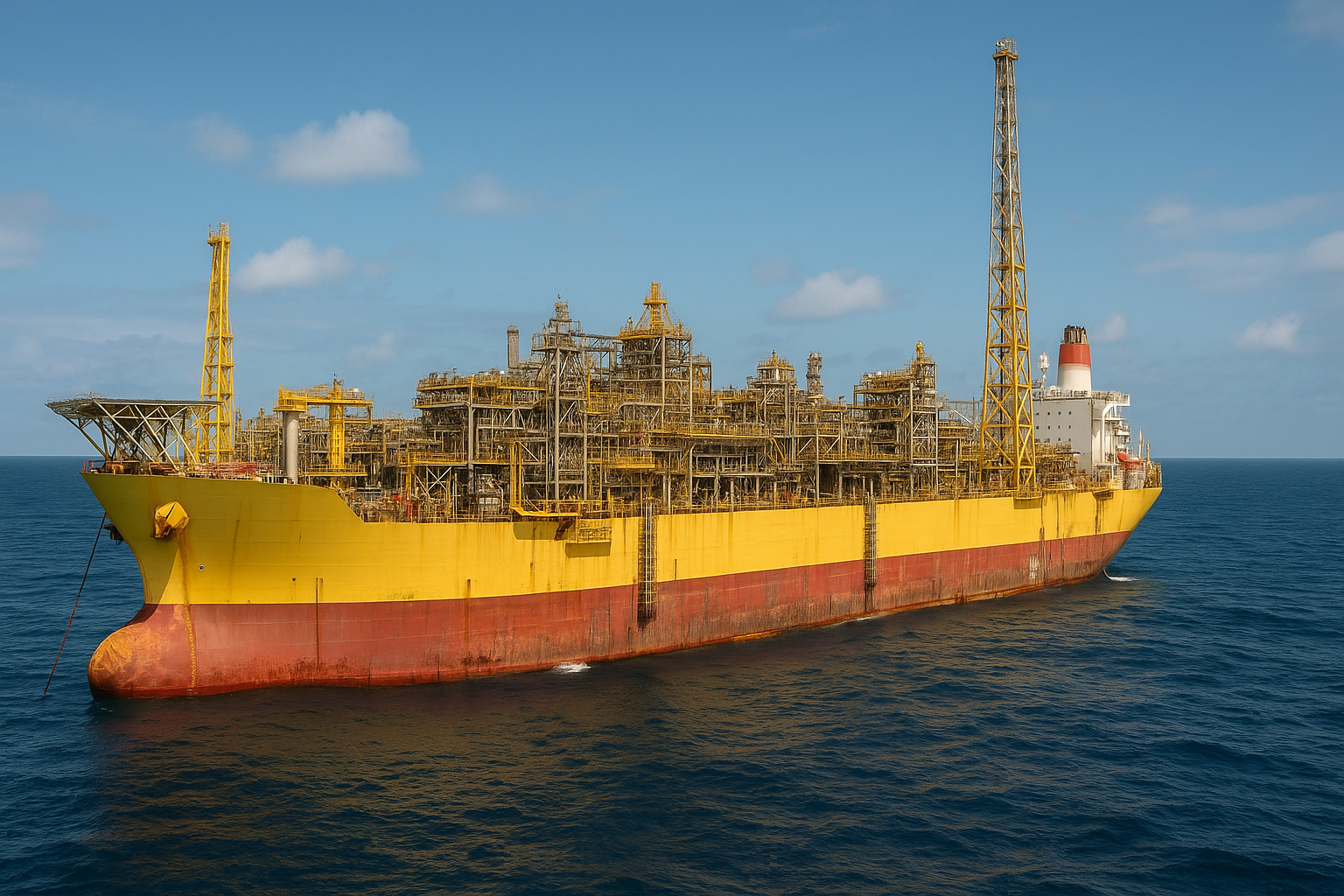

Understand How FPSOs Work, Their Origin and Importance in Offshore Production, and Master Everything About This Essential Floating Platform in the Oil Industry.
Have you heard of FPSO, but still don’t quite understand what this term means?
In this guide, you will discover everything about this essential concept in the oil and gas industry. By the end of the reading, you will understand its origin, operation, and importance.
Therefore, keep reading to master the subject with confidence and depth.
-
The FLIP: A 108-Meter Ocean Laboratory That Stood Vertically for 60 Years, Dismantled in 2023

-
North Korean Fiasco: Launch of the Largest Warship Ends in Sinking

-
While giant ships still burn heavy fuel and the maritime sector races against climate targets, Maersk and Vale are starting to bet on ethanol as a new route to reduce emissions at sea.

-
China begins construction of the world’s largest LNG ship, a 344-meter giant capable of supplying 4.7 million homes for a month, carrying 271,000 m³ of gas, and placing QatarEnergy in the largest naval order ever recorded in world history.


What Is FPSO and Why Is It So Important?

First of all, FPSO is the acronym for Floating Production Storage and Offloading. In English, it means Floating Production, Storage, and Offloading Unit.
In summary, it is a maritime structure that acts as a floating platform, capable of processing oil, storing it and then transferring it to shuttle tankers.
While fixed platforms need to be built on the seabed, FPSOs offer a much more flexible alternative.
For this reason, they are ideal for offshore operations, especially in areas with temporary production or in hard-to-reach places, such as the Brazilian pre-salt.
Moreover, their mobility allows a single unit to serve different fields over time.
In this way, companies can reduce costs and adapt their operations more agilely. This means that the FPSO has become a highly strategic solution for the global energy industry.
According to the National Agency for Petroleum, Natural Gas and Biofuels (ANP), the use of FPSOs has been growing worldwide precisely because of their flexibility and efficiency in handling oil in deep waters.
The Origin and Evolution of the Technology
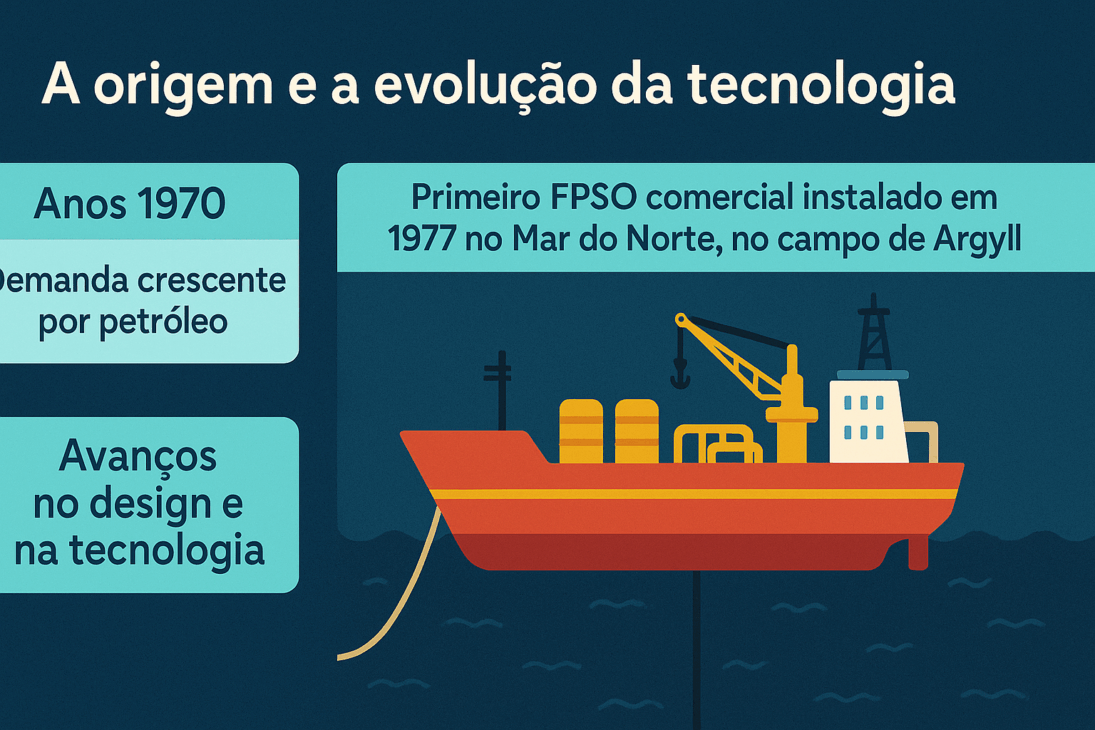
To understand the emergence of FPSOs, it is essential to go back to the 1970s. As reported by the International FPSO Association, at that time, global demand for oil was rising rapidly.
Consequently, companies needed to seek new ways to explore reserves offshore.
From this need came the idea of transforming tanker ships into floating units capable of producing and storing oil.
Thus, the first commercial FPSO was installed in 1977 in the North Sea, in the Argyll field.
The International FPSO Association highlights that, although it was a simple structure, the model proved to be efficient and thus began to be adopted by various operators.
Since then, the concept has evolved considerably. Currently, FPSOs operate with modern mooring systems, automated processing, and state-of-the-art technology.
Thanks to this, they can operate at depths exceeding 2,000 meters, facing extreme weather conditions efficiently.
In addition to technical advancements, it is worth noting that the use of FPSOs has reduced environmental impact during the installation of units.
For this reason, many companies prefer to adopt this solution instead of fixed platforms.
According to a recent report from the International Energy Agency (IEA) in 2023, the adoption of FPSOs contributes to offshore operations with lower environmental impact, reinforcing their strategic role for an increasingly sustainable sector.
How Does an FPSO Work in Practice?
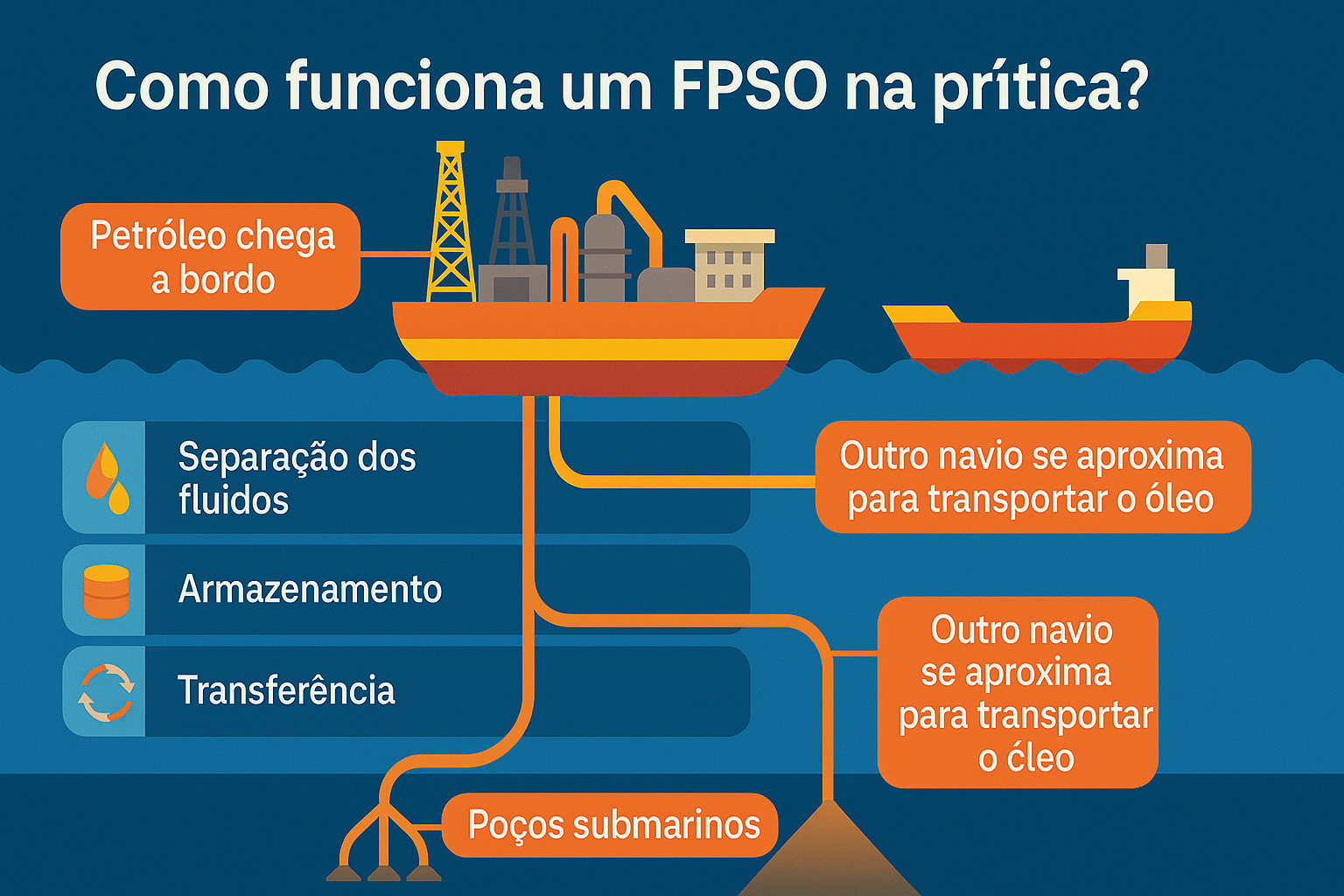
To understand how an FPSO works, it is important to visualize its operation as that of a floating factory.
The oil wells, drilled at the bottom of the sea, connect to the FPSO via subsea pipelines. In this way, the oil reaches onboard, where it goes through different processing stages.
First, fluid separation occurs. Next, natural gas is treated, water is reinjected into the reservoirs and waste is burned in a controlled manner.
Shortly after, the treated oil is stored in tanks aboard the FPSO.
Meanwhile, another ship periodically approaches to receive the oil and transport it to the shore.
This process allows production to continue continuously for several years, without the need to return to land.
In addition, the FPSO’s infrastructure is complete. The vessel has accommodations for the crew, power generation systems, safety, environmental control, and communication.
Therefore, it operates like a floating city, ready to function for long periods.
According to Petrobras, the main FPSO operator in Brazil, its units feature advanced technology to ensure safety and production efficiency in highly complex areas, especially in ultra-deep water operations in the pre-salt region.
Strategic Advantages
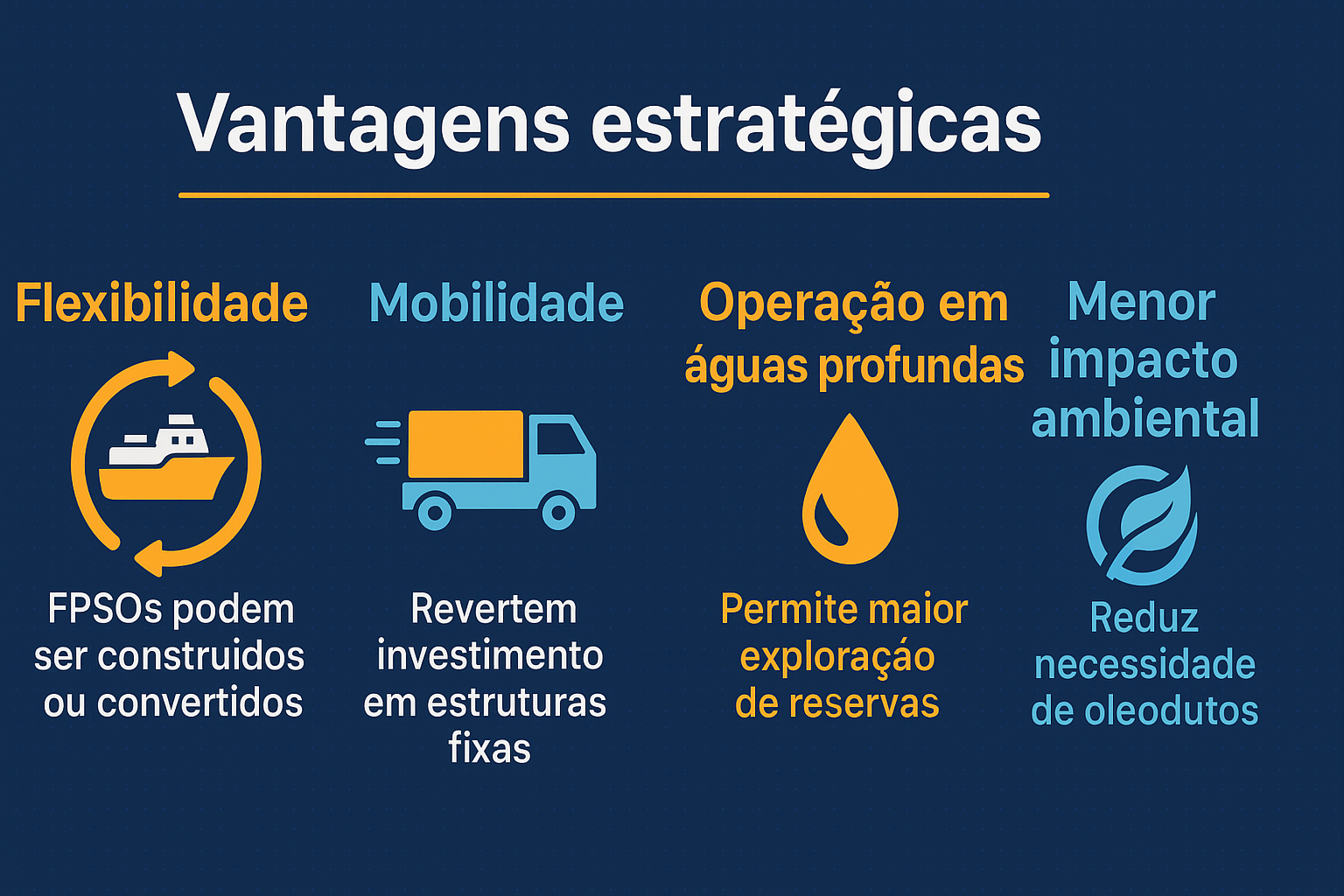
First and foremost, the main advantage of the FPSO lies in its flexibility. As explained by the National Agency for Petroleum (ANP), companies can build it from scratch or convert it from old tankers.
This versatility allows customizing the unit according to the characteristics of the field to be explored.
In addition, the mobility of the FPSO represents an important logistical gain. As it can be easily repositioned, it serves different regions and avoids heavy investments in fixed structures. This reduces the total cost of operation.
Another relevant point is its ability to operate in deep waters. While conventional platforms face technical limitations, the FPSO can reach remote and challenging areas.
Consequently, this expands the possibilities for exploring new reserves.
It is also worth noting that the FPSO reduces the need for pipelines to the shore. This represents lower environmental impact and greater efficiency in the flow of production.
Therefore, its adoption continues to grow in various parts of the world.
According to a 2023 report from ANP, the use of FPSOs in Brazil has soared in the last 15 years, following the advancement of pre-salt exploration and ultra-deep water operations.
Mastering FPSO Is Understanding the Present and Future of Offshore Production
As we have seen throughout this guide, understanding what an FPSO is means diving into a universe of technology, logistics, and strategy.
From its origin in the 1970s, documented by the International FPSO Association, to the latest advancements, these floating platforms have evolved significantly.
Today, they represent a modern, economical, and safe solution for offshore oil production.
And more than that: they are a symbol of innovation and adaptability of the energy industry.
Therefore, if you want to understand how oil reaches refineries, or if you plan to work in the oil and gas sector, mastering the concept of FPSO is an essential step.
After all, these structures define a significant portion of global production and will continue to influence the sector in the coming years.