Portuguese
  Spanish


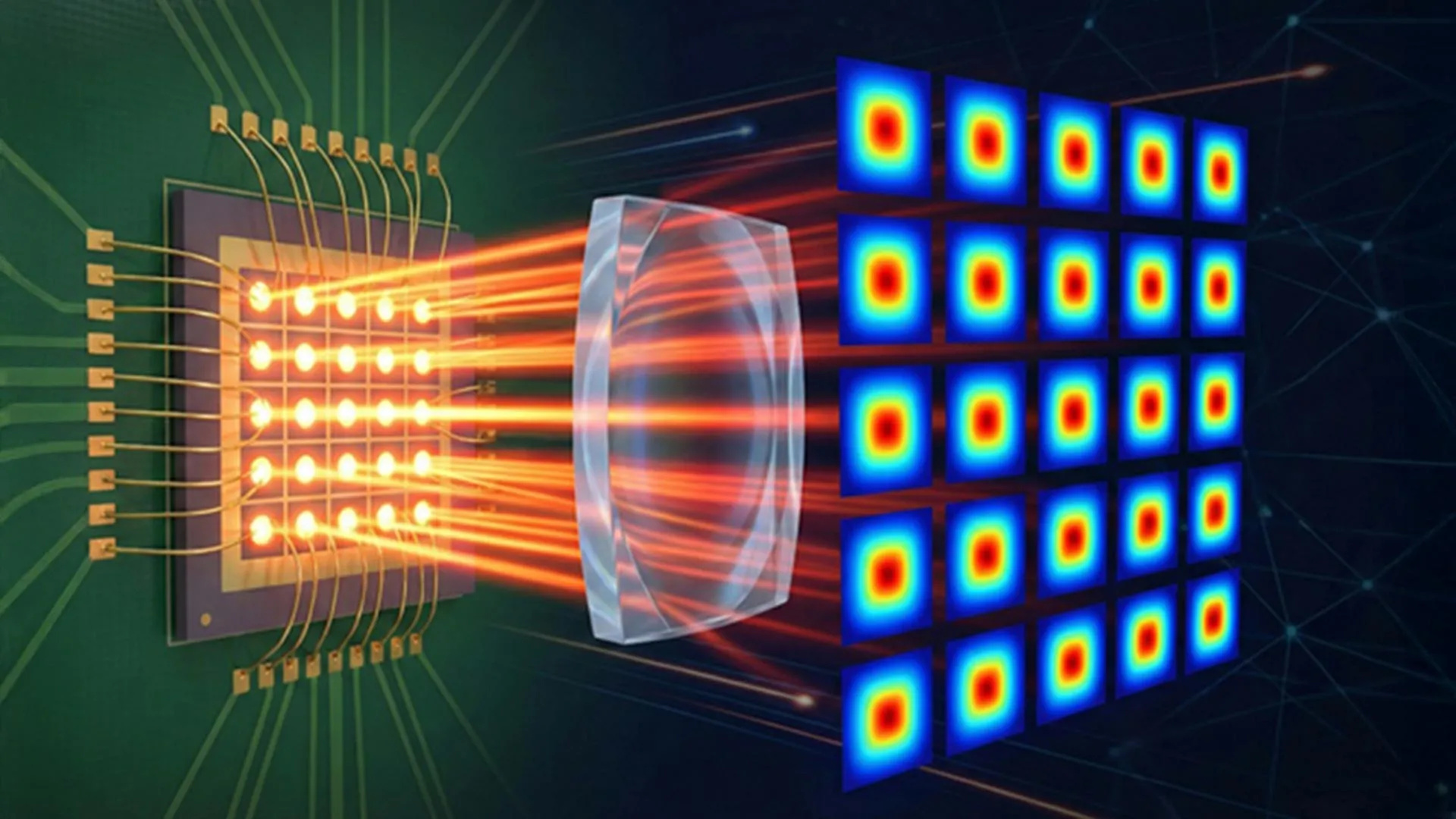

New optical communication chip developed with miniature laser array reaches record speeds of 360 Gbps and drastically reduces electricity consumption by replacing radio waves with directed light beams.
An innovation in the field of optical communications promises to transform global connectivity by replacing traditional radio waves with light beams. Researchers have developed a microscopic chip integrated with dozens of miniature lasers capable of transmitting data at speeds exceeding 360 gigabits per second.
The discovery, presented by SPIE — International Society for Optics and Photonics, utilizes laser-powered fr technology to offer faster and more efficient connections. In addition to the performance leap, the new system drastically reduces electricity consumption compared to current standards.
The end of traditional radio frequency congestion
Most current connections rely on radio frequencies, such as Wi-Fi and cellular networks, which face increasing bottlenecks due to the excess of connected devices. Busy indoor environments often suffer from signal interference and instability, hindering essential services such as video calls and streaming. The implementation of laser-powered wireless technology emerges as a solution to these challenges, offering significantly higher bandwidth and interference-free connections.
-
The beer that was hidden for 3,000 years has returned to the world: scientists find yeast preserved in Ancient Egyptian vessels and recreate a pharaoh’s drink to discover the lost taste of an ancient civilization.

-
NASA spotted a giant “surfboard” crossing the Moon’s orbit at 11,500 km/h, and the truth behind the mysterious object required a 0.338 millisecond photo to be revealed.

-
Brazilian project based on nanotechnology transforms the recovery of degraded areas in the Amazon, receives international recognition, and uses research in 9 states to accelerate the growth of native species and increase carbon capture.
-
The battery that promises to change cell phones and electric cars still has a microscopic enemy: researchers discover how lithium dendrites pierce the solid electrolyte and are already testing ways to prevent cracks and short circuits.




Unlike radio waves, light can be directed with high precision, making it ideal for locations with high user density. Offices, hospitals, and data centers are the environments that can benefit the most from this precision in data transmission. The system uses a 5×5 VCSEL laser array and custom optics to create a structured grid of points that ensure connection stability.
Miniaturization and energy efficiency at chip scale
The major differentiator of this advancement is the integration of multiple lasers into a compact nanometer-scale platform. This design allows large volumes of information to be sent simultaneously, achieving the record mark of 360 Gbps in initial tests. By using light as a transport medium, the laser-powered wireless technology can operate with only half the energy required by conventional Wi-Fi systems.
This reduction in energy consumption is a critical factor for sustaining the growth of connected devices without overloading electrical networks. The team from the University of Cambridge, responsible for the optical development, focused on creating a chip that was both powerful and economical. The thermal and electrical efficiency of the device enables continuous operation without the overheating common in traditional networking equipment.
New frontiers for virtual reality and data centers
The demand for ultra-fast connections is driven by emerging technologies, such as virtual reality and real-time automation systems. The laser-powered wireless technology provides the minimal latency and speed necessary for these tools to function smoothly. With the ability to transmit data in gigabits per second, the system eliminates the delays that currently limit the use of immersive applications in public and residential environments.
Experts predict that the adoption of these tiny lasers will help alleviate global networks that are already operating at the limit of their capacity. The precision of the light beam allows multiple users in the same room to use extremely high bandwidths without competing for the same signal. Thus, the discovery establishes a new standard for network infrastructure, combining high speed and environmental sustainability.
With information from: ScienceDaily