





 Portuguese
  English
  Spanish
  7 min of reading
  0 comments


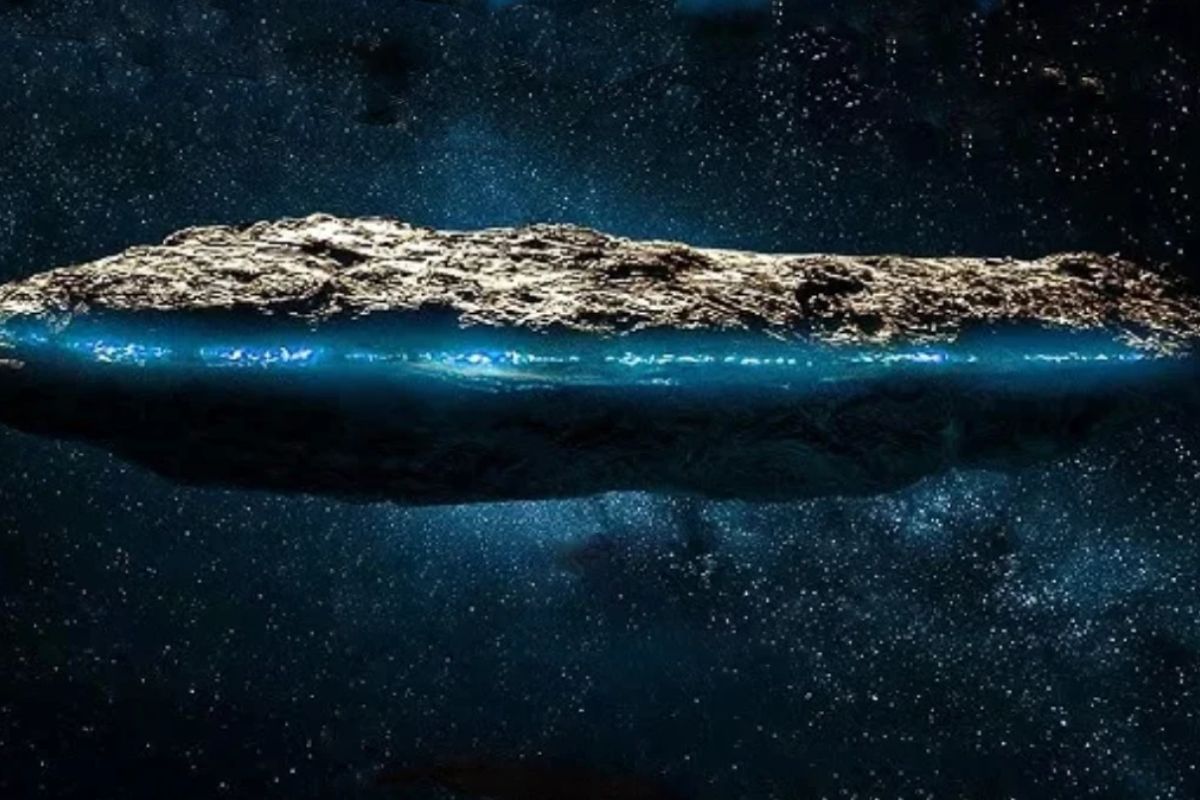
3I/ATLAS Approaches Earth and Challenges Science with Mysterious Acceleration
The countdown to the passage of 3I/ATLAS through the inner Solar System transforms a rare astronomical event into a significant test for science, particularly for models that describe the dynamics of objects coming from beyond our cosmic neighborhood. Classified as an interstellar object, it did not form alongside the Sun and the planets but was ejected from a distant planetary system and is now crossing our region in an approach that, although safe, is scientifically decisive.
Expectations are centered on December 19, 2025, when 3I/ATLAS will be in the most favorable position for observation from Earth, posing no risk of collision, but with enough brightness and geometry for professional and amateur telescopes. It is during this interval that astronomers hope to determine whether they are dealing with a conventional interstellar comet, with already known acceleration mechanisms, or an object whose trajectory requires bolder hypotheses involving forces not yet well explained.
What Makes 3I/ATLAS Different from Other Interstellar Visitors
3I/ATLAS is the third identified interstellar object crossing the Solar System, after asteroid 1I/‘Oumuamua, observed in 2017, and comet 2I/Borisov, in 2019.
-
Nikola Tesla said that intelligent people tend to have fewer friends, and now science partially confirms this: a study with over 15,000 people showed that for the more intelligent, socializing too much can even reduce life satisfaction.

-
A superyacht worth US$ 17 million is delivered in impeccable condition, sets out to sail, and hits a bridge in the Bahamas just two hours later.

-
Residents of Australia woke up to a sky completely red like blood before the arrival of Cyclone Narelle, which hit the coast with winds of 250 km/h, tearing off roofs and lifting iron dust in a scene they described as apocalyptic.
-
New 100% clean fuel produced in Brazil could retire diesel.


Like them, it follows a hyperbolic orbit, which means it is not gravitationally bound to the Sun and that this passage is unique: once the flyby is completed, the object will head back into interstellar space, with no return.
Every observation missed during this window cannot be repeated in the future.
Modeling indicates that 3I/ATLAS may have formed tens of millions of years ago in a distant planetary system, being ejected after intense gravitational interactions with giant planets or neighboring stars.
Since then, it may have wandered through the galaxy until crossing the solar neighborhood.
Even so, the calculated trajectory maintains a comfortable margin from Earth, on the order of approximately two astronomical units, double the average distance between our planet and the Sun.
The proximity is enough to allow an unprecedented observational campaign, but far enough to eliminate any impact scenarios.
The Mysterious Acceleration that Intrigues Astronomers
Since 3I/ATLAS was detected, its movement has shown behavior that deviates from what is expected for a body governed solely by solar gravity.
Orbital calculations indicate a component of acceleration that cannot be explained solely by the gravitational attraction of the Sun and other bodies in the Solar System.
In practical terms, this means that the object is undergoing small changes in velocity and direction beyond what purely gravitational models predict.
The most likely scenario, initially, is that of an interstellar comet releasing gas and dust as it heats up while approaching the Sun.
This material ejection acts like a form of continuous micropropulsion, generating non-gravitational acceleration.
In the case of 3I/ATLAS, however, the intensity and orientation of this acceleration seem to combine radial and transverse components that do not easily fit into a simple outgassing model.
Additionally, the object exhibits an anti-tail, a dust structure seemingly oriented toward the Sun, which makes the interpretation of its geometry and dynamics even more complex.
What the Global Observation Campaign Hopes to Measure in December
The December approach mobilizes a network of observatories distributed across different hemispheres, equipped with telescopes sensitive to various wavelengths.
The central goal is to precisely measure the brightness of 3I/ATLAS, track its variation over the days, and decompose the captured light to infer the chemical composition of the coma and any gas jets.
If significant material release occurs, the spectral signature and brightness evolution should reveal patterns consistent with comets, albeit in an extreme version.
Another critical point will be refining the orbit with high-precision data by comparing the observed positions with the positions predicted by gravitational models.
From these differences, it will be possible to better quantify the non-gravitational acceleration of 3I/ATLAS, separating radial and transverse components and testing which physical mechanisms can reproduce the measured behavior.
The absence of clear outgassing signals, combined with persistent acceleration, would open the door for more unusual hypotheses, broadening the debate about the nature of the object.
3I/ATLAS as a Laboratory for the Physics of Interstellar Comets
Even in a strictly natural scenario, 3I/ATLAS already serves as a valuable laboratory for the physics of small bodies.
Unlike traditional comets, which formed in the same primordial cloud as the Sun, interstellar objects carry the chemical and structural signature of other planetary systems, with combinations of ice, dust, and organic compounds that may not have direct analogs in our Solar System.
The comparison between 3I/ATLAS, ‘Oumuamua, and Borisov allows for a broader set of examples to explore models of planetesimal formation, material distribution in protoplanetary disks, and processes that lead to the ejection of these bodies into interstellar space.
Every piece of data obtained in December will help determine whether these visitors share a typical origin in systems similar to ours or whether they represent samples from very distinct environments, expanding the map of possibilities for planet and comet formation in the Milky Way.
The Boundary Between Extreme Natural Phenomenon and Interstellar Technology
The unusual characteristics of 3I/ATLAS fuel speculations that go beyond classical astrophysics.
The combination of non-gravitational acceleration, difficulty in adjusting simple outgassing models, and geometric aspects like the anti-tail leads some in the community to consider, at least as a working hypothesis, the possibility that we are dealing with an interstellar technological artifact.
In this line of thought, the object could be some type of passive probe, a fragment of a luminous sail, or a structure designed to harness stellar radiation.
Despite the legitimate curiosity, the majority approach remains cautious. The priority is to exhaust all plausible natural explanations before resorting to technological scenarios.
This means examining the physics of ice sublimation in different geometries, studying how partial fragmentations could mimic anomalous behaviors, and evaluating subtle effects of solar radiation and tidal forces on a possibly irregular structure.
Only if the dataset from December proves incompatible with those natural models will the interstellar technology hypothesis gain consistent scientific weight.
The Role of Amateur Telescopes and Science Communication
Although finer analysis depends on large observatories, 3I/ATLAS should also be accessible to part of the amateur astronomy community, especially those with medium-sized telescopes and dark skies.
The contribution of these observers can be significant in increasing the recording cadence, covering time windows that large facilities may not always be able to monitor.
In events with rapid dynamics, such as brightness variations and small changes in apparent trajectory, a distributed network of observers helps fill data gaps.
At the same time, public interest in 3I/ATLAS creates an important opportunity for science communication.
Clearly explaining what an interstellar object is, how non-gravitational acceleration is measured, and why there is no risk of impact are fundamental steps to avoid alarmism while maintaining the public’s legitimate fascination with the event.
Responsible communication, anchored in well-defined data and uncertainties, helps bring society closer to the real process of constructing scientific knowledge.
What to Expect from the Passage on December 19, 2025
The period around December 19 should concentrate the most valuable data on 3I/ATLAS. During this time, the object will be in a favorable position for ground telescopes, with better brightness-to-angular-distance ratio from the Sun, facilitating prolonged observations.
The priority will be to continuously monitor the evolution of the coma, the presence or absence of well-defined jets, and any changes in color and intensity, indirect indicators of physical processes occurring on the surface and inside the object.
Theoretically, this same period will allow refining the description of the mysterious acceleration accompanying 3I/ATLAS.
Updated numerical models in near-real-time, fed by successive position measurements, will be able to test different combinations of natural forces and verify which ones best reproduce the observed trajectory.
The final result, whether an extreme interstellar comet or something more unusual, will redefine the current understanding of what can be expelled from distant planetary systems and reach our surroundings.
The approach of 3I/ATLAS transforms the coming months into a period of productive high tension for astronomy, where each new observation can confirm established models or open avenues for deep revisions.
The combination of interstellar origin, non-gravitational acceleration, and unusual geometric behavior makes the object a case study without recent parallel, capable of informing both the physics of comets and debates about possible technologies beyond Earth.
Beyond immediate curiosity, 3I/ATLAS serves as a reminder that the Solar System is not isolated but immersed in a constant flow of materials coming from other regions of the galaxy.
The way the scientific community interprets the December data will say much about our willingness to explore bold hypotheses without abandoning rigor.
In your opinion, what would be more transformative for humanity: confirming that 3I/ATLAS is merely an extreme interstellar comet or finding consistent evidence that it could be a technological artifact from another stellar system?








-

-

-

-

37 pessoas reagiram a isso.