





 Portuguese
  English
  Spanish
  4 min of reading
  0 comments


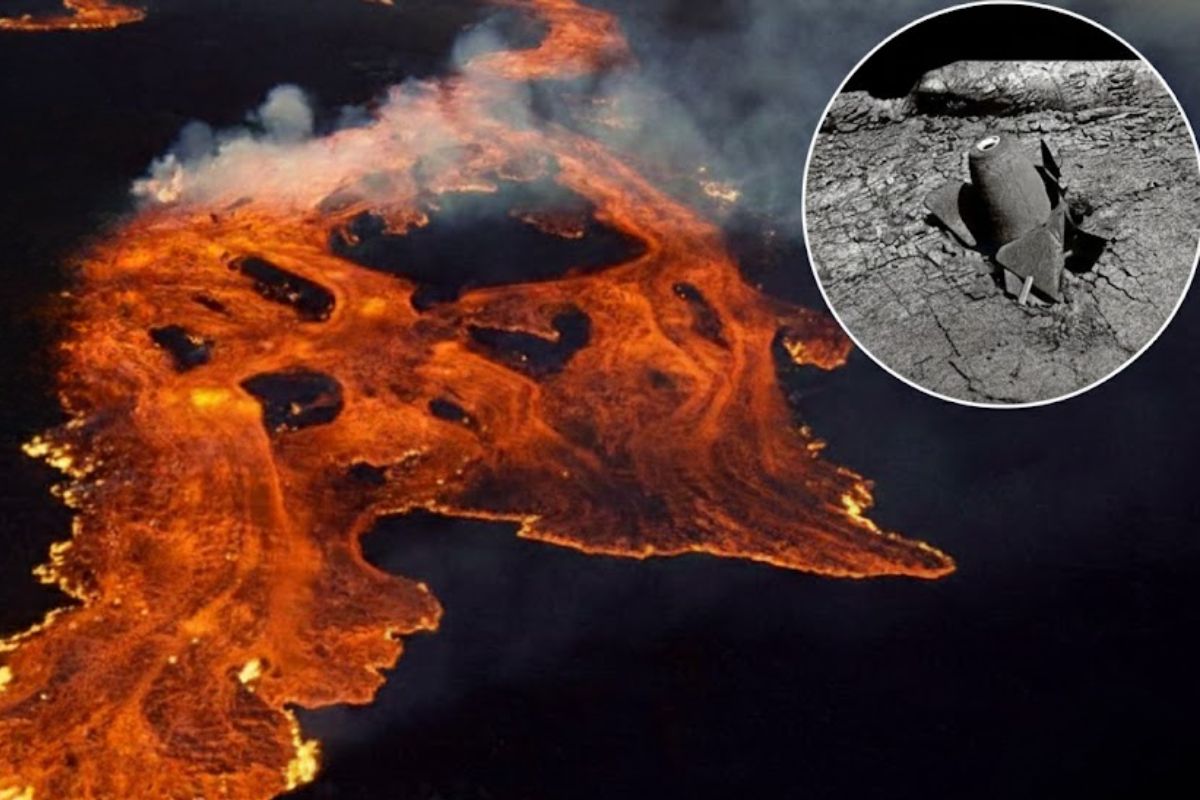
In March 2020, Teams at Mauna Loa Found Unexploded Bombs Embedded in Ancient Lava Channels, Reminiscent of Missions in 1935 and 1942, When Army Airplanes Tried to Divert the Flow Toward Hilo; The Episode Exposes Risks, Scientific Skepticism, and Cultural Shock with Pele That Still Echo Today
The discovery of unexploded bombs on the slopes of Mauna Loa in March 2020 brought an uncomfortable detail to the surface: explosives dropped decades ago remain present, preserved in ancient lava channels, as if time had just slowed down within the rock.
More than a curiosity, the rediscovery reopens an old discussion about how far humanity tries to impose control when danger approaches, especially when the answer involves military technology applied to a geological phenomenon that does not negotiate and does not back down under intimidation.
The Rediscovery of 2020 and the Risk That Remained Active

The bombs were located in a remote and hard-to-access area of Mauna Loa, the largest active volcano on Earth. They appeared embedded in ancient lava channels, having withstood extreme heat and decades of severe exposure to the elements.
-
Motorola launched the Signature with a gold seal from DxOMark, tying with the iPhone 17 Pro in camera performance, Snapdragon 8 Gen 5 that surpassed 3 million in benchmarks, and a zoom that impresses even at night.

-
Satellites reveal beneath the Sahara a giant river buried for thousands of kilometers: study shows that the largest hot desert on the planet was once traversed by a river system comparable to the largest on Earth.

-
Scientists have captured something never seen in space: newly born stars are creating gigantic rings of light a thousand times larger than the distance between the Earth and the Sun, and this changes everything we knew about stellar birth.

-
Geologists find traces of a continent that disappeared 155 million years ago after separating from Australia and reveal that it did not sink, but broke into fragments scattered across Southeast Asia.

What is striking is that these artifacts maintained much of their structure, which raises security concerns: this is not just abandoned metal, but devices launched with the intention to detonate, which remained as a physical liability from a past emergency. The scar did not just remain in the landscape; it remained in the risk.
1935: When the Threat to Hilo Took Bombs to the Sky
To understand why bombs were dropped on the lava, we must go back to 1935, when Mauna Loa erupted vigorously. The flow was advancing toward Hilo, the largest city on the Big Island, with the potential to impact critical areas such as the port and water supply.
The most radical proposal came from volcanologist Thomas Jaggar, founder of the Hawaiian Volcano Observatory (HVO).
The idea was to use aerial explosives to break lava tubes and structures near the eruption source, trying to obstruct the path or induce overflow to dissipate energy before reaching the city. This was science under pressure, with method and desperation in the same package.
The Military Operation: 20 Bombs, 600 Pounds, and a Bet Against the Scale of the Planet
The operation was coordinated by then-Lieutenant Colonel George S. Patton, who would later become a key figure in World War II. On December 27, 1935, U.S. Army Keystone B-6 planes dropped 20 bombs weighing 600 pounds (about 270 kg) on Mauna Loa.
Each unit contained TNT, designed to detonate on impact or with a delay, aiming to maximize damage to specific geological structures. Still, even with precision and power, the logic faced an obvious limit: explosives are intense, but the dynamics of a large lava flow are persistent, continuous, and may not respond like a conventional target.
The “Success” That Divided Opinions and the Repetition in 1942
Days after the 1935 bombing, the eruption stopped. Jaggar declared victory, arguing that the human intervention had been decisive in saving Hilo, which helped crystallize the episode as a hallmark of technical audacity.
Over time, however, skepticism grew. Many experts began to consider it plausible that the end of the eruption was a coincidence, as the volume of lava and the scale of the volcanic system could be too large to be altered by a few tons of explosives.
In 1942, new bombs were dropped, this time in a wartime context: there was fear that the glow of the lava could serve as a nighttime reference for Japanese submarines, increasing the risk of attack. The lava also became a strategic problem, not just a geological one.
Consequences, Culture, and What Changed in Risk Management
Beyond the discussion of effectiveness, there exists the invisible cost of such decisions. The presence of bombs decades later illustrates how an emergency action can leave a dangerous legacy, requiring assessment, removal, or safe neutralization long after the original crisis has passed.
There is also a deep cultural shock: for Native Hawaiians, eruptions are associated with the deity Pele, and bombing the volcano is seen as sacrilege.
Today, risk management in Hawaii relies on advanced monitoring and urban planning, rather than trying to “force” a change in the volcano’s behavior with explosives. Technology has evolved, but the central lesson remains the same: nature cannot be commanded.
The history of the bombs at Mauna Loa is not just about an eccentric episode, but about limits: limits of human power in the face of geological processes, ethical limits of quick interventions, and limits of what is considered acceptable when a city is under threat.
If you had been in Hilo in 1935, with lava advancing and infrastructure at risk, would you support dropping bombs as a “last resort,” even without a guarantee of effect? And today, when technical decisions collide with cultural beliefs and long-term risks, what should weigh more in the balance: urgency, scientific evidence, or respect for territory and tradition?








-

-

-

4 pessoas reagiram a isso.